
One-Hour Real Estate Team Meeting Agenda Singapore with MyEraCareer

The best real estate team meeting typically runs about an hour and centers on one purpose: turning last week’s activity into this week’s decisions. Structure it around five segments, wins and recognition, a scoreboard and pipeline review, a short training or role-play block, and blockers with owned action items, and require pre-work so agents arrive with updated numbers, not excuses.
TL;DR:
Meetings should be strictly timed and structured around five specific segments to maximize productivity and prevent overruns.
Pre-work, including updated scorecards and shared dashboards, is essential to keep discussions data-driven and focused.
Short, targeted training sessions using demos, role-plays, and immediate feedback improve skill retention and engagement.
Adjust meeting length and content based on the meeting’s purpose, from quick weekly huddles to deep strategy sessions.
Clear roles, enforced time limits, and offline coaching rules help maintain focus and ensure impactful use of the meeting time.
Table of Contents
Team Meeting Agenda Real Estate Leaders Can Copy Today
Most real estate team meetings fail for one reason: nobody owns the clock. Agents ramble through status updates, the leader improvises the agenda in real time, and the “training” segment gets cut because wins and gripes ran long. A written, timed agenda fixes that before it starts.
The industry standard for a real estate sales meeting agenda runs close to an hour and includes structured segments for recognition, metrics and pipeline review, training, and action items, according to Tom Ferry’s meeting framework. That’s the backbone worth building on, whether you’re running a five-person boutique team or a 40-agent office.
Here’s a detailed template, with time blocks and ownership assigned so nobody has to guess who’s talking next.
Time Block | Segment | Owner | Goal |
— | Opening and objective | Host | State the week’s single objective; 30-second personal headlines |
— | Wins and recognition | Host or rotating rep leader | Celebrate closings, referrals, milestones |
2 to 3 minutes | Scoreboard and metrics | Timekeeper displays dashboard | Review leading and lagging numbers against goals |
8 minutes | Pipeline priorities | Rotating rep leader | Flag hot deals, stalled listings, next steps |
10 minutes | Training or role-play | Rotating presenter | Practice one skill with live feedback |
4 minutes | Blockers and commitments | Note-taker records | Surface obstacles, assign owners and deadlines |
— | Close and recap | Host | Confirm actions, deadlines, next meeting date |
Assign four roles before the meeting starts: the host sets the objective and keeps discussion on-topic, the timekeeper enforces the clock without apology, the note-taker logs every action item with an owner and a deadline, and a rotating rep leader takes turns running the pipeline and training segments to keep the team engaged, as explained in our guide to the role of real estate agents. HubSpot’s sales meeting agenda template backs the rotating-presenter model specifically because it keeps the room engaged instead of passively listening to leadership.
Send typed minutes within an hour of wrap. List each action item as owner, task, and deadline, three columns, nothing more, and drop it into your team’s shared drive or CRM notes so nobody has to ask “wait, who owns that?” three days later.
Adjusting the Agenda by Meeting Frequency and Goal
The 60-minute template is a default, not a rule. Trim it for a fast weekly huddle, or expand it when the goal shifts from accountability to strategy.
30-minute weekly huddle: wins (3 minutes), two core metrics only, one blocker discussed, no training block. Save skill-building for the full meeting.
60-minute weekly accountability meeting: the full five-segment template above. This is your default, run every week without exception.
90-minute pipeline deep-dive: double the pipeline segment to 30 minutes, add a 10-minute review of marketing initiatives or listing inventory, keep training but shorten it to 10 minutes.
Monthly strategy session: drop weekly scorecards in favor of 30-day and quarterly trends, review team goals against actual production, and spend real time on initiatives, new tools, or compensation changes rather than day-to-day pipeline items.
Run the weekly meeting for rhythm and accountability. Reserve monthly strategy sessions for the decisions that reshape how the team operates, comp plans, lead sources, hiring, because mixing those conversations into a weekly huddle is how 60 minutes turns into 90 and nobody notices until it’s too late.
How to Run the Meeting: Roles, Pre-Work, and Scoreboards
A tight agenda still fails if agents show up with stale numbers. The prep work matters as much as the meeting itself.
Require scorecard updates before the meeting. Every agent updates their numbers, calls made, appointments set, listings taken, closings, the night before or morning of. Nobody should be updating live during the meeting.
Share the scoreboard 24 hours ahead. A concise real estate agenda template works best when it’s distributed a full day early so agents come prepared to discuss numbers rather than see them for the first time, per Noota’s sales meeting guidance.
Track leading and lagging metrics side by side. Leading metrics, calls made, appointments set, listing presentations booked, predict next month’s results. Lagging metrics, closings, GCI, revenue, confirm what already happened. HubSpot recommends tracking at least four leading metrics weekly so the review stays growth-focused instead of purely retrospective.
Add pipeline value and forecast gap. Show total pipeline value against the month’s goal, and name the gap out loud. Ambiguity here is where accountability quietly dies.
Assign follow-ups to a single owner. The note-taker distributes the action list same-day; the host checks it at the top of next week’s meeting before moving on.
A shared performance dashboard displayed live during the scoreboard segment removes the debate over whose numbers are right, because everyone is looking at the same screen.
Building a Training Block That Actually Improves Skills
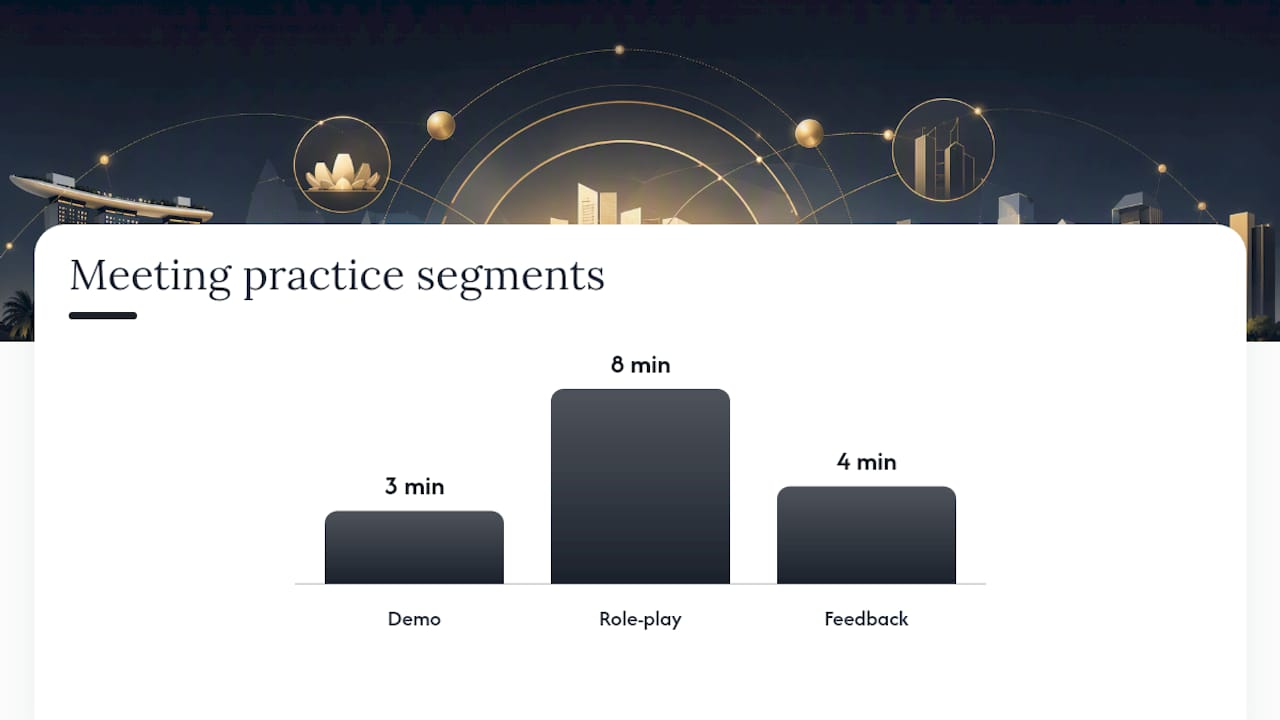
Skip the generic “let’s talk about objections” conversation. Pick one micro-skill per meeting, something narrow enough to practice in 15 minutes, and run it the same way every time: demo, role-play, feedback.
Demo (3 minutes): the presenter shows the skill once, cleanly, no interruptions.
Role-play (8 minutes): pair agents up and run 2 to 3 practice rounds per pair so everyone gets live reps, not just one shot.
Feedback (4 minutes): each pair reports one thing that worked and one thing to adjust.
Track a single practice metric across weeks, objection-handling success rate, or how many role-play rounds ended in a scheduled next step, so practice converts into a number you can actually watch improve. HubSpot’s research on short, structured practice rounds found that designated feedback and rotating presenters both improve how well new skills stick.
Pro Tip: Rotate who brings the week’s scenario. A rep who just lost a deal to a specific objection brings far more urgency to a role-play than a script pulled from a training manual. Pull real scenarios from recent calls using resources like objection handling scripts built for practice.
Facilitation Rules That Keep the Room Focused
Structure alone doesn’t stop drift. These four rules do the enforcing.
Time-box every segment and stick to it. The timekeeper calls “time” out loud, mid-sentence if necessary, and tables anything unfinished for a 1:1.
Open with 30-second personal headlines. One sentence per agent on how their week is going, nothing longer, keeps the check-in human without eating 10 minutes.
Run an energy check on a 1 to 10 scale. A quick number from each agent flags who needs a private follow-up without spending group time on one person’s deep coaching.
Push deep coaching offline. Treat the weekly meeting as a growth hour, not a troubleshooting session, and schedule 1:1s for anything that needs more than five minutes.
Templates and Tools Worth Copying Into Your Workflow
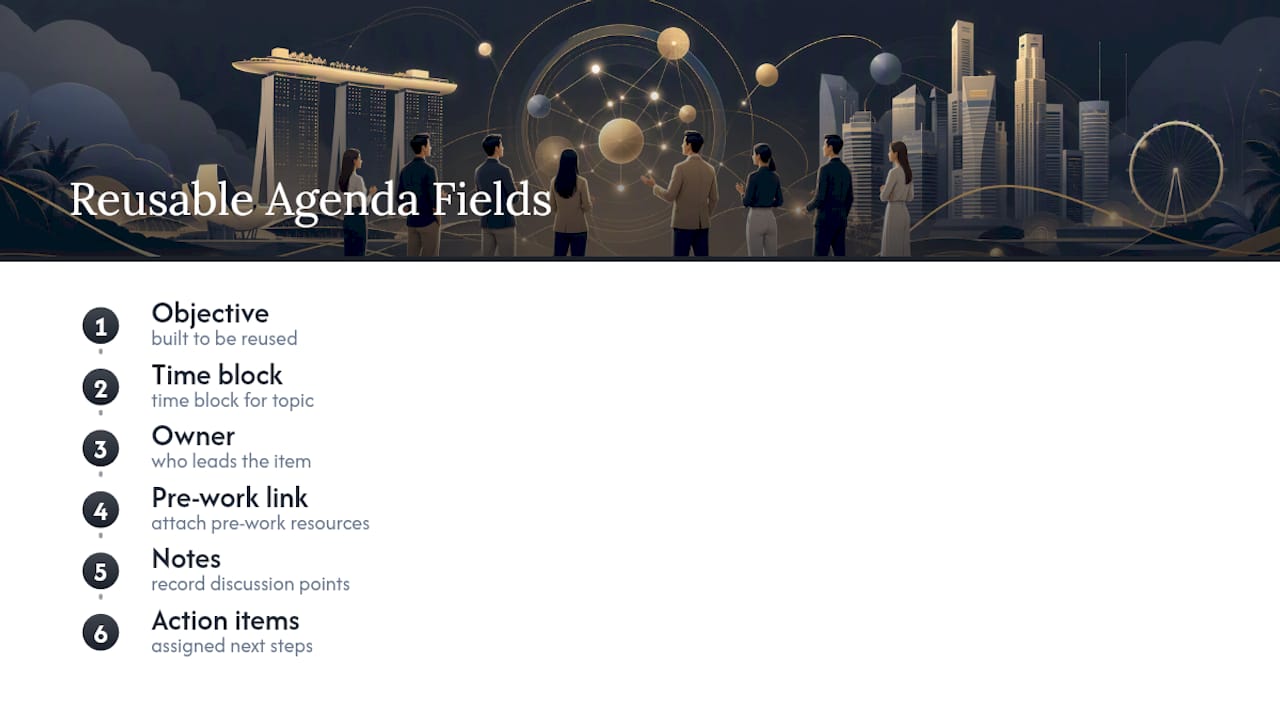
An agenda document only earns its keep if it’s built to be reused, not rewritten from scratch every week. Six fields cover it: objective, time block, owner, pre-work link, notes, and action items.
Your scorecard needs its own short list of fields: calls made, appointments set, listing presentations, pipeline value, and closings, with the formula behind each score visible so nobody assumes it’s arbitrary. Start from agent scorecard metrics built for fast rollout if you’re building yours from zero.
For the training block, pull from a modular prospecting script bank or a coaching question tracker agents can fill out as pre-work. Editable agenda formats are also widely available on general template repositories that copy cleanly into Google Docs or Notion.
Why We Push Pre-Work Harder Than Most Teams Expect
Teams that treat the weekly meeting as a growth hour, not a status update, get more out of 60 minutes than teams that meet for 90. The difference isn’t energy or talent. It’s whether the scoreboard was accurate before anyone walked in the room.
Visible scorecards and required pre-work strip out the noise that eats meeting time, arguing over whose numbers are right, re-explaining a deal everyone should already know about. That frees the training block to actually build skill instead of getting cut for time, again. If your team is still improvising its agenda live, MyEraCareer can help you build a leader framework suited to how your team actually operates.
— Donny
Get Structured Leader Support From MyEraCareer
There are available systems built specifically for real estate teams that provide recruitment and onboarding support, sales performance tracking tools, and personalized leadership coaching for team leaders running this kind of weekly rhythm.

If you’re building a new team or hiring your next agent, MyEraCareer’s new agent onboarding program covers RES exam guidance and CEA licensing requirements from day one. If you’re already leading a team and want coaching on running tighter, more productive meetings, the experienced team leaders program walks through leadership frameworks tailored to your team’s stage of growth. Reach out and you’ll get a template pack and a short coaching intro call to see where your current meeting structure has gaps.
Sources
Recommended
Comments