
Show These Four CEA Disclosures in Every Singapore Property Ad

Every property advertisement you publish, print, or post must display four things: your name as registered with the Council for Estate Agencies, your CEA registration number, your agency’s name, and your agency’s licence number. This applies across every medium, from a flyer slipped under a door to an Instagram Story that disappears in 24 hours. Skip any one of them, and you’re exposed to a disciplinary process that can end in a fine, a suspension, or worse.
TL;DR:
Agents must display their registered name exactly as on the CEA register, including registered nicknames, to avoid breach-related penalties.
All advertisements require clear, visible identification details, such as CEA registration number and agency license, placed prominently and accurately.
Owner consent must be documented in writing with specific details, and re-sharing listings mandates permission from all involved agents.
Using misleading headlines, unsubstantiated superlatives, or outdated images without proof can trigger enforcement actions and fines.
Across all media, including social media and messaging, mandatory details must be legible, properly placed, and compliant before publishing to prevent violations.
Table of Contents
How the Rules Change Across Print, SMS, Portals, and Social Media
Common Breaches, Enforcement Triggers, and What to Do If You’re Flagged
A Step-by-Step Ad-Approval Workflow You Can Start Using Today
Rules on Exclusive Listings and Multiple Agent Representation
Virtual Tours, AI-Generated Images, and What the Guidelines Say
Why Compliance Habits Shape Your Whole Career, Not Just This Ad
What the CEA Advertising Guidelines Actually Require
The four-item identification rule isn’t a suggestion buried in fine print. It’s the backbone of the Practice Guidelines on Ethical Advertising, known as PG 02-11, which has governed how Singapore agents market property since June 2011. The Gov confirms the same standard from the consumer side: buyers and tenants are told to check for your registered name, your CEA number, your agency’s name, and its licence number before they trust anything you’ve posted.
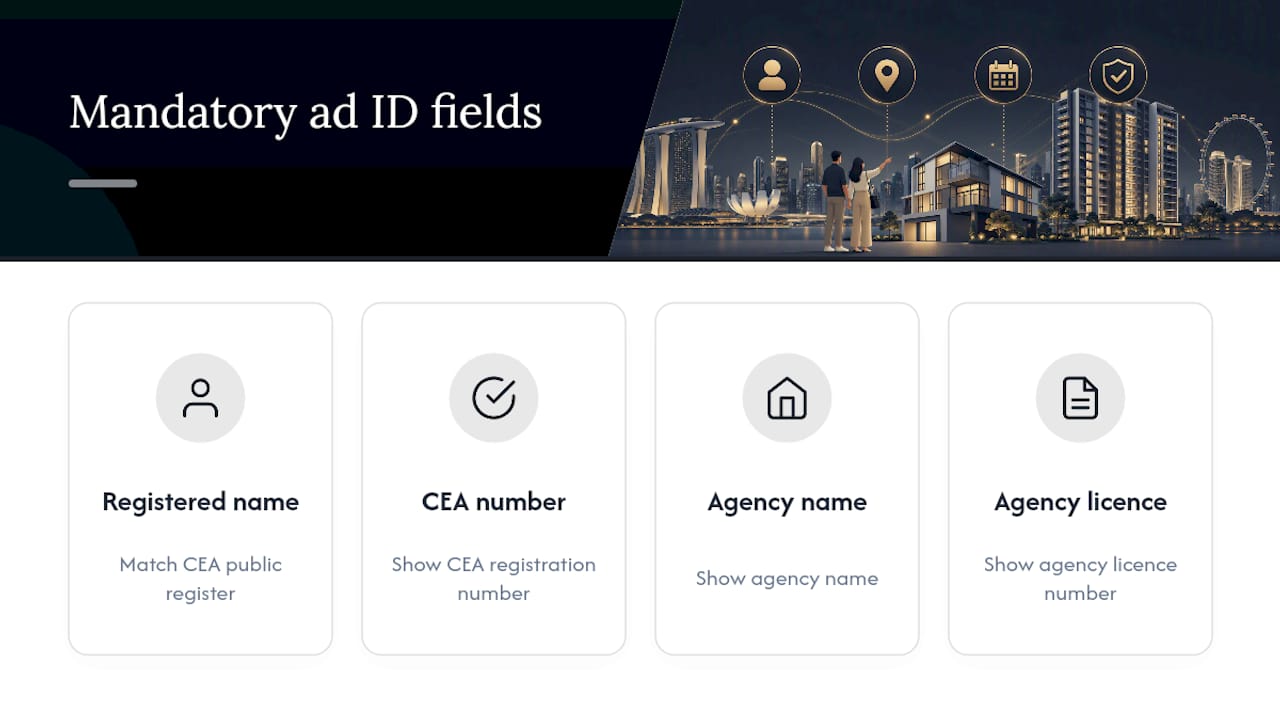
There’s a detail that trips up more agents than you’d expect. Your registered name has to match exactly what appears on the CEA public register, including any nickname, only if that nickname is officially registered. Advertise under “Ah Beng” when the register says “Tan Wei Ming” and you’ve technically breached the guideline, even if every client in your network calls you Ah Beng. This single mismatch shows up often enough in RES exam prep and in enforcement records that it deserves its own line item on your checklist.
Beyond identification, the guideline also bans misleading headlines (think “King of Toa Payoh” with nothing to back it), unsubstantiated superlatives, and expert claims you can’t support. These rules apply to every agent, every listing, every platform, with no carve-out for “just a casual repost.”
Quick Compliance Checklist Before You Publish Any Ad
Before an advertisement goes live, run it against this list. It takes less time than fixing a breach after the fact.
Full registered name exactly as it appears on the CEA register, not a nickname unless that nickname is registered.
CEA registration number, spelled out in full, not abbreviated or truncated to save space.
Estate agency name matching your current employer of record.
Agency licence number, placed near the agency name, not buried at the bottom of a long caption.
Owner consent status confirmed in writing before the ad goes anywhere.
Property address or unit reference accurate enough that a viewer isn’t misled about location or size.
Price wording that says “asking price” or “indicative price,” never “valuation” unless a licensed valuer actually produced one.
Legibility check: identification text at a font size and contrast that a reader can actually see, not white text on a white background or a font size 6 caption footer.
Placement check: mandatory details visible in the post itself, not hidden behind a “read more” link, a swipe-up, or a separate bio page.
Print this list, paste it into your agency’s CRM, or build it into a pre-publish approval form. The goal is to make compliance a habit, not an afterthought you remember only after someone flags your post.
How the Rules Change Across Print, SMS, Portals, and Social Media
CEA’s guidelines apply equally to a laminated flyer and a 15-second TikTok clip, but each medium creates its own way to accidentally break the rules. A CEA blog post on flyer distribution reminds agents that flyers should reach intended recipients responsibly, not get stuffed indiscriminately into every letterbox on a street. That same principle of intentional, traceable distribution extends to digital channels.
Instagram Stories and TikTok videos are two of the biggest blind spots. Both formats reward short, punchy visuals, which tempts agents to drop the mandatory details entirely or shrink them into an unreadable corner. Because Stories vanish quickly, some agents assume they’re exempt. They aren’t. Every video needs a text overlay carrying your name, CEA number, agency name, and licence number, ideally held on screen long enough to actually read.
Property portals usually have dedicated fields for agent details, so the risk there is smaller, but double-check that the fields auto-populate correctly rather than pulling outdated information from a template. SMS and WhatsApp blasts carry two extra traps: character limits that encourage cutting corners on disclosures, and timing. Avoid sending promotional messages between 10 p.m. and 9 a.m., and always give recipients a clear way to opt out.
A few practical fixes worth building into your routine:
Save a caption template with your four mandatory details pre-written, so you paste rather than retype.
Screenshot every post before it disappears, in case a Story-based ad needs to be reviewed later.
Keep a story highlight or archive folder specifically for ad content, separate from personal posts.
Owner Consent and Co-Broking: What You Must Document
Written owner consent is not optional. It’s the legal foundation that lets you advertise a property at all, and the practice guidelines treat its absence as a serious breach, not a technicality.
Your consent record should capture, at minimum:
Owner’s full name matching the title documents.
Unit or property reference.
Scope of consent (exclusive listing, co-broking allowed, specific platforms approved).
Date of consent.
Signature or an authorized electronic affirmation (an email reply or e-signature counts, a verbal “go ahead” over the phone does not).
Co-broking adds another layer. If you’re re-sharing a listing that belongs to another agent, you need separate permission from that primary listing agent, not just the owner’s blanket consent. A deep dive on advertisement infringements under practice circular PC 07-18 shows CEA treats unauthorized re-shares as an infringement in their own right, independent of any owner consent issue. Store every consent record in a central folder or CRM entry with a timestamp, and keep it for as long as the listing is active plus a reasonable buffer afterward, since disputes often surface months after a transaction closes.
Common Breaches, Enforcement Triggers, and What to Do If You’re Flagged
The same handful of mistakes account for most disciplinary cases CEA has publicized. In order of how often they show up:
Omitted or incomplete registration details, usually a missing CEA number or a licence number left off a social post.
Misleading or outdated photos, including stock images or shots that don’t match the current condition of the unit.
Advertising without documented owner consent, often when an agent assumes verbal approval is enough.
Bait-and-switch pricing, where the advertised price bears little relation to what’s actually negotiable.
Blind ads, listings with no verifiable agent identity attached.
Unsubstantiated superlatives, the “best deal in the district” language PG 02-11 specifically prohibits.
CEA’s enforcement notices and newsroom posts document real cases of agents fined or suspended for exactly these breaches, most commonly the combination of missing registration details and inaccurate advertising claims.
Sanctions escalate with severity and repetition: a first-time minor omission might draw a letter of advice, while repeated or deliberate breaches can lead to fines, suspension of your registration, or in the most serious cases, revocation.
If you discover an ad has been flagged, or you spot the error yourself, act immediately: take the ad down, notify the property owner of the issue, preserve every record related to the listing (consent forms, photo sources, correspondence), and prepare a corrective notice explaining what happened and what you’ve fixed. Moving fast and documenting your response matters almost as much as the original compliance.
A Step-by-Step Ad-Approval Workflow You Can Start Using Today
A repeatable workflow beats relying on memory, especially once you’re juggling multiple listings. Here’s a sequence agencies and solo agents can adopt without much overhead:
Draft the advertisement, text, photos, and pricing language, in one place before it touches any platform.
Run the mandatory ID check: name, CEA number, agency name, licence number, all present and legible.
Verify owner consent against your documentation, confirming scope matches what you’re about to publish.
Check factual accuracy: photos genuinely depict the advertised unit, floor plans are current, and no claim exceeds what you can substantiate.
Adapt for the platform: add caption templates for social media, text overlays for video, correct fields for portals.
Get final sign-off, ideally from a second person if you work within a team, before the ad goes live.
Archive everything: the final ad, consent records, and photo sources, with a timestamp.
A simple template file should capture consent status, the source of every photo (including who took it and when), the basis for any pricing claim, and your CEA details ready to paste. A photo-source log with date, filename, and photographer noted gives you proof of provenance if a listing’s accuracy is ever questioned.
Pro Tip: Tie this workflow into your CPD renewal cycle. Reviewing your own ad-approval habits once a year, alongside your continuing professional development hours, catches drift before it becomes a pattern regulators notice.
Guidelines on Property Prices and Descriptions in Ads
Price language is one of the most litigated corners of advertising compliance, and the fix is simpler than most agents assume. Use “asking price” or “indicative price” for any figure that hasn’t been confirmed by a licensed valuation. The word “valuation” carries specific legal weight; using it loosely, even to describe your own estimate of market value, misrepresents the property’s status and violates PG 02-11’s disclosure standards.
Descriptions face similar scrutiny. A unit described as “renovated” should have been renovated recently and substantively, not touched up with a coat of paint five years ago. Square footage figures need to match the source document (usually the title deed or a floor plan from the developer), not a rounded estimate you eyeballed. If a description mentions proximity to an MRT station or school, that claim should be checkable, not aspirational.
The safest approach treats every descriptive word as something a buyer could challenge later. If you can’t point to a document, a measurement, or a dated photo backing up a claim, soften the language or remove it. This isn’t about being timid in your marketing. It’s about making sure the excitement you build around a listing survives contact with a skeptical buyer’s due diligence, which in Singapore’s transaction environment, it usually will.
Rules on Exclusive Listings and Multiple Agent Representation
Exclusive listings come with their own advertising logic. If you hold an exclusive mandate, your ads should say so clearly, and no other agent should be marketing that same unit without your documented permission. This is where co-broking consent, covered earlier, becomes operationally critical rather than just a paperwork exercise.
Multiple agent representation gets murkier when a property isn’t under an exclusive arrangement and several agents are marketing it simultaneously, sometimes with different prices or descriptions attached. This inconsistency doesn’t just confuse buyers; it can trigger scrutiny of whether each agent actually secured owner consent for their specific version of the ad. If you’re advertising a non-exclusive listing, keep your description and pricing aligned with what the owner has actually authorized, and be prepared to show your own consent trail independent of what other agents are doing with the same property.
Team leaders overseeing multiple agents on a shared listing should centralize the ad-approval workflow described earlier, so every version of the ad, regardless of who’s posting it, passes through the same consent and accuracy check. This is where scattered file storage across individual agents’ phones becomes a real liability. A shared CRM record for the listing solves it.
Client Confidentiality and Data Privacy in Property Ads
Every advertisement is a public document the moment it’s posted, which means anything in it about the seller, tenant, or their circumstances is now public too. The safest default is to advertise the property, not the person selling it. Skip details like why the owner is selling, financial urgency, or any personal circumstance that could identify or disadvantage them, even if it seems like it might create urgency for buyers.
Photos deserve the same caution. Interior shots that reveal family photos, mail with names and addresses, or identifiable personal items should be edited out or reshot before publication. This matters even more with video walkthroughs and virtual tours, where it’s easy to capture more of a client’s life than intended in a single continuous take.

Contact details in your ad should route to you, not create a path for buyers to reach the owner directly and bypass the transaction process entirely. If you’re using a CRM or lead-capture form linked to your ad, confirm it stores enquirer data securely and that you’re not sharing client information with third parties beyond what the transaction genuinely requires. Confidentiality isn’t just good manners here; it protects the owner’s negotiating position and keeps you clear of privacy complaints layered on top of any advertising issue.
Virtual Tours, AI-Generated Images, and What the Guidelines Say
Virtual tours and 3D walkthroughs are treated exactly like photos and floor plans under the existing framework: they must accurately represent the unit being advertised. A virtual tour stitched together from a similar unit in the same development, rather than the actual unit for sale, crosses into the same misleading-imagery territory as using outdated or stock photos.
AI-generated images raise a newer question, but the underlying principle from PG 02-11 still applies cleanly: any image, however it was produced, has to depict the property honestly. An AI-staged rendering showing furniture, lighting, or a view that doesn’t exist in the actual unit is a misleading representation regardless of the technology behind it. If you use AI tools to stage an empty unit or enhance a listing photo, disclose that the image has been digitally staged or enhanced, and never use AI to alter structural features, room dimensions, or the view from a window.
The OECD’s good practice guide on online advertising reinforces this from an international best-practice angle: advertising should be clearly identifiable as advertising, and any disclosure, including one about digital staging or AI enhancement, needs to be clear and conspicuous, not buried in a caption’s final line. Treat that as the working standard until CEA issues technology-specific guidance of its own.
How to Lodge a Complaint or Resolve an Advertising Dispute
If you spot a non-compliant advertisement, whether from a competitor or someone impersonating a registered agent, CEA accepts complaints through its official channels, and the practice guidelines and circulars page is the starting point for understanding what qualifies as a reportable breach. Complaints typically need specifics: a screenshot or link to the ad, the date it was published, and the details you believe are missing or misleading.
For disputes between agents, such as a co-broking disagreement or a claim over who had valid consent to advertise a listing, the first step is usually direct resolution between the parties or their agencies, with documentation (your consent records, timestamps, correspondence) serving as your evidence. If that doesn’t resolve things, agencies can escalate through their internal compliance processes before a formal CEA complaint becomes necessary.
The practical lesson here loops back to everything covered above: the agents who resolve disputes quickly are the ones who kept records in the first place. A timestamped consent form or a photo-source log turns a “he said, she said” dispute into a five-minute fact check.
Why Compliance Habits Shape Your Whole Career, Not Just This Ad
I’ve come to see advertising compliance less as a rulebook and more as an early test of professional discipline. New agents who treat the four mandatory disclosures as an afterthought tend to carry that same looseness into consent documentation, client communication, and eventually their exam preparation. It’s the same muscle.
Team leaders feel this most acutely. A single non-compliant post from someone on your team becomes your problem too, and untangling it after the fact costs far more time than building the habit would have. The step-by-step workflow outlined earlier isn’t complicated, but doing it consistently, every listing, every platform, is what actually separates agents who avoid disciplinary trouble from those who eventually don’t.
This is also where good onboarding pays off. Structured training that ties compliance directly into your CEA registration process and ongoing CPD gives new agents a framework before bad habits form, rather than correcting them after a warning letter arrives. If you’re building or joining a team, Myeracareer’s training resources for new agents and leadership frameworks for team leaders are built with exactly this kind of workflow in mind, giving you templates rather than a blank page.
— Donny
Where to Verify CEA Advertising Rules Yourself
For the primary source, read PG 02-11: Practice Guidelines on Ethical Advertising in full, along with the practice guidelines and circulars index and the gov.sg consumer explainer. For international context on digital disclosure standards, the OECD’s online advertising guide is worth bookmarking, and Haio offers useful local examples of compliant listing formats.
Sources
Recommended
Comments