
90 Minute Social Media Plan for Real Estate Agents


Pick two platforms and one repurpose channel this week: Instagram and Facebook for most agents, with Reels feeding a YouTube Shorts or TikTok pipeline. Build every post from four pillars, Educate, Showcase, Connect, Convert, at a 4:1 ratio of value to ask. Post three to five times a week on the feed, plus daily Stories. Then block 90 minutes this weekend to batch and schedule seven days of content before you do anything else.
TL;DR:
Posting three to five times a week with daily Stories on Instagram and Facebook helps maintain consistency and build familiarity with your audience.
Using short-form videos like Reels and TikTok feeds expands reach, while carousels and saved posts are better for lead comparison and revisit.
Batching content creation into a 90-minute weekly routine allows agents to produce a week’s worth of material efficiently and prevent burnout.
Focus on tracking saves and DMs rather than likes to measure genuine engagement and lead quality, responding promptly to convert interest into appointments.
Avoid over-promotion and inconsistent posting, as both erode trust and reliability, which are crucial for capturing new clients through social media.
Table of Contents
Your One-Page Social Media Plan for Real Estate
A plan only works if it fits on one page and survives a busy week. Start by naming one specific, measurable goal, something like three listing appointments a month, rather than “grow my following.” Pair that goal with one primary audience: first-time buyers, sellers weighing a listing, or investors comparing yield. Trying to speak to all three in the same caption is how most agents end up speaking to none of them.
Next, apply the platform rule: one primary channel where you post natively, and one repurpose channel where you reshare the same footage in a different format. Instagram works as a primary for buyer-facing and lifestyle content because of Reels and Stories. Facebook suits agents leaning on local groups and older sellers. LinkedIn fits investor and commercial audiences almost exclusively.
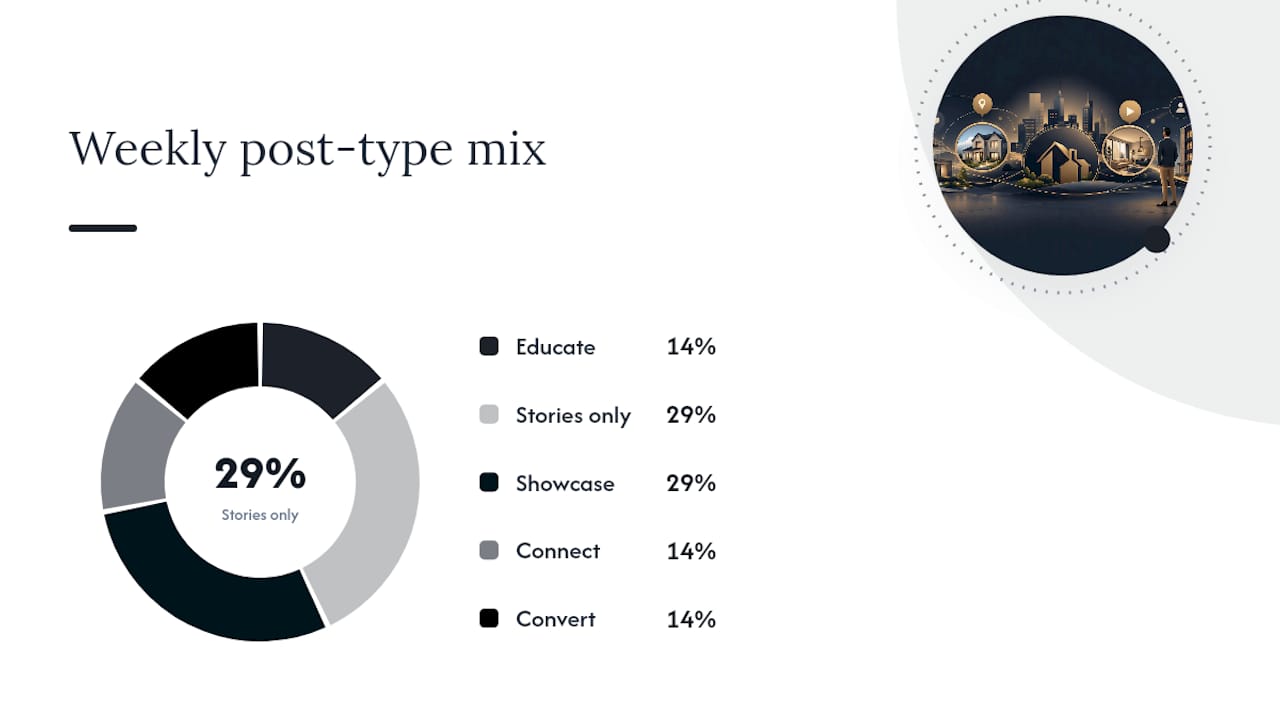
A sample week might look like this:
Monday: Educate post (market update carousel)
Tuesday: Stories only (behind-the-scenes at a showing)
Wednesday: Showcase post (new listing Reel)
Thursday: Stories only (poll: “Renovate or sell as-is?”)
Friday: Connect post (client story or neighborhood spotlight)
Saturday: Showcase post (open house Reel or carousel)
Sunday: Convert post (soft CTA: “DM me for this week’s listing sheet”)
Here is a fill-in-the-blank set of seven captions you can adapt tonight:
“3 things buyers overlook when touring [neighborhood] homes.”
“Behind the scenes prepping [address] for photos.”
“Just listed: [address] — swipe for the kitchen.”
“Poll: Would you rather have a bigger yard or a bigger kitchen?”
“Meet the [last name] family, who closed on their first home last week.”
“Open house Saturday at [address], 2 to 4 PM.”
“DM me ‘VALUATION’ for a free estimate on your home.”
Before any of these go live, run a fast pre-post check: confirm seller or landlord permission to feature the property, disclose any virtual staging clearly, and get brokerage sign-off if your office requires it. Skipping that step is the fastest way to turn a good post into a liability.
How Do You Choose the Right Platforms for Real Estate?
The right platform depends on who you’re trying to reach, not which app is trending. Match the channel to the audience before you match it to the algorithm.
Instagram: Best for buyers and younger sellers; Reels drive discovery, Stories build familiarity, and carousels earn saves.
Facebook: Strongest for local groups, older sellers, and community-based referrals.
LinkedIn: Fits investors, commercial clients, and referral partners like mortgage brokers or attorneys.
TikTok: Effective for agents targeting first-time buyers under 35, especially in competitive urban markets.
YouTube Shorts: A solid repurpose channel for the same Reels footage, extending its shelf life without extra filming.
Format matters as much as platform. Short-form video pulls new eyes toward your profile, while carousels get saved and revisited when someone is actually comparing agents. Stories do neither of those jobs well, but they build the day-to-day familiarity that turns a stranger into a follower who trusts you enough to DM.
A workable rule of thumb: one primary platform where you invest most of your effort, one repurpose channel for the same content in a different format, and one experiment channel you test quarterly without committing real budget. Treat your profile itself as a landing page, not a photo album. Your bio should state your specialty, your service area, and a single link, ideally to a valuation form or your latest listing, not a generic “linktree” with ten options competing for attention.
Building Content Pillars That Don’t Burn You Out
Four pillars carry the entire plan, and each one does a different job. Educate posts answer buyer or seller questions, think market updates, mortgage rate explainers, or “what does contingent mean” breakdowns. Showcase posts feature listings, open houses, and before-and-after renovations. Connect posts humanize you, client stories, neighborhood spotlights, a photo from a closing day. Convert posts make a direct ask, a valuation offer, an open house invite, or a “DM for the full listing sheet.”
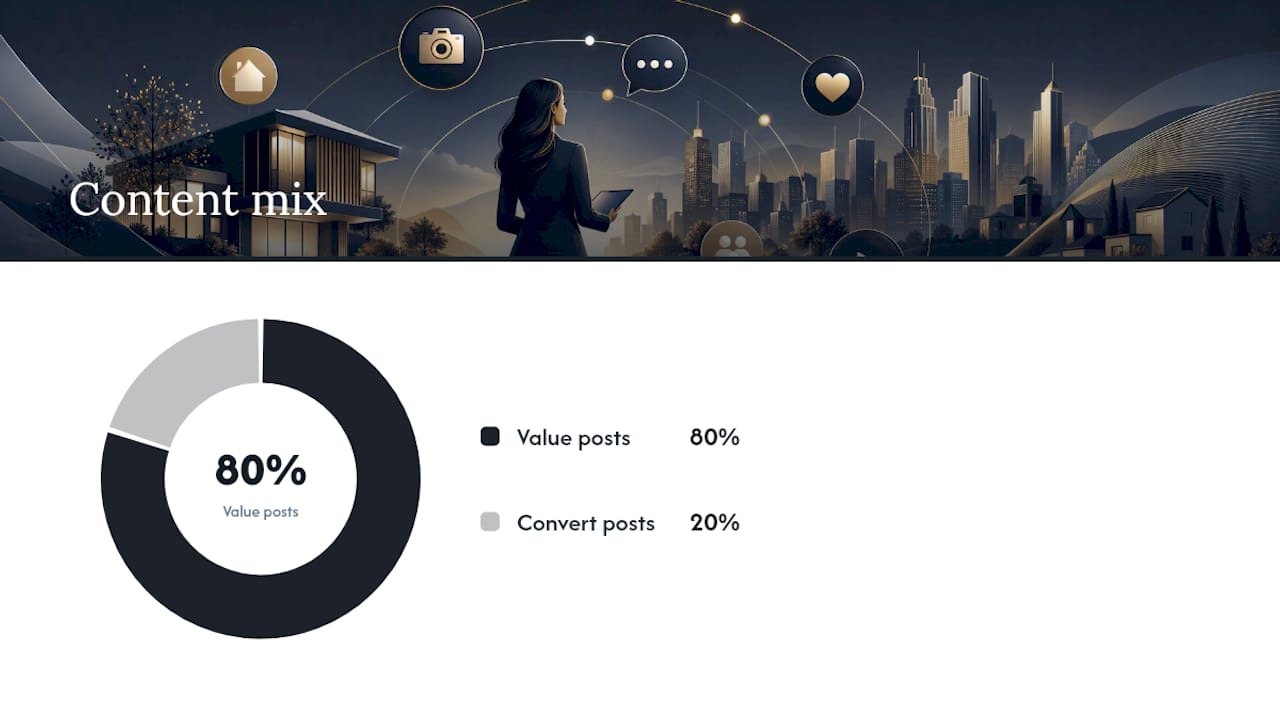
The CloseDaily content calendar framework recommends a 4:1 ratio of value to ask, and that math holds up for a reason: followers tolerate an occasional pitch from someone who has already given them something useful four times in a row. Flip that ratio and you train your audience to scroll past you.
Here’s a compact 30-day grid for a solo agent posting five times a week:
Week | Educate | Showcase | Connect | Convert |
1 | Market update carousel | New listing Reel | Client testimonial story | Open house invite |
2 | “What is escrow?” explainer | Before/after renovation | Neighborhood spotlight | Valuation offer |
3 | Rate/affordability post | Just-sold announcement | Behind-the-scenes at inspection | DM for buyer checklist |
4 | Local market myths debunked | Weekend open house Reel | Team or family moment | Free market snapshot |
Adjust the pillars to your price point. Luxury listings lean harder into Showcase, with cinematic Reels and fewer, more polished posts. Entry-level and first-time buyer markets lean into Educate, since that audience has more questions and less patience for polish. Localize every topic, swap generic “market update” language for your actual zip code or neighborhood name, because specificity is what makes an Educate post feel like advice instead of filler.
The 90-Minute Batching Routine That Keeps You Consistent
Most agents don’t fail at social media because they lack ideas. They fail because they try to create content daily instead of batching it once. A single 90-minute session, done the same day each week, produces enough material to cover the next seven days without touching your phone again until it’s time to post.
Plan (15 minutes): Pick five post ideas from your pillar list and match each to a format.
Capture (45 minutes): Film and photograph everything in one pass, ideally at a listing or open house you’re already visiting.
Caption (20 minutes): Write all seven captions back to back, using the fill-in-the-blank formulas from your calendar.
Schedule (10 minutes): Load everything into your scheduler and lock in posting times for the week.
One listing visit, filmed well, can become three Reels, one carousel, and a full week of Stories, which is the single most efficient repurpose move available to a solo agent. Shoot vertical, phone-first footage: a walkthrough clip, a close-up on one standout feature, and a quick to-camera intro are usually enough raw material for the whole set.
Pro Tip: Write your hook, the first three words of your caption or the first three seconds of your video, before you write anything else. If the hook doesn’t stop a scroll, the rest of the caption never gets read.
Before you schedule anything featuring a client or a listing, confirm you have permission to post it, flag any virtually staged photos clearly, and route anything sponsored or brokerage-branded through your compliance review if your office requires it.
What’s the Right Posting Cadence for Real Estate Agents?
Posting multiple Reels and at least one carousel per week, plus regular Stories, is a sustainable baseline for most solo agents. If Stories aren’t realistic for your schedule, shift to three to five feed posts a week instead and skip the daily requirement entirely. Consistency beats volume, an agent posting four times a week for six months will outperform one who posts daily for three weeks and quits.
Test posting windows over two to three weeks rather than guessing: try early morning (7 to 8 AM) and evening (6 to 8 PM) slots, then compare saves and reach.
Reserve Lives and community-group posts for market updates or Q&A sessions, not routine listing promotion.
Keep one or two weekly slots unscheduled for real-time updates, an offer that just came in, a price drop, breaking local news that affects buyers.
Schedule the rest in advance during your batching session so a busy showing week never means a dead feed.
The Amplifiles Instagram playbook for agents backs up the format split here: short-form video is your reach engine, while carousels are what get saved and returned to when someone is actually comparing agents rather than just scrolling.
Turning Social Media Interactions Into Booked Appointments
A soft call-to-action converts better than a hard sell almost every time on social media. “DM me ‘VALUATION’ for a free estimate” or “Link in bio for the full listing sheet” gives someone a low-pressure way to raise their hand.
Build one lead magnet you can create in a single afternoon: a buyer’s checklist, a “what’s my home worth” one-pager, or a market snapshot for your zip code.
Set up a link-in-bio valuation form so anyone who clicks through has a direct next step instead of a dead end.
Reply to every DM within two hours during business hours; interest fades fast when a response takes a day.
Use a simple response template: thank them, ask one qualifying question (timeline, budget range, or area), and offer a call or a form link.
Tracking matters as much as the CTA itself. Add UTM parameters to any link-in-bio or Story link so you know which platform actually drove the click, and create a “lead source” field in your CRM that captures the exact post or platform behind every new contact. A tool built for this, similar to what’s outlined in this practical guide to converting online interest into real estate leads, makes that attribution far less painful than trying to reconstruct it from memory a month later.
Which Metrics Actually Predict New Business?
Likes feel good and mean almost nothing. Saves and DMs are the two metrics worth checking every week, because both signal someone taking a real step, bookmarking your post to revisit or reaching out to talk. CloseDaily’s practitioner data points to saves and DMs as stronger predictors of lead quality than surface-level engagement like likes or comment counts.
Weekly quick-check: saves per post, DMs started, and profile visits.
Monthly attribution: appointments booked and leads generated, matched back to their originating platform.
Set up now: a CRM field for “lead source” and a UTM-tagged link for every platform you post to.
Statistic Callout: Pew Research documents broad social media use across adult age groups, which is part of why saves, DMs, and profile visits are worth tracking as legitimate discovery signals rather than vanity numbers.
Steady improvement over eight to twelve weeks usually looks like a gradual climb in saves and DMs per post, not a viral spike. If your numbers are flat after three months, the fix is almost always in the hook or the CTA, not the platform.
The Mistakes That Quietly Cost Agents Trust
Over-promotion is the fastest way to lose an audience that was starting to trust you. A feed that’s all listings, no value, reads like an ad account, and people stop engaging long before they unfollow. Inconsistent posting does similar damage in slower motion: three weeks of silence followed by a burst of five posts tells followers you’re not reliable, which is a bad look for someone asking to handle their largest financial transaction.
Ignoring DMs for more than a day signals you’re too busy to help, even when that’s not true.
Misleading imagery, undisclosed virtual staging or heavily filtered photos, damages credibility the moment a buyer sees the property in person.
Posting client details or property information without permission is both a trust problem and a potential compliance one.
The FTC’s guidance on social media disclosures requires clear disclosure of material connections and sponsored content, which applies directly to any agent posting paid partnerships or brokerage-sponsored promotions.
If you’re ever unsure whether a post needs a disclosure or a compliance review, that uncertainty is itself the red flag. Pause and check with your brokerage before publishing rather than after.
Which Tools Actually Speed Up Your Content Production?
You don’t need every tool on the market, you need one from each of four categories: a scheduler, a short-form video editor, a link-in-bio page, and a CRM that captures social-origin leads. Beyond that, budget dictates the rest of your stack.
Scheduler: any tool that lets you batch a week of posts in one sitting.
Short-form video editor: phone-based apps with caption overlays and trending audio work fine for most agents.
Link-in-bio: a simple landing page pointing to your valuation form and current listing.
CRM integration: a system that tags leads by source, so social traffic doesn’t disappear into an unsorted inbox.
Build a light template kit alongside your tools: a 30-day calendar, a caption library organized by pillar, a repurpose checklist, and a permissions log for every client or property you feature. If you’re phone-only, stick to free or low-cost apps; if you have any production budget, outsourcing editing frees up the 45-minute capture block for actual client work. For caption and listing copy specifically, a resource like this AI listing description guide can cut that 20-minute writing block down considerably, and pairing it with the right real estate CRM setup closes the loop between a DM and a tracked lead.
What the Research Says About Social Media for Agents
The case for treating social media as a real lead channel, not a side project, rests on solid ground. Pew Research’s data on adult social media use confirms these platforms reach a wide enough slice of buyers and sellers to justify the weekly time investment. Canva’s guide to real estate social strategies backs the pillar-based approach used throughout this plan, showing that structured content categories outperform ad-hoc posting for both consistency and engagement.
Batching works because it matches how attention actually functions: focused creative time followed by scheduled distribution beats scattered daily effort. Resources worth pairing with this plan include:
Myeracareer’s guide to real estate leads for turning social interest into booked appointments.
Listing presentation guidance for the proof points that make strong Showcase posts.
Background on real estate agent roles for context on what clients expect from agents day to day.
Agents building out training paths through Myeracareer are welcome to share results or ask for help refining a calendar that fits their specific market.
Why the Standard Social Media Advice Fails Busy Agents
Most social media advice aimed at agents is written by people who have never had to leave a showing, drive to an inspection, and still find time to post before dinner. It assumes unlimited creative energy and treats posting frequency as the goal, when frequency without a system just produces burnout by week three.
The pillar framework and batching routine in this plan work because they respect the actual constraint agents face: time, not ideas. Ideas are cheap. A repeatable 90-minute process that turns one listing visit into a week of content is what actually survives a busy quarter.
Where I’d push back hardest on conventional wisdom is the obsession with posting frequency over saves and DMs. An agent posting three times a week who tracks saves and responds to every DM within two hours will out-earn an agent posting daily who never checks either number. Vanity metrics are comfortable because they require no follow-up. Saves and DMs require you to actually talk to a stranger, which is uncomfortable and also the entire point of the exercise.
Prioritize the batching session and the DM response habit before you touch anything else in this plan. Everything downstream, the calendar, the pillars, the platform choice, only works if those two habits hold.
— Donny
How Myeracareer Supports Agents Running This Plan
A support system is available for agents who want this plan to actually stick, not just another content calendar sitting unused in a folder. Some services pair new and experienced agents with ongoing mentorship, digital coaching, and tools built to reinforce exactly the kind of consistent, metrics-driven habits this article walks through.

The New Agents page describes onboarding steps such as guidance through the RES exam, licensing requirements, and a structured runway into early production, paired with leadership frameworks for team development. Instead of piecing together a social strategy alone while also studying for licensing, some agents get mentorship and performance tracking built around appointment-and-lead goals similar to those this plan is designed to hit. If you’re weighing a switch from another agency or just starting out, visit the New Agents page to see what onboarding and ongoing support options may look like before your next listing goes live.
Where to Go Next for Templates and Guidance
Bookmark these before your next batching session:
FTC disclosure guidance for any sponsored or paid-partnership content.
Pew Research on social media use for the broader case behind treating social as a real channel.
Myeracareer’s CRM guide and email marketing tools roundup for closing the loop between social traffic and booked appointments.
Sources
Recommended
Comments