
7 Objection Handling Scripts and a One Week Practice Plan for Agents


Objections aren’t rejections. They’re a buyer or seller telling you exactly what stands between them and “yes.” Handle every one with the same four-move sequence, acknowledge, isolate, reframe, advance, and close by asking one isolating question or offering to pull comps. The scripts and practice plan below give you the rest.
TL;DR:
Objections in real estate are indications of “not yet” and should be addressed by isolating the real concern instead of rushing to a close.
Consistently using the four-move sequence—acknowledge, isolate, reframing with data, and advance—improves success in handling any client hesitation.
Building a library of tailored scripts and practicing out loud with feedback helps agents respond confidently to common objections like fees, timing, or competing agents.
Asking specific isolating questions reveals the true objection, often rooted in trust or fear rather than surface concerns like price or commission.
Early transparency, ongoing communication, and personalized responses for different client types foster trust, reducing objections before they even arise.
Table of Contents
How to Ask Isolating Questions That Reveal the Real Objection
Handling Commission Objections: Scripts, Evidence, and When to Negotiate
Handling Timing Objections: Model Scenarios and Low-Commitment Options
Personalizing Your Approach to Different Client Personalities
Objection Handling in Virtual and Remote Real Estate Conversations
Structured Training and Mentorship for Agents Who Want to Practice This For Real
What Is Objection Handling in Real Estate, Really?
Objection handling in real estate is the structured process of responding to a client’s hesitation without either backing down or arguing. Most agents think it means having a clever comeback for “your commission is too high.” It doesn’t. It means understanding what a client actually needs to hear before they’ll move forward, and delivering that in a way that builds trust instead of pressure.
The standard industry term for this discipline borrows from broader sales training, where it’s often called consultative selling or needs-based selling. In real estate, the mechanics are the same but the stakes are different. A buyer stalling on an offer isn’t comparison shopping software. They’re deciding where their family will live and how much of their savings to risk. That weight is why generic sales scripts fall flat, and why the framework below is built specifically around real estate’s most common friction points: fees, timing, competing agents, and fear of the market itself.
Why Objections Matter and the Attitude That Works
An objection almost always means “not yet,” not “no.” A seller who says “your commission feels high” is asking you to prove your value, not showing you the door. Treat every pushback as a request for more information, and the conversation changes shape.
Three attitudes separate agents who convert objections from agents who lose the room:
Listen first. Let the client finish the sentence before you start formulating a response.
Empathize before you correct. Acknowledge the concern is reasonable, even if you disagree with the conclusion.
Avoid defensiveness. A guarded tone signals you have something to hide, even when you don’t.
Realtor frames this well: successful handling isn’t about winning an argument, it’s about guiding clients toward the goal they already have, whether that’s maximizing profit, protecting their security, or getting through a move without chaos. Agents who internalize that mindset see objections convert into trust, and trust compounds into referrals over a career, not just a single deal.
The Four-Move Framework for Handling Any Objection
Every objection in real estate, no matter how it’s phrased, responds to the same four-step sequence. CloseDaily’s research on objection scripts confirms this repeatable pattern works on both familiar pushback and objections you’ve never heard before, because it isolates the real concern rather than guessing at it.
Acknowledge. Repeat back what you heard in your own words, without a “but” attached. “You’re worried about locking into a contract before you’ve seen how the market moves this spring,” lands very differently than “I understand, but let me explain why that’s not a concern.”
Isolate. Ask one clarifying question that narrows a vague objection into something specific and solvable. “When you say you want to wait, is that about price or about timing your move?”
Reframe. Answer with evidence, not opinion. Pull a comp, cite days-on-market data, or state plainly what your fee covers.
Advance. Propose a small, low-risk next step. Not “sign today,” but “let’s set a 15-minute call Thursday to walk through three comps.”
Pro Tip: Never skip the isolate step to save time. Reframing before you know the real concern means you’re often answering a question the client didn’t ask, which reads as scripted and tone-deaf.
The sequence works because it respects the client’s pace instead of racing to a close.
The Objection Script Bank Every Agent Needs
Build a repository of ready lines for the seven objections you’ll hear most, then adapt tone to the client in front of you. Each script below follows the four-move framework: acknowledge, isolate, reframe, advance.
Commission or fee. Acknowledge: “It’s fair to ask what that fee covers.” Isolate: “Are you comparing it to a discount brokerage, or a specific number you had in mind?” Reframe: show net proceeds side by side, not just the percentage. Advance: “Let me walk you through exactly what’s included in my service and what a typical seller nets after each line item.”
Price expectations. Acknowledge: “You clearly have a number in mind, and that’s a good starting point.” Isolate: “What’s that number based on, a specific comp or a general feeling about the market?” Reframe: pull three recent, genuinely comparable sales and explain the adjustments. Advance: “Can I send you those three comps tonight so we’re working from the same data tomorrow?”
Timing or “we’ll wait.” Acknowledge: “Waiting can feel like the safer move.” Isolate: “Is the wait about the market, or about your own readiness to move?” Reframe: model both scenarios honestly, what carrying costs or rate shifts could mean either way, without predicting the market. Advance: “Let’s prep the listing now so you can go live the moment you’re ready, no pressure to launch before then.”
Competing agent. Acknowledge: “It makes sense to want options.” Isolate: “What matters most to you in choosing who represents this sale, marketing reach, negotiation, or communication style?” Reframe: offer a side-by-side plan, not a takedown of the other agent. Advance: “Would a second opinion on pricing strategy be useful before you decide?”
FSBO (for-sale-by-owner). Acknowledge: “Selling it yourself can save on fees, no argument there.” Isolate: “Have you thought through negotiating directly with a buyer’s agent who represents the other side full time?” Reframe: point to the asymmetry, buyers almost always have representation, sellers going solo often don’t. Evaluating comparable properties correctly is one of the most common places FSBO sellers lose money without realizing it. Advance: “I’m happy to price it for you at no obligation, even if you decide to list it yourself.”
“Let me think about it.” Acknowledge: “Big decisions deserve real thought.” Isolate: “What specifically do you want to think through, the price, the timing, or whether I’m the right fit?” This question, backed by GradeMyClose’s objection research, turns a vague stall into a concrete, solvable issue. Reframe: address whichever concern surfaces directly. Advance: “Let’s schedule a follow-up call for Thursday so this doesn’t stall out.”
Market crash fear. Acknowledge: “Headlines about a crash are unsettling, that’s a rational worry.” Isolate: “Are you worried about your specific neighborhood, or the national picture you’re reading about?” Reframe: show local, current data, days-on-market trends and price-per-square-foot for their actual area, not national averages. Advance: “Let’s revisit the local numbers together every two weeks so you’re deciding on facts, not headlines.”
Every reframe above depends on real data. CloseDaily’s caution is worth repeating: never invent a statistic to win a point. A script built on a fabricated figure backfires the moment a client checks it, and it should.
How to Ask Isolating Questions That Reveal the Real Objection
Vague objections hide the real concern behind polite language. Your job is to ask the one question that surfaces it.
“What specifically worries you about that?” Works on almost any stall and forces specificity without sounding confrontational.
“If price weren’t a factor, would this work for you?” Separates a price objection from a deeper hesitation about the property or timing.
“What would need to be true for you to move forward today?” Surfaces the actual condition standing in the way, sometimes it’s not what they said first.
“Is this about the number, or about trust in the process?” Useful when a commission objection is really a trust objection wearing a different costume.
Once you have the real answer, convert it immediately into an offer: pull the comp, send the disclosure, schedule the walkthrough. Realtor.com’s framework emphasizes that the question itself is often more persuasive than any answer you could give, because it shows you’re solving their problem, not managing them.
Handling Commission Objections: Scripts, Evidence, and When to Negotiate
Commission objections are rarely about the percentage. They’re about whether the client believes they’re getting proportional value back. Separate the rate from net proceeds immediately, because a lower rate with weaker marketing can net a seller less, not more.
Show the math, not the opinion. Walk through a real net-proceeds comparison using a recent comparable sale.
List your actual service. Staging coordination, professional photography, negotiation on inspection items, and marketing spend all cost money whether or not the client sees the invoices.
Offer a demonstration, not a discount. “Let me show you what a full-service listing netted versus a discount listing on a similar property last quarter” beats caving on rate every time.
GradeMyClose’s research backs this up directly: agents who demonstrate net proceeds and itemize exactly what the fee funds outperform agents who jump straight to a discount.
Pro Tip: Keep two or three real net-proceeds comparisons saved on your phone. Pulling one up in real time during a listing appointment carries far more weight than promising to “send something over later.”
Only negotiate rate when the scope of service genuinely changes, not as a reflex to make the objection go away.
Handling Timing Objections: Model Scenarios and Low-Commitment Options
“We’ll wait” is one of the hardest objections to handle honestly, because you can’t promise the market will move in the client’s favor. What you can do is model both scenarios without prediction and offer something lower risk than a full listing.
Present balanced scenarios. Show what carrying costs, mortgage rate exposure, or missed spring buyer volume could mean under both paths, without stating either as certain.
Offer a pocket listing or “prep now, list later” plan. This gives hesitant sellers momentum without forcing a public commitment.
Ask the specific timing question. Inman’s reporting points out that whether a client is waiting for a market shift or a specific price point changes your entire follow-up strategy.
Set a real follow-up date. If they genuinely need more time, schedule the next touchpoint before you leave the room, not “I’ll check in soon.”
Handling Loyalty, Competing Agent, and FSBO Objections
These three objections share a common thread: the client isn’t rejecting you outright, they’re weighing options or trying to avoid conflict. Handle them with respect, not pressure.
For competing agents: offer a comparative plan instead of criticizing the other agent. “I’d be glad to show you how my marketing plan differs, then you can decide with both in front of you.”
Stay visible if they choose someone else. A short, genuine note or market update six months later keeps you top of mind for their next move or a referral.
For FSBO sellers: be direct about the asymmetry. Buyers almost always arrive with representation; a seller negotiating alone against a professional negotiator is at a structural disadvantage, and understanding buyer representation makes that gap concrete rather than abstract.
Building the Practice Habit That Makes Scripts Stick
Scripts memorized but never rehearsed out loud tend to collapse the moment a real client goes off script. Inman’s reporting on turning objections into opportunities recommends organizing recurring role-play sessions and recording them for review, and that structure matters more than raw repetition.
A workable weekly routine: block 30 minutes twice a week with a partner or team, rotate through two or three objections per session, and record the exchange on your phone. Review the recording for tone, not just word choice, defensiveness often shows up in pacing before it shows up in language.
Pair with a colleague and swap roles, buyer and agent, seller and agent, so you feel both sides of the pressure.
Keep a running document of every line that worked in a real conversation, and retire lines that consistently fall flat.
Run monthly group sessions rotating through a full objection list, since practicing with different partners exposes blind spots one partner alone won’t catch.
Track which scripts you use most and A/B test small wording changes over several weeks.
Agents building this habit early in their career often lean on structured training and mentoring programs to shortcut the trial and error, especially while still navigating licensing requirements.
The Psychology Behind Why Clients Object
Most real estate objections aren’t really about the stated topic. They’re loss aversion showing up in conversation. Behavioral research on decision making consistently finds people weigh potential losses roughly twice as heavily as equivalent gains, which explains why a seller will obsess over “what if I sell too low” far more than “what if I could have sold higher.”
Price objections often mask a fear of regret, not a genuine belief the number is wrong. Timing objections frequently mask fear of commitment, the sunk cost of walking away from a familiar situation feels safer than the unknown of a new one. Commission objections can mask a trust gap dressed up as a math complaint, because criticizing a number feels less confrontational than saying “I’m not sure I believe you’ll deliver.”
Understanding this changes how you respond. Arguing with the surface objection while the real fear goes unaddressed just prolongs the stall. That’s exactly why the isolate step in the four-move framework matters so much, it forces the real psychological driver into the open where you can actually address it, instead of debating a number that was never the real issue.
Personalizing Your Approach to Different Client Personalities
The same objection needs a different delivery depending on who’s sitting across from you. A detail-driven client and a relationship-driven client can raise the identical concern, “I’m not sure about the price,” and need completely different responses to move forward.
Analytical clients want data before reassurance. Lead with comps, price-per-square-foot figures, and days-on-market trends before you say anything about how you feel about the number. Skipping straight to reassurance with this client reads as evasive.
Relationship-driven clients respond better to a conversational tone and a sense that you understand their situation personally before you show them a spreadsheet. Lead with empathy, then bring in the data as support, not as the opening move.
Decisive, fast-moving clients get impatient with a long buildup. Acknowledge briefly, isolate quickly, and get to the reframe and advance steps faster than you would with a more deliberative client. Cautious clients need the opposite, more time in the acknowledge and isolate steps, and a next step that feels genuinely low-risk rather than a hard close.
Reading these cues takes practice, but the fastest way to learn is watching how a client responds to your first question. Someone who immediately asks “what’s your source on that” is analytical. Someone who says “that makes sense, I just want to feel good about this” is relationship-driven. Adjust your script’s tone accordingly, without changing the underlying four-step sequence.

Strategies to Build Trust Before an Objection Even Comes Up
The best objection handling happens before the objection is spoken. Clients who trust you going into a conversation raise fewer objections, and the ones they do raise land softer.
Transparency early prevents defensiveness later. If you explain your commission structure and what it funds during the first conversation, rather than waiting for a listing appointment, the fee objection often never materializes because there’s no surprise to react to.
Consistent, low-pressure communication before any transaction is on the table builds familiarity. A market update sent quarterly, with no ask attached, does more for trust than a single polished pitch. Clients remember agents who showed up with useful information when nothing was being sold to them.
Demonstrating local expertise concretely, not just claiming it, matters too. Referencing a specific recent sale on their street carries more weight than a general statement about “knowing the market.” It’s the difference between a claim and evidence, and clients notice which one they’re getting.
Finally, honesty about downsides builds more trust than a flawless pitch. Telling a seller upfront that their kitchen will likely be a sticking point for buyers, before they ask, signals you’ll tell them the truth later too. That reputation for candor is what makes your reframes credible when an objection does surface.
Handling Multiple Objections in a Single Conversation
Clients rarely raise one objection at a time. A seller might question your commission, then pivot to timing, then circle back to whether they should just try FSBO first, all inside five minutes. Handling this well means resisting the urge to answer everything at once.
Address one objection fully before moving to the next. Jumping between three half-finished responses leaves the client feeling unheard on all three, and creates confusion about what’s actually resolved. Run the full acknowledge, isolate, reframe, advance sequence on the loudest objection first, then ask directly: “Does that address your concern, or is there something else on your mind?”
That question matters because it often surfaces which objection is the real blocker versus which ones are secondary noise the client is voicing out of habit. Sometimes the commission objection resolves cleanly and the timing concern turns out to be the actual decision point. You won’t know until you clear the first one and ask.
Keep a mental or written tally during longer conversations, especially over a listing presentation, so nothing gets dropped. A client who raises four points and gets three answered will fixate on the one you missed, even if it was the smallest of the four.
When to Walk Away From an Objection
Not every objection deserves a fourth attempt at reframing. Persistence has a point of diminishing returns, and pushing past it damages the relationship rather than saving the deal.
Walk away, or at least step back, when the same objection resurfaces after you’ve already addressed it with solid evidence twice. At that point, it usually isn’t the stated objection anymore, it’s a values mismatch or a decision the client has already quietly made. Continuing to argue the data reads as pressure, not service.
Watch for a shift in tone rather than content. If a client’s objections start sounding irritated or repetitive rather than curious, that’s a signal to offer space instead of another reframe. “It sounds like you need more time to think this through independently, I’ll check back in two weeks” preserves the relationship far better than a fifth attempt to close.
There’s also a category of objection that simply isn’t yours to solve, a client who fundamentally doesn’t trust real estate agents as a profession, or one whose expectations are detached from any realistic market outcome. Recognizing that early saves both of you time, and a graceful exit often preserves the door for a future referral in a way that a forced close never would.
Objection Handling in Virtual and Remote Real Estate Conversations
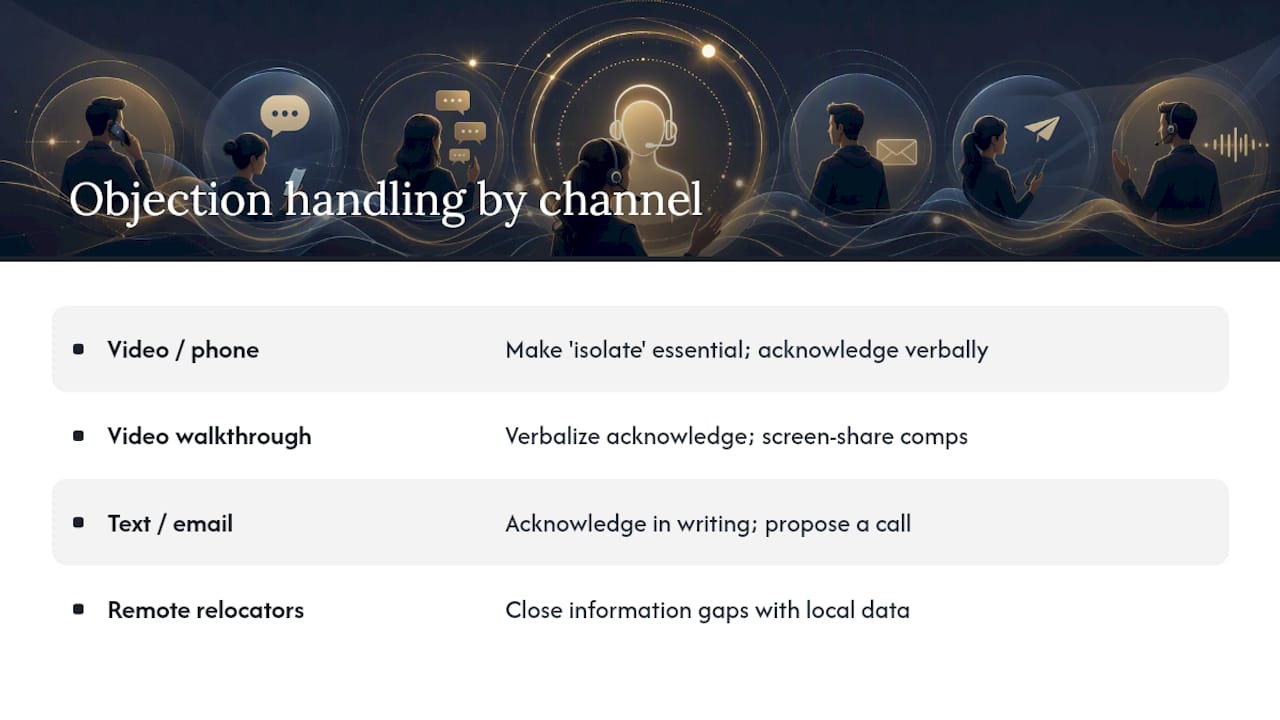
Video calls and phone-first client relationships strip away some of the cues you’d normally read in person, a hesitant pause, a shift in posture, a glance at a spouse. That makes the isolate step even more essential on a virtual call, since you can’t rely on body language to tell you an objection is coming.
On a video walkthrough, verbalize the acknowledge step more explicitly than you would in person. “I can hear some hesitation in that, tell me what’s on your mind” does the work that a raised eyebrow would do face to face. Screen-sharing comps in real time during a virtual listing presentation also replaces the physical handout, and it tends to land better because the client is looking at the exact numbers while you’re addressing their exact concern.
Text and email objections need a different rhythm entirely. A written “your commission seems high” deserves a call, not a written rebuttal, because tone is nearly impossible to convey accurately in text and the reframe lands far better as a conversation. Use the written message only to acknowledge and propose the call: “That’s a fair question, let’s hop on a quick call so I can walk you through exactly what that covers.”
Remote clients relocating from another market often raise objections rooted in unfamiliarity rather than skepticism, “is this price normal for this area” is really “I have no reference point.” Treat that as an information gap to close with data, not a trust issue to manage.
What I’ve Learned Watching Agents Handle Objections
The agents who struggle most with objections aren’t the ones who lack scripts. They’re the ones who never rehearsed the scripts out loud before a real client tested them. A line that reads well on paper can fall apart the first time someone actually pushes back, and that gap only closes with repetition.
What tends to separate strong performers over time is treating every rejected pitch as data, not defeat, and going back to refine the one line that didn’t land.
— Donny
Structured Training and Mentorship for Agents Who Want to Practice This For Real
Reading scripts is the easy part. Practicing them out loud, with feedback, under conditions that mirror a real listing appointment, is where most agents stall out on their own. Myeracareer builds that practice directly into its onboarding, rather than leaving new agents to rehearse alone or learn by losing deals.

New agents get structured mentorship, guided role-play sessions, and access to the Sales+ app for tracking which scripts and responses actually convert in real client conversations. Experienced agents leading their own teams get personalized leadership frameworks for running the same kind of practice with junior agents, so skill building doesn’t stop at the individual level.
Mentored onboarding built around real objection scenarios, not generic sales theory
Sales+ app for tracking performance and refining your script bank over time
Leadership frameworks for team leads who want to run structured practice at scale
If you’re starting out, explore training and mentoring for new agents to see how the onboarding path works. If you’re already leading a team and want a repeatable practice structure for your agents, check the program for experienced team leaders. Either way, request a mentor session to see how the framework applies to your next listing conversation.
Sources
Recommended
Comments