
20 Minute Practice, 10 Calls: Modular Real Estate Prospecting Scripts


This article hands you paste-ready prospecting scripts for FSBO, expired listings, circle prospecting, buyer leads, investors, sphere, door knocking, voicemails, and text follow-ups. Pick two lead types today, practice the openers aloud for 20 minutes, and schedule 10 focused calls tomorrow. Donny built this playbook around modular frameworks rather than memorized lines, and it includes CRM follow-up workflows plus a compliance note on PDPC rules so your dialing stays clean.
TL;DR:
Using a reason, empathy, ask, permission framework increases engagement by connecting with prospects’ specific situations rather than delivering generic pitches.
Binary, direct calls to action significantly improve appointment rates by removing scheduling ambiguity and making it easier for prospects to decide.
Tailoring scripts to lead types, such as FSBO, expired, or investor leads, boosts relevance and effectiveness during cold calls and door-knocking.
Consistent follow-up sequencing, including calls, voicemails, and texts over 30 to 60 days, is more impactful than relying on a single contact attempt.
Rehearsing scripts as flexible frameworks and maintaining disciplined CRM follow-up are key to converting leads and preventing burnout from rigid memorization.
Table of Contents
What Makes a Real Estate Prospecting Script Actually Work?
Most agents fail on the phone before they even reach an objection. They lead with a bio nobody asked for instead of a reason the call matters right now. A prospect who hears “Hi, I’m a top-producing agent in your area” hangs up mentally within two seconds. A prospect who hears a specific, relevant observation stays on the line.
The modular framework taught by Propphy breaks every call into four parts you can rearrange depending on the lead: Reason, Empathy, Ask, Permission. Call it REAP. You state a concrete reason for the call, acknowledge whatever situation the prospect is in, ask one sharp discovery question, and request permission for the next step rather than pushing an appointment on them cold.
Questions-first calling beats pitch-first calling because it shifts the prospect from defense to conversation. Instead of “I’d love to send you a market analysis,” try “What’s your timeline looking like if the right offer came in?” One question. One pause. Let them talk.
Binary calls to action close more appointments than open-ended ones. “Would Tuesday at 4 or Thursday at 10 work better?” outperforms “When would you like to meet?” nine times out of ten, because you’ve removed the mental labor of scheduling from a stranger who wasn’t planning to make a decision on this call.
A few operating principles worth rehearsing before you dial:
Call Tuesday through Thursday, 10 AM to 12 PM or 5 PM to 7 PM, when pickup rates run highest.
Aim for 40 to 60 dials in a focused session rather than scattering calls across a full day.
Slow your pace by roughly 20% compared to normal conversation. Rushed voices sound like telemarketers.
Drop your pitch tone slightly at the end of questions instead of rising, which reads as more confident and less salesy.
Smile before you dial. It changes your vocal tone even though the prospect can’t see you.
Cold Call Scripts by Lead Type You Can Use Today
Different lead types need different reasons for the call. A FSBO seller and an investor are not motivated by the same thing, so the opener has to change even though the underlying REAP structure stays the same.
1. FSBO seller script
“Hi, this is [Name] with [Brokerage]. I saw your listing on [Street] and wanted to reach out, not to pitch you, but because I work with a lot of buyers in this price range. Are you finding the showings you’re getting are the right fit, or mostly tire-kickers?”
Follow with a timeline question: “If it doesn’t sell in the next month or two, is there a point where you’d want a second opinion on pricing or exposure?” Offer something low-pressure, like a free comparative market analysis, before ever mentioning representation.
2. Expired listing script
“Hi [Name], this is [Name] with [Brokerage]. I noticed your home came off the market last week. I pulled the data on why homes in [Neighborhood] typically don’t sell the first time around, and I think you’d find two of the reasons pretty relevant. Do you have two minutes?”
Data-led openers work here because expired sellers are already skeptical of agents. Showing you did homework before calling separates you from the ten other agents who called with the same generic script.
3. Circle prospecting script
“Hi [Name], this is [Name] with [Brokerage]. I’m calling because we just [sold/listed] a home on [Street] near you, and I wanted to give you a quick update on what that means for values in the neighborhood. Have you thought at all about what your home might be worth in this market?”
4. Buyer lead follow-up script
Speed matters more than polish here. “Hi [Name], I saw you were looking at [Address] online. That one’s still active. Are you looking to see it this week, or are you still early in the search?” Qualify fast with one question, then invite to a showing rather than a generic consultation.
5. Investor outreach script
Investors want numbers, not rapport. “Hi [Name], this is [Name] with [Brokerage]. I work with buyers looking for cash-flow properties in [Area]. What’s your target cap rate, and are you open to off-market deals if the numbers work?”
6. Sphere and referral script
“Hi [Name], it’s [Name]. I haven’t caught up with you in a while. I’ve actually been getting more real estate questions lately from people in your circle, and I wanted to check in and see how you’re doing, and whether you know anyone thinking about buying or selling this year.”
7. Open-house invitation script
“Hi [Name], I’m hosting an open house this Saturday at [Address] from 1 to 3. It’s a great chance to see what’s moving in the area even if you’re not ready to buy yet. Would you want me to save you a private viewing time before the crowd?”
Two objection responses apply across nearly every script above:
“I’m not interested” → “Totally fair, most people aren’t until the timing is right. Can I check back in three months, or would a quick text update work better?”
“I already have an agent” → “Good to hear, sounds like you’re covered. Mind if I ask what you liked about working with them, just so I can learn?”
Leave a voicemail when you get a generic greeting or no pickup after two rings past hello. Send a text instead of a voicemail when the lead came from an online form and has never spoken to you, since a cold voicemail from a stranger often reads as spam.
Door-Knocking Scripts, Safety, and Leave-Behinds
Door knocking still works, but only when the opener respects the fact you’re standing on someone’s porch uninvited. Realtor confirms that low-pressure, value-based openers consistently outperform anything that sounds like a pitch, and The Close’s door-knocking playbook recommends leading with curiosity rather than a sales line.
Try this curiosity opener: “Hi, sorry to catch you off guard, I’m [Name] with [Brokerage]. I’m actually just walking the neighborhood today letting folks know about a home that just sold two streets over. Have you seen much activity around here lately?”

For a just-sold script: “We just closed on [Address] for [above/at] asking price. I wanted to give neighbors a heads-up since it usually shifts what your own home is worth. Would it help if I dropped off a quick market snapshot?”
Collecting contact information works best as a natural byproduct, not a demand; tools like AgentWrite can help agents quickly generate compelling listing copy to include on QR-enabled leave-behinds that support these efforts. Offer to text them the market update instead of asking for their number outright. If they decline, leave a flyer with a QR code linking to a market report rather than pushing for an email on the spot.
A few practical guardrails:
Knock between 10 AM and 6 PM on weekdays or weekends, never in early morning or after dark.
Stand back from the door after knocking and keep a visible, professional appearance.
Respect a “No Soliciting” sign. It isn’t a suggestion.
Log every conversation before moving to the next house, not at the end of the block when memory gets fuzzy.
Singapore agents also need to keep PDPC’s Do-Not-Call provisions in mind once a phone number is collected in person. Getting a number at the door doesn’t exempt you from checking it against the Do Not Call Registry before you dial it later.
Pro Tip: Tag every door-knock outcome in your CRM the same day, using a simple label like “warm, follow-up in 2 weeks” or “no answer, retry evening.” A cold lead from three weeks ago with no notes is functionally a dead lead.
Voicemail and Text Templates That Get Replies
Voicemails and texts do the heaviest lifting after the call itself, and HousingWire’s research on cold calling scripts points to sequencing, not any single message, as the real driver of conversion. Five to eight touches spread over 30 to 60 days consistently beats a single aggressive call.
Six voicemail drops worth keeping on hand:
Intro: “Hi [Name], this is [Name] with [Brokerage]. Nothing urgent, just wanted to introduce myself since I work a lot in your neighborhood. I’ll follow up with a text.”
Buyer inquiry: “Hi [Name], saw you were looking at [Address]. It’s still active, wanted to see if you’d like a private showing this week.”
FSBO: “Hi [Name], I work with buyers in your price range and wanted to see how showings have been going. Call or text anytime.”
Expired: “Hi [Name], I looked into why homes near you didn’t sell the first time and found a couple of things worth discussing. Two minutes whenever works.”
Open-house follow-up: “Hi [Name], thanks for stopping by Saturday. Wanted to see what you thought and answer any questions.”
No answer, second attempt: “Hi [Name], following up again, no pressure. I’ll send a quick text so you have my info handy.”
Texting works best as a strategic follow-up layer, not a cold opener. A short, conversational message tied to the prior call earns far more replies than a text sent out of nowhere. Keep it under 140 characters: “Hi [Name], it’s [Name] from [Brokerage], just left you a voicemail about [Address]. Text or call whenever works!”
Sequence it as call, then voicemail, then text within the same 24 hours, and space subsequent touches three to five days apart.
Objection Handling That Keeps the Conversation Alive
Objections aren’t rejections. They’re almost always a request for more information dressed up as resistance, and the ARP framework handles that request cleanly: Acknowledge, Reframe, Present value, then close with a binary ask.
The four objections you’ll hear most often:
Commission is too high.
“I already have an agent.”
“I’m not interested.”
Price expectations don’t match reality.
Word-for-word replies you can adapt on the spot:
Commission: “I hear that a lot, and it’s a fair question. What most sellers care about isn’t the percentage, it’s the net number in their pocket at closing. Can I show you how that breaks down?”
Already have an agent: “That’s great, sounds like you’re taken care of. If anything changes down the line, would it be okay if I checked back in a few months?”
Not interested: “Totally understand, most people aren’t until the timing lines up. Mind if I send you a quick text so you have my info for whenever that changes?”
Price expectations: “I get why that number feels right, it’s your home. Would it help if I walked you through what’s actually closed nearby in the last 60 days?”
Turning Your Scripts Into a Daily Playbook
A script only works if you rehearse it enough that it stops sounding memorized. Run a 20-minute warmup before every calling session, role-playing your top two scripts with a colleague or recording yourself and listening back for pacing.
A simple CRM workflow keeps leads from slipping through the cracks:
Import your list and segment it by lead type (FSBO, expired, circle, buyer, investor).
Log every call attempt immediately, tagging outcomes as No Answer, Warm, Hot, or Follow-up Date.
Trigger an automated next-touch sequence based on the tag: voicemail, then SMS, then an automated follow-up email.
Review your sales pipeline weekly to spot which lead type is converting fastest.
Watch four numbers daily: contacts made, appointments booked, conversion rate from contact to appointment, and average touches-to-conversion. A minimal performance dashboard tracking those four figures will tell you more about where your pipeline leaks than any script rewrite will.
What Actually Moves the Needle in Live Calls
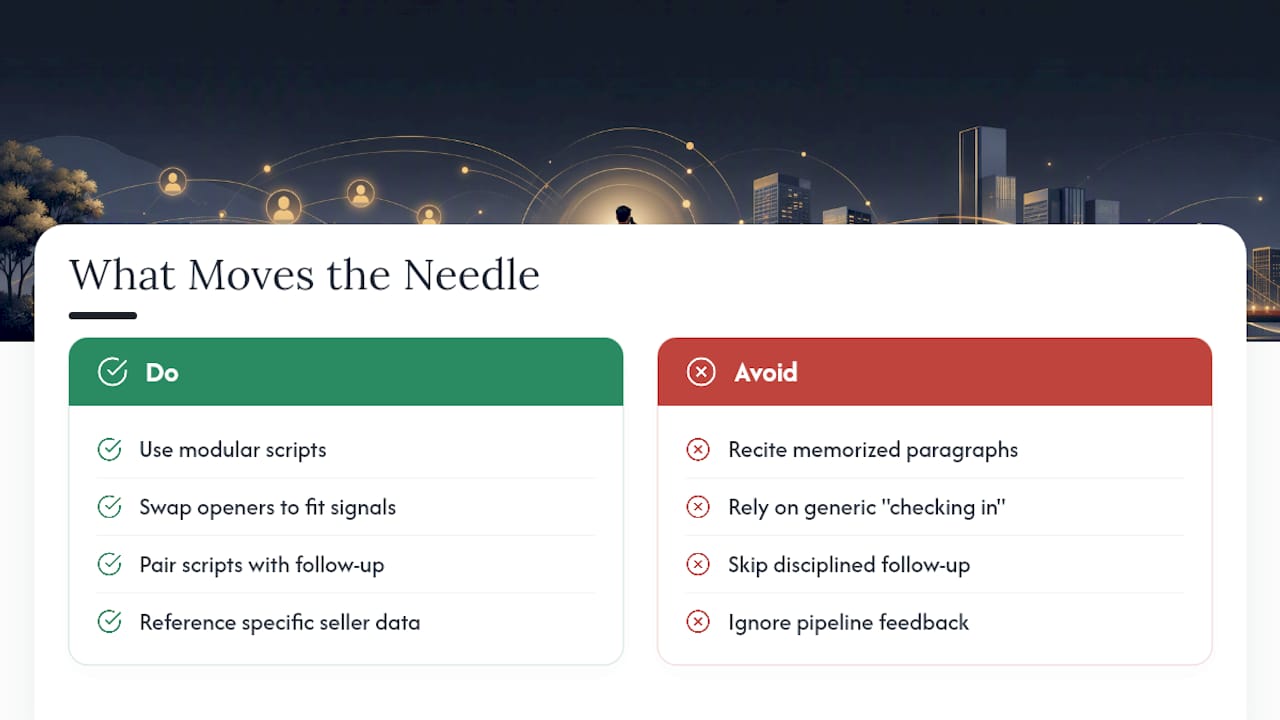
Script modularity paired with disciplined follow-up is what separates agents who convert consistently from agents who burn through leads. Donny has seen the pattern repeat across new agents going through onboarding: the ones who treat scripts as flexible frameworks, swapping in a sharper opener or a better discovery question based on what they hear back, out-convert the ones reciting a memorized paragraph word for word.
One anonymized example from a small pipeline review: an agent working expired listings switched from a generic “just checking in” opener to the data-led version above, referencing a specific reason the home likely didn’t sell. Appointment-set rate on that segment moved noticeably within the first two weeks, without changing anything else about the follow-up cadence.
The Honest Take on Why Most Scripts Fail
Most prospecting advice treats scripts as scripture, something to memorize word for word and deliver flawlessly. That’s backwards, and it’s the biggest reason agents quit cold calling after two bad weeks. A script memorized too tightly falls apart the moment a prospect says something unexpected, because the agent is reciting instead of listening.
The scripts in this guide work as frameworks: swap the reason, adjust the discovery question, keep the binary close. That flexibility is what lets an agent sound human on call forty of the day instead of call four. The conventional advice obsesses over finding the “perfect” opening line. The real lever is follow-up discipline, tagging every outcome and actually running the five to eight touches research points to, rather than giving up after one unanswered call.
If you take one thing from this guide, prioritize the CRM habit over the script wording. A mediocre script followed up eight times beats a perfect script followed up once.
— Donny
Get Coaching on These Scripts, Not Just the Scripts Themselves
Reading a script is one thing. Delivering it with the right pacing, handling a live objection without freezing, and knowing when to switch from FSBO mode to investor mode mid-call is another. Myeracareer builds that skill directly into onboarding rather than leaving new agents to figure it out through trial and error on real leads.

If you’re newly licensed or working toward your RES exam, the New Agents program pairs script practice with live role-play sessions and mentorship from agents actively closing deals, so your first hundred calls happen with feedback instead of guesswork. Team leaders looking to install this playbook across a whole roster can review the Experienced Team Leaders track for frameworks on training and accountability at scale. Agents switching teams who want sharper conversion habits and Sales+ app coaching should look at the Experienced Agents page. Book a session to see which track fits where you are right now.
Where These Scripts and Compliance Rules Come From
Singapore agents collecting or calling contact numbers should review PDPC’s Do-Not-Call provisions before running any calling campaign, since penalties apply for numbers checked against the registry incorrectly. For door-knocking playbooks, The Close and Realtor.com both cover in-person scripts and etiquette in depth. For broader cold-calling and voicemail frameworks, Propphy’s lead scripts guide and HousingWire’s cold calling scripts article round out the follow-up sequencing data referenced throughout this guide.
Sources
Recommended
Comments