
Week One Plan for a CEA Disciplinary Case: MyEraCareer Steps
- donnylee532
- 2 days ago
- 7 min read

CEA handles disciplinary matters either under the Letter of Censure (LOC) framework for less serious breaches or before a Disciplinary Committee (DC) for serious breaches. Outcomes range from warnings and fines up to $5,000 under LOC to fines, suspensions, or licence revocation under a DC ruling, with steep per-breach penalties for AML/CFT lapses. This guide walks through the process, real case examples, and what to do if you or your agency gets pulled into one.
TL;DR:
Penalties under LOC are limited to warnings and fines up to $5,000, while DC rulings can impose fines up to $200,000 and license suspensions or revocations.
Serious breaches like deliberate misconduct, client harm, or AML/CFT failures trigger referrals to a Disciplinary Committee, not the Letter of Censure process.
The disciplinary process involves multiple stages, from complaint assessment and investigation to hearings, with contested cases typically taking longer and risking harsher penalties.
Prompt cooperation and thorough documentation are essential for agents under investigation, as good-faith efforts can lead to lighter sanctions.
Official rules are accessible on CEA’s website, and building compliance habits early helps protect your career and reputation.
Table of Contents
What Separates a Letter of Censure from a Disciplinary Committee Hearing
Not every breach lands an agent in front of a tribunal. CEA sorts complaints into two tracks, and which one applies determines how much is at stake.
The Letter of Censure framework covers less serious lapses, things like paperwork errors, minor advertising slip-ups, or a missed disclosure that caused no real harm. These typically resolve with a Letter of Warning or an LOC carrying a financial penalty.
Referral to a Disciplinary Committee happens when CEA sees:
Deliberate misconduct or a pattern of repeat behavior
Consumer harm or financial loss to a client
AML/CFT related failures under the PMLFT Regulations
Conduct that raises broader public interest concerns
One date matters more than most agents realize: the LOC framework went live on July 30, 2021, and CEA only counts LOC or Letter of Warning records dated on or after that day when it assesses an agent’s current disciplinary profile. If your record includes anything older, it’s worth confirming with CEA whether it still factors into future assessments.
What Penalties Actually Look Like Under LOC and DC Rulings
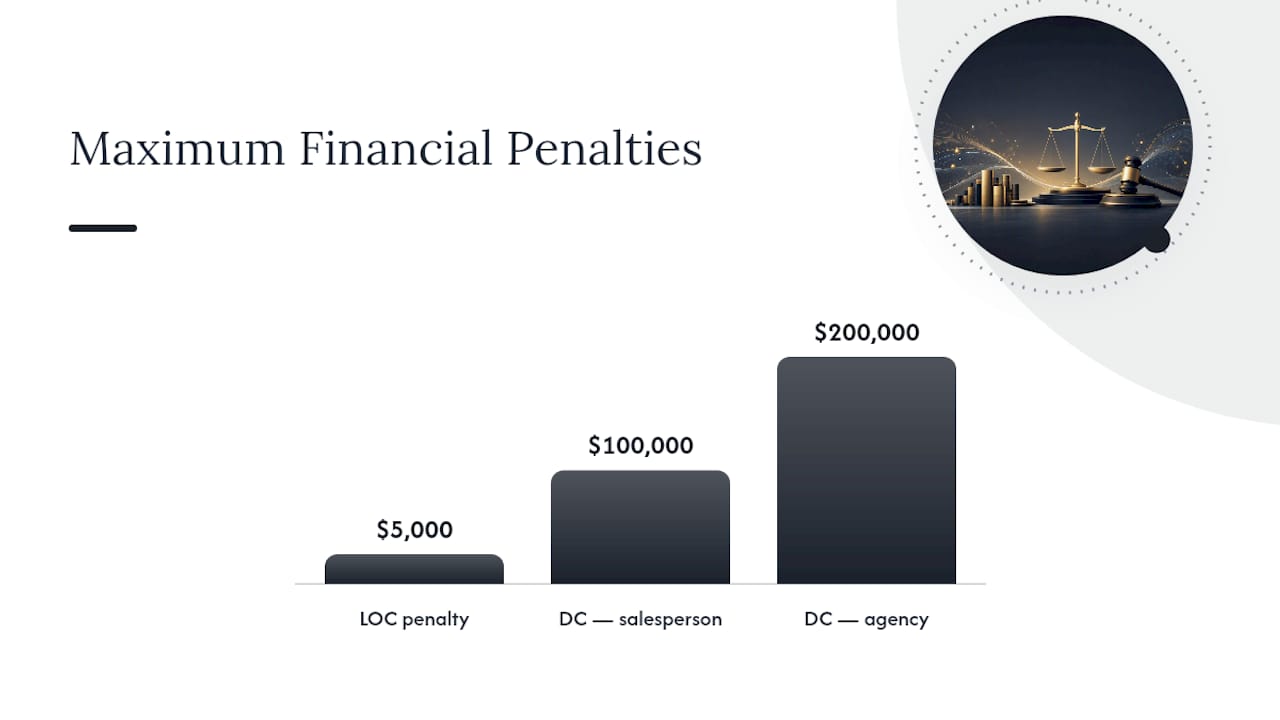
The financial gap between the two tracks is enormous. An LOC penalty tops out at $5,000 per case. A Disciplinary Committee ruling can impose fines up to $100,000 for a real estate salesperson or $200,000 for an estate agency, and for AML/CFT breaches occurring after July 1, 2025, those maximums apply per breach, not per case. A single transaction with three separate due diligence failures could theoretically generate three penalties.
Money isn’t the only lever CEA pulls. A Disciplinary Committee can also:
Suspend a licence or registration for a defined period
Revoke it outright
Attach conditions to future practice
Issue a formal admonishment
Order the agent or agency to pay fixed costs to CEA
Real cases show how these penalties stack. In one advertising case, an RES was fined a total of $14,000 and suspended for five months for publishing grossly misleading listings. In a separate co-broking dispute, an agent drew a similar $14,000 fine paired with a seven-month suspension for refusing to co-broke a transaction and putting up a false advertisement. Neither case involved a single, isolated violation. Both combined a fine with months out of the field, which is the pattern DC rulings tend to follow when the breach is deliberate rather than careless.
How a CEA Disciplinary Case Moves From Complaint to Verdict
A disciplinary case doesn’t jump straight to a hearing. It moves through a fairly predictable sequence, and knowing the stages helps both agents and complainants set realistic expectations.
Preliminary assessment. CEA reviews the complaint to decide if it falls within its jurisdiction and warrants investigation.
Agency-level investigation. Where the complaint concerns a licensed agency, CEA often directs that agency to investigate internally and submit a report, typically within two weeks unless told otherwise.
Assignment to an investigation officer. For matters CEA pursues directly, a CEA officer takes over the fact-finding, gathering documents, transaction records, and witness statements.
Service of charges. If the evidence supports it, formal charges are served on the agent or agency.
Pre-hearing conference (PHC). Both sides appear before the case moves forward, often to clarify the scope of the charges and explore whether the matter will be contested.
Trial or plead-guilty hearing. Contested cases proceed to a full trial with witnesses and documentary evidence. Where the agent admits the breach, the matter moves to a plead-guilty hearing instead, which is faster and often results in a lighter sentence.
Newton hearing, where needed. If facts remain disputed even after a guilty plea, a Newton hearing resolves the factual disagreement before sentencing.
Sentencing. The Disciplinary Committee delivers its ruling, fine, suspension, revocation, or conditions.
Appeal. A dissatisfied party has 14 days to appeal to the Appeals Board.
Uncontested matters move faster and usually attract more lenient outcomes than fully litigated ones, largely because cooperation signals accountability rather than concealment.
How to File a Complaint With CEA and What Happens Next
If you believe an agent or agency has breached the Code of Ethics, CEA accepts complaints directly through its website. Before you submit, put together a clear paper trail:
A written chronology of events, in order
Screenshots of listings, ads, or messages in question
Copies of contracts, option forms, or exclusive agency agreements
WhatsApp, email, or SMS communications relevant to the dispute
Once filed, CEA checks whether the matter falls within its jurisdiction. If it does, and the complaint involves a licensed agency, CEA may direct that agency to investigate and report back within two weeks. Otherwise, a CEA investigation officer takes the case directly.
Outcomes eventually surface on CEA’s public register of past disciplinary cases, which currently shows enforcement actions going back three years. Complainants should expect a process measured in weeks or months, not days. CEA doesn’t publish live status updates on individual complaints while they’re under investigation.
If You’re Under Investigation: What to Do in the First Week
The instinct to go quiet is the wrong one. Cooperate fully with your agency’s internal inquiry, and start gathering your own file in parallel: every transaction record, listing draft, and client message tied to the complaint. Ask your agency for a copy of whatever report it submits to CEA. You’re entitled to see what’s being said about your conduct.
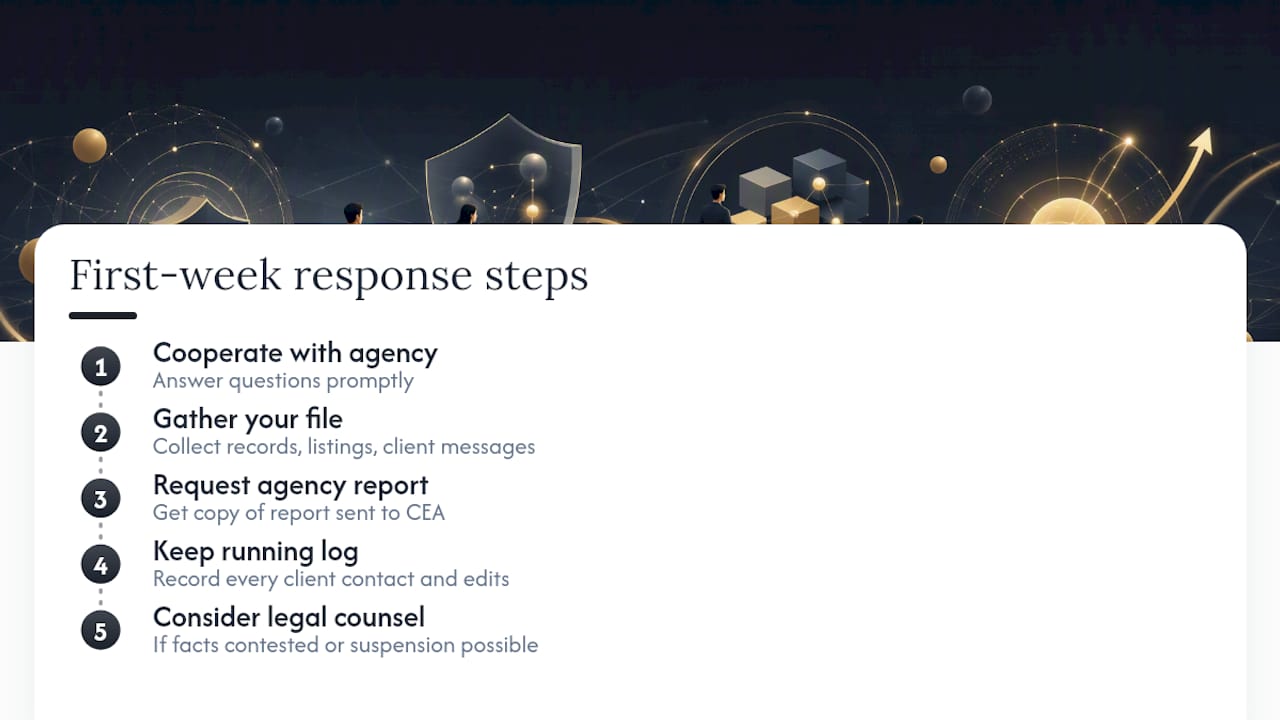
If the matter advances to a pre-hearing conference or sentencing, consider legal representation, particularly if the facts are contested or the potential penalty includes suspension. Solid documentation habits from day one of your career make this process far less stressful. Structured onboarding that covers CEA registration requirements, CEPCC training, and PMLFT due diligence checklists gives agents a working system for record-keeping long before any complaint ever lands.
Pro Tip: Keep a running log of every client communication and listing edit, even for transactions that seem routine. The agents who struggle most in a CEA review are rarely the ones who did something egregious. They’re the ones who can’t reconstruct what actually happened.
Three Lessons From Published CEA Enforcement Cases
Real cases repeat the same mistakes. Three lessons stand out:
Verify every claim in an ad before it goes live. Misleading listings are one of the most common triggers for DC referral.
Co-broke fairly and document the conversation. Refusing to share a transaction to protect commission has drawn multi-month suspensions.
Follow prescribed customer due diligence under the PMLFT Regulations, and keep records that prove you did.
Intent matters enormously to how a DC weighs a case. A deliberate misrepresentation draws a harsher sentence than an honest oversight caught late, which is exactly why documented, good-faith effort tends to soften outcomes even when a breach is confirmed.
Where to Verify These Rules Yourself
Confirm any detail directly against CEA’s own pages:
Why Compliance Shapes an Agent’s Whole Career
A disciplinary record follows you. Team leaders and hiring agencies check it, clients ask about it, and it colors how much supervision you’re given early on. None of that means a past LOC or DC finding ends a career. Remediation, better documentation habits, and mentorship from agents who’ve built clean track records go a long way toward rebuilding trust, and toward preventing a repeat entry on your file.
— Donny
How MyEraCareer Supports Agents Through the CEA Compliance Process
Staying clear of a disciplinary file starts long before your first transaction. Myeracareer’s New Agents program builds compliance into onboarding from day one, covering CEA licensing guidance, CEPCC ethics training, and PMLFT due diligence checklists so new RES candidates in Singapore understand exactly where the lines are before they’re tested by a real client situation.

Beyond the paperwork, agents get hands-on mentorship from team leaders who’ve navigated CEA’s rules for years, plus access to the Sales+ app for tracking performance and client communications, the same kind of documentation habit that keeps agents out of trouble when a dispute arises. Whether you’re preparing for the RES exam or switching agencies and want a team that takes compliance seriously, the New Agents page is where to start. You can also read more about the practical side of staying fit and proper under CEA standards or explore partner perspectives on behaviors that quietly limit agent success before you commit to a team.
Sources
Recommended
Comments