
The Recruiting Strategy That Actually Fills Your Roster


The best way to recruit real estate agents is to build an always-on, measurable system rather than chase one-off hires whenever your roster thins out. That system pairs a quantifiable value proposition, one that goes well beyond commission splits, with a published training playbook and disciplined follow-up. Get those three pieces working together, and recruiting stops being a scramble and starts producing predictable results.
TL;DR:
Building a continuous recruiting system with a measurable value proposition, a training playbook, and disciplined follow-up yields consistent agent hires.
An effective funnel includes six stages: attract, engage, qualify, meet, nurture, and close, with strict service-level agreements to maintain momentum.
Segment prospects based on experience and likelihood-to-move scores, automating initial touches and prioritizing manual outreach for top prospects.
Successful recruiting combines organic content, direct prospecting, and targeted paid campaigns, ensuring messaging consistency across channels.
Tracking key metrics like time-to-ramp, close rate, retention, and cost-per-hire guides ongoing improvement and validates recruiting strategies.
Table of Contents
Building an Always-On Agent Recruiting System
Most brokers only recruit when someone leaves. That reactive habit is the single biggest reason recruiting feels exhausting. A repeatable funnel, with clear stages, owners, and follow-up cadences, produces stronger hires than scattered outreach, according to HousingWire’s recruiting roadmap.
Your funnel needs six stages, each with a name attached to it:
Attract: content and outreach generate initial interest (owned by whoever runs your social presence or ISA team).
Engage: a recruiting lead responds within 24 hours and starts a conversation.
Qualify: a screening call confirms fit, production history, and motivation to move.
Meet: the team leader takes over for a sit-down or video conversation.
Nurture: prospects who aren’t ready get added to a scored, segmented follow-up sequence.
Close: the offer goes out, with onboarding scheduled before the ink dries.
Set service-level agreements for each stage. Twenty-four hours for first contact, 48 hours from qualified call to team leader meeting, and no prospect goes untouched for more than three weeks in the nurture stage. Your CRM should track experience level, current brokerage, production trend, and a likelihood-to-move score, because these fields determine who gets a phone call this week versus who gets a quarterly check-in. Tools like the ones covered in WhatsApp CRM options for real estate agents make that kind of tracking realistic for a small recruiting team, not just enterprise brokerages.
How Do You Build an Agent Persona That Attracts the Right Recruits?
Recruiting the wrong agent type wastes months. Before you write a single outreach message, decide who you actually want on your team, because a newly licensed agent and a top producer respond to completely different offers.
Profile your ideal mix. A workable target composition, drawn from brokerages that recruit well, runs roughly two-thirds producing buyer’s agents and about a quarter newly licensed agents, according to the HousingWire roadmap, with the remainder reserved for experienced top producers you’d poach selectively.
Write outcome-focused offers, not split pitches. Winning recruitment messaging centers on quantifiable outcomes, qualified appointment flow, coaching results, production gains, rather than a bare split number, per NAR’s guidance on recruiting and retaining salespeople. A strong offer typically falls into one of a few buckets: AI-powered tools, qualified leads, training access, or measurable culture.
Draft one-sentence tests. Try something like “We hand new agents 8 qualified buyer appointments in their first 90 days” against “We offer a 70/30 split with full support.” Run both for two weeks across the same channel and track reply rates before committing.
Splits still matter to candidates, and reviewing commission split models helps you frame your number honestly against competitors, but leading with it rarely wins the best producers.
Publishing a Recruiting Playbook Agents Actually Trust
A published playbook does double duty: it trains the agents you hire and it recruits the agents you haven’t hired yet. Publishable training content and public mini-lessons attract higher-quality candidates because they prove your development path is real, not a slide deck promise, according to Faribai’s 2026 recruiting playbook analysis.
Structure the first 90 days around three checkpoints:
Days 1 to 30: licensing paperwork, CRM setup, shadowing two listing appointments, first scripted cold calls.
Days 31 to 60: first solo showings, weekly production reviews, mentor-led role play on objection handling.
Days 61 to 90: first closed deal targeted, KPI review against a written ramp benchmark, mentor pairing evaluated for fit.
Pair every new agent with a mentor who receives a small override or bonus tied to the mentee’s first six months of production, not just a flat stipend for showing up.
Pro Tip: Take one weekly training module, strip out anything proprietary, and post it as a two-minute video. Candidates who watch a real training session convert faster than those who only hear about “great support” in a phone call.
Screening, Interviewing, and Qualifying Candidates Effectively
A screening call should run five to ten minutes and answer exactly one question: is this person worth a second conversation? Longer than that, and you’re doing an interview on the phone, which wastes everyone’s time.
Open with production history. Ask directly what they closed last year and what changed this year. A sudden drop or a sudden spike both signal something worth exploring.
Ask why now. Vague answers (“just exploring”) usually mean low urgency; specific frustrations (splits, lead flow, lack of mentorship) mean they’re closer to moving.
Run one scenario prompt. Ask how they’d handle a seller who wants to list $50,000 above market. The answer reveals negotiation instinct faster than any resume line.
Check the data before you call back. Pull recent production trends and license history so your second conversation starts from facts, not a cold reintroduction.
Save the deep scenario work, handling a blown inspection, a buyer who ghosts at closing, for the in-person or video meeting, where you can actually watch how someone thinks under pressure.
Which Channels Actually Produce Quality Recruits?
Running one channel at a time is why most recruiting pipelines dry up. Organic content, direct prospecting, and paid funnels each pull a different type of candidate, and the strongest brokerages run all three in parallel, per Faribai’s research.
Organic content built around celebrating agent wins, publishing mini-lessons, and sharing real case studies produces higher close rates because candidates already trust you before the first call, according to the same Faribai analysis. It’s slower to build volume, but the trust it creates shortens every conversation that follows.
Direct prospecting through Boolean searches on LinkedIn, local industry meetups, and straightforward agent referrals still fills the top of the funnel fastest when you need volume this quarter.
Paid funnels and events work when they’re built around a specific ask: a webinar that ends in a booked demo call, an ad campaign that drives to a signup form, or an in-person recruitment mixer with a clear next step, not just free drinks.
Whoever runs each channel needs to understand the offer the same way, because a prospecting agent who pitches splits while your webinar pitches training creates a confusing, inconsistent message.
Segmenting Prospects for a CRM-Driven Nurture Program
Not every prospect deserves the same attention, and treating them identically burns your recruiting lead’s time on people who aren’t close to moving. Segment your list by experience band (newly licensed, 2 to 5 years, veteran), agent type (buyer’s agent, listing specialist, team leader), and likelihood-to-move score built from production trend data.
Escalate outreach for agents showing a recent production drop or an unexplained spike, since both patterns correlate with openness to a move, per HousingWire’s segmentation guidance.
Automate the first three touches (an intro email, a case study, a training preview) and hand off to a human the moment a prospect replies or opens three consecutive messages.
Keep top-producer segments on manual outreach only. Automated sequences read as impersonal to agents who already get pitched weekly.
A real estate CRM built for agents and brokers makes this segmentation practical without requiring a full-time data analyst on your team.
Retention: The Levers That Keep Recruits From Leaving
Recruiting a good agent and losing them within a year is worse than not recruiting at all, since it costs you the placement fee, the onboarding hours, and your credibility with the next candidate. Retention tracks closer to culture and development access than to the size of a commission split, according to NAR’s research on retaining salespeople.
Run KPI-driven progress reviews at 30, 60, and 90 days using a consistent performance review template, not an informal check-in.
Tie mentor compensation to the mentee’s retention past month six, not just their first closed deal.
Build a recurring ritual, a weekly win-share call or a monthly deal breakdown session, that gives agents a reason to show up beyond their own transactions.
Pro Tip: Ask departing agents one question in every exit conversation: “What would have kept you here?” The pattern in those answers usually points straight at your next culture fix.
What Metrics Prove Your Recruiting Is Working?
If you can’t measure it, you’re guessing. Track four numbers monthly: time-to-ramp (days from hire to first closed deal), close rate from outreach (qualified conversations that become signed agents), 12-month retention rate, and cost-per-hire across every channel combined.
Benchmark time-to-ramp against your own onboarding plan. If your 90-day playbook targets a first closing by day 75 and agents consistently hit day 110, the gap is your playbook, not the agent.
A dashboard with four columns, funnel stage, agent name, days in stage, and next action, keeps a recruiting lead from letting prospects go cold.
Report monthly, not quarterly. Recruiting funnels move fast enough that a quarter is too long to catch a stalled stage.
An agent performance dashboard built around these same fields turns this from a spreadsheet chore into a five-minute weekly review.
Practical Templates From MyERA Career You Can Adapt This Week
Templates only work if they’re built for the market you’re recruiting in, and generic scripts tend to fall flat the moment a candidate asks a specific question about splits or lead flow. MyERA Career’s onboarding materials, including guidance on agent income expectations, give you a starting point you can adjust rather than build from scratch.
Borrow the 90-day ramp structure outlined earlier and swap in your own production targets.
Adapt a screening script by keeping the four-question structure (production history, motivation, scenario prompt, data check) and localizing the scenario to deals typical in your market.
Before you change any contract term, split structure, or licensing requirement based on a template, verify it against your local regulatory requirements. Onboarding rules and licensing steps vary by jurisdiction, and a script written for one market can misstate obligations in another.
Studying How Other Agencies Recruit
Watching a competing team’s recruiting messaging for a month tells you more than any internal brainstorm. Pull up the recruiting pages of three or four agencies you compete with for talent and note exactly what they lead with: is it splits, technology, culture, or leads?
Most agencies still open with commission numbers, which is precisely why an outcomes-first offer stands out. If a competitor leads with “90/10 split, no fees,” you can differentiate immediately by leading with a specific, provable claim, appointment volume, ramp speed, mentor access, that a bare split number can’t match.
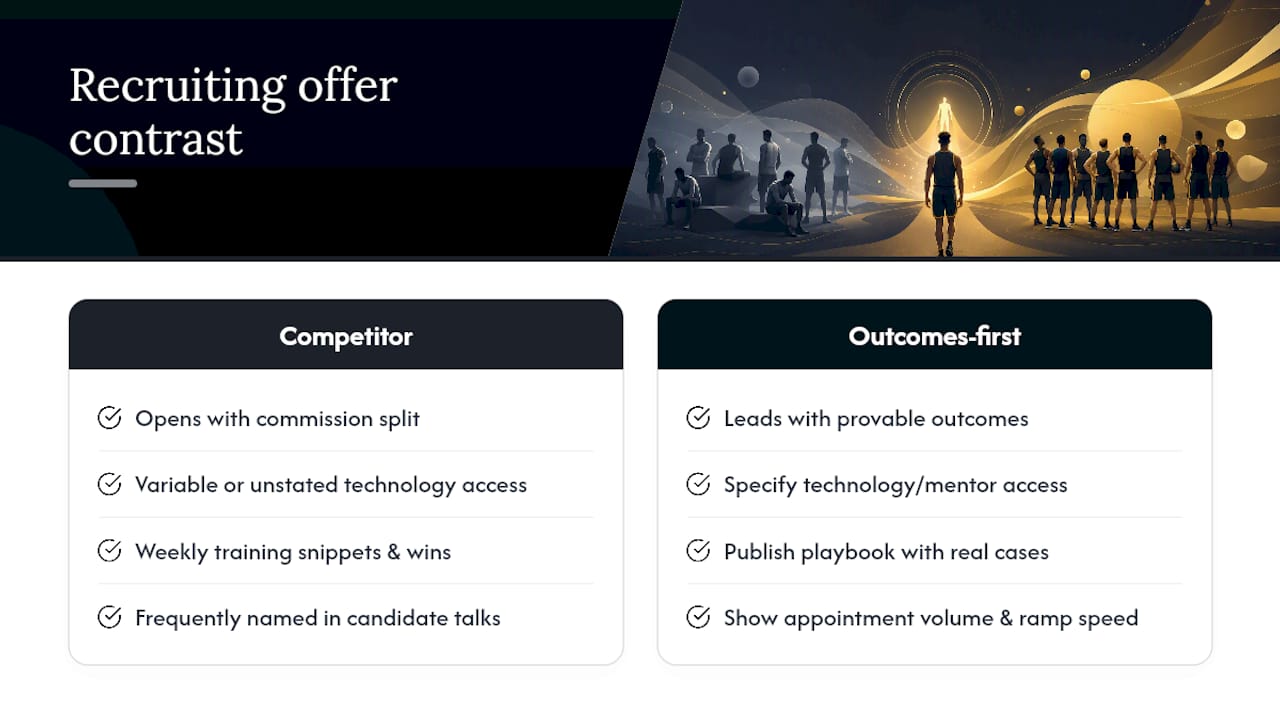
Pay attention to their content cadence too. An agency posting weekly training snippets and win celebrations is running exactly the organic strategy outlined earlier, and if they’ve been at it for six months, they’ve likely built a trust advantage that’s hard to out-message with paid ads alone. The counter isn’t to copy their content style. It’s to publish your own playbook with more specificity: real ramp numbers, real mentor names, real case studies from your own roster.
Track which competitors show up in candidate conversations. If the same two or three names keep surfacing when you ask “who else are you talking to,” study their offer structure directly rather than guessing at it from job boards. Candidates comparing you against a specific competitor will tell you exactly what matters to them if you ask.
Legal and Compliance Considerations in Agent Recruiting
Recruiting moves fast, but licensing and contract rules don’t bend to match your timeline. Every jurisdiction sets its own requirements for how agents transfer between brokerages, what notice periods apply, and how commission agreements from a prior brokerage get resolved before a new one takes effect.
Before extending any offer, confirm the candidate’s license is active and in good standing, and check whether their current brokerage has any pending disciplinary matters tied to their name. Skipping this step is how brokers inherit liability they never agreed to take on.
Non-compete and non-solicitation clauses in a candidate’s current contract deserve a direct conversation, not an assumption. Some brokerages restrict an outgoing agent from contacting clients from active listings for a set period after departure; others don’t. Ask the candidate to review their existing agreement before you build compensation promises around a start date, because a contractual restriction can delay a transfer by weeks.
Advertising claims in your recruiting materials carry the same scrutiny as any other business communication. A claim like “average agent earns X in year one” needs to be defensible with real data, not aspirational rounding. If your jurisdiction’s real estate council or licensing board publishes advertising standards for recruitment communications, treat those as a floor, not a suggestion. When in doubt on a specific clause or claim, a short conversation with a local real estate attorney costs far less than untangling a dispute after the fact.
Leveraging Employee Referral Programs Effectively
Your current agents already know who’s unhappy at their old brokerage. A structured referral program turns that knowledge into your cheapest, highest-quality recruiting channel, because a referred candidate arrives with built-in trust and a realistic picture of what working with you actually looks like.

Structure the incentive around retention, not just signature. A referral bonus paid entirely at signing rewards volume over fit; splitting it, a smaller payment at signing and the larger portion at the six-month or twelve-month mark, rewards your agents for referring people who actually stick. That structure also protects you from a referral rush of names your agents barely know.
Make the ask specific rather than generic. “Know anyone looking to move?” gets ignored. “Do you know anyone frustrated with their lead flow right now?” gets a name. Build this question into your regular team meetings rather than treating it as a one-time email blast, since the best referral candidates surface in casual conversation, not formal surveys.
Track referral-sourced hires separately in your metrics. If referred agents show a shorter time-to-ramp and stronger 12-month retention than agents sourced through paid channels, and they typically do, that data justifies raising your referral incentive rather than spending more on ads.
Author Donny’s One-Page Recruiting Checklist
This week: audit your value proposition against a split-only competitor, pick three specific prospects showing a production shift, and run a 60-minute recruiting webinar built around one real case study. Book screening calls before Friday, not “sometime next month.”
Over 90 days, staff two roles: someone owning first response within 24 hours, and a mentor pipeline with compensation tied to retention. The webinar and referral ask are low-effort wins you’ll feel by month two. The mentor incentive structure and published playbook take longer to build, but they’re what makes every recruit after the first one easier to close.
— Donny
How MyERA Career Supports Team Leaders Who Recruit
Building all of this alone, the funnel, the playbook, the screening scripts, the mentor incentive structure, takes months most team leaders don’t have. MyERA Career gives you that system already built: structured onboarding for newly licensed agents, a published training pathway, AI-powered sales tools through the Sales+ app, and personalized leadership frameworks for the team leader running the recruiting itself.
Instead of assembling screening scripts and ramp plans from scratch, you plug into a framework that’s already been tested across cohorts of new and experienced agents. If you’re recruiting newly licensed candidates, the New Agents program walks them through RES exam preparation and CEA licensing requirements before they ever touch a live deal. If you’re building or joining a leadership team, the Experienced Team Leaders program pairs you with performance tracking and mentorship structures designed for people managing rosters, not just closing their own listings. Book a conversation about which track fits your team, and start recruiting with a system already in place instead of one you’re still building.
Sources
Recommended
Comments