
20–50 Deals: 6 Team Structures for Singapore Agents and Who to Hire

If you’re closing 20 to 30 transactions a year and drowning in paperwork, a lead-centric team with one transaction coordinator is your fastest fix. Under 20 deals, wait and build systems first. Past 40, look at a hybrid or pod model with departmentalized roles. Start with a CRM and a documented follow-up standard before you hire anyone, and treat your growth as stages, not a single leap.
TL;DR:
Teams handling fewer than 20 deals should focus on building systems and a CRM before hiring support staff.
For 20 to 50 transactions annually, hiring a transaction coordinator provides the highest return on time savings.
When team volume exceeds 50 deals per year, departmentalized or hybrid models with separate sales and operations groups become most effective.
Lead routing should be transparent, with response times under 5 minutes and clear follow-up cadences to prevent growth caps.
Support staff compensation is typically salaried with bonuses, and hiring should be based on specific bottlenecks, not growth ambition.
Table of Contents
What Real Estate Team Structure Actually Looks Like
Every workable team, regardless of size, splits into two functional sides: sales and operations. Sales covers listing agents, buyer’s agents, and inside sales agents (ISAs) who generate and convert leads. Operations covers transaction coordinators, marketing, and admin, the people who keep deals moving without needing a producer’s attention. That two-sided split is the skeleton underneath every model below.
Teams move through predictable growth stages: solo with light support, small team, medium team, and full team or mega team. Each stage carries different hiring triggers, and jumping stages without the right hire in place is how teams stall.
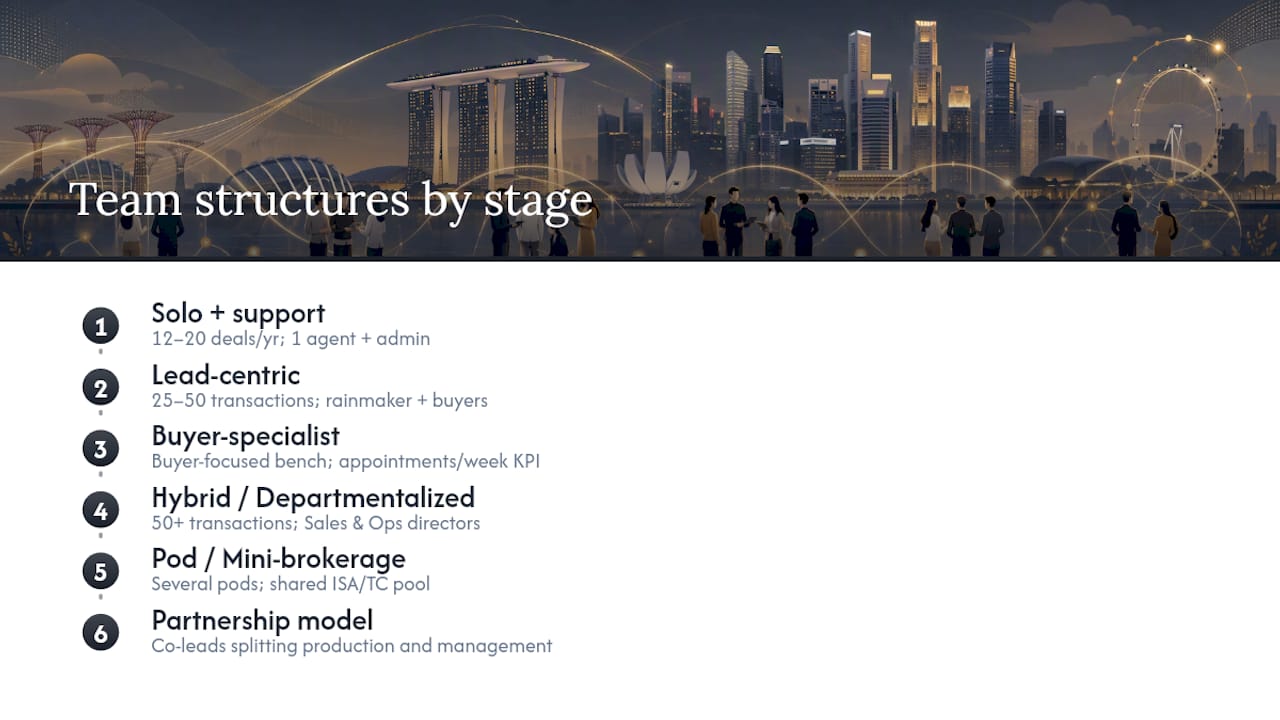
Solo + support. One producing agent, one part-time or virtual assistant handling admin and scheduling. Ideal for 12 to 20 deals a year. Org chart: Agent at the top, one admin line underneath. KPI to watch: hours per week spent on non-selling tasks. If that number is above 15, you’re ready for the next stage.
Lead-centric (listing-focused). A rainmaker generates leads and lists property; buyer’s agents and a showing assistant work the pipeline underneath. Works well for 25 to 50 transactions a year. Org chart: Team Leader → Listing Coordinator and Buyer’s Agents (2 to 4) → Showing Assistant. KPI: listing-to-close ratio and buyer-agent conversion rate.
Buyer-specialist model. Flips the emphasis: one or two agents source listings, a bench of buyer specialists handles showings and offers. Fits markets with heavy buyer lead flow. KPI: appointments set per buyer agent per week.
Hybrid/departmentalized. Sales and Operations become distinct departments, each with its own lead. Suited to 50+ transactions a year. Org chart: Team Leader → Sales Director and Operations Director → their respective staff. KPI: department-level P&L, not just individual production.
Pod/mini-brokerage. Several self-contained “pods,” each with a lead agent, buyer’s agent, and shared ISA/TC pool. This structure flexes staffing up or down without adding fixed payroll, which is why it’s gaining traction among teams wary of overtiring.
Partnership model. Two or more equal-status agents co-lead, splitting both production and management. Works only with clear written agreements on decision rights and exit terms.
In Singapore’s market, note that CEA licensing and agency-affiliation rules shape how a team’s org chart maps onto formal reporting lines. That’s a legal detail to confirm with your agency before finalizing titles, not a reason to change which model fits your volume.
Who Does What: Core Roles on a Real Estate Team
Role overlap is the single fastest way to break a team’s momentum. Define ownership before you define titles.
Team leader/rainmaker. Owns strategy, recruiting, and the biggest relationships. A leader scaling past the small-team stage should spend roughly 60 to 70% of their time on business development and leadership tasks rather than day-to-day transactions, according to research on high-performing team structures. KPI: team-wide GCI growth, recruiting pipeline health.
Listing specialist. Owns seller relationships, pricing strategy, and listing presentations. KPI: list-to-sale price ratio, days on market.
Buyer’s agent. Owns buyer consultations, showings, and offer negotiation. KPI: showings-to-offer ratio, buyer-to-close conversion.
Showing assistant. Handles lower-stakes showings so buyer’s agents focus on serious prospects. KPI: showings completed per week.
ISA (inside sales agent). Owns first contact and lead qualification, nothing past the appointment. KPI: lead-to-appointment conversion rate.
Transaction coordinator (TC). Owns paperwork, deadlines, and compliance from contract to close. KPI: on-time closing rate, error-free file rate.
Marketing coordinator. Owns listing marketing, social content, and brand consistency. KPI: lead volume generated, cost per lead.
Admin/client-care specialist. Owns scheduling, database hygiene, and post-close client touch points. KPI: CRM data accuracy, client satisfaction follow-up completion.
Every one of these roles needs a written scope. Verbal understandings collapse the moment volume spikes.
When Should You Hire Your Next Team Member?
Hire based on bottlenecks, not ambition. The clearest signal is a persistent gap in your lead-to-appointment or appointment-to-offer rate that isn’t closing on its own, a pattern worth tracking against the guidance in Inman’s team-sizing framework.
Under 20 transactions/year, no hires yet: fix your systems and CRM discipline before adding headcount.
20 to 6 accepted offers a month with admin backing up: hire a transaction coordinator first. Coaching data consistently points to TCs and marketing/admin support as the highest-return early hires for busy producers, since they free the most billable hours per dollar spent.
50+ leads a week with slow response times: hire an ISA before adding another buyer’s agent.
Team leader spending over half their week on transaction management: that’s the trigger to hire, or promote, an operations lead.
Avoid hiring ahead of demand. A common failure mode is adding a buyer’s agent because a leader feels ready, not because lead volume justifies the payroll. Build a simple succession plan alongside every leadership hire too, so a departure doesn’t strand a book of clients with no clear owner.
Compensation Design and Commission-Split Examples
There’s no universal split, but a few frameworks cover most teams. 50/50 splits are common for newer buyer’s agents working leader-supplied leads. 60/40 or 70/30 in the agent’s favor fits experienced producers bringing their own sphere. Support staff, TCs, marketing coordinators, admin, are usually salaried with a performance bonus rather than commissioned, which keeps their incentives aligned with service quality instead of deal volume, according to operations guidance from DocJacket.
Break-even check: before adding any commissioned hire, calculate their cost against expected revenue per closed transaction. If a new buyer’s agent needs four transactions a year to cover their draw and onboarding cost, and your team’s lead flow can’t reliably produce four extra closings, you’re hiring on hope, not math.
Run this math on every hire, not just the first one. A detailed breakdown of split models is worth reviewing before you finalize numbers, and pairing it with disciplined commission tracking avoids tax and payment disputes down the line. Non-monetary incentives, flexible schedules, mentorship access, a clear promotion path, matter almost as much as the split percentage itself. Transparency on how splits are calculated reduces turnover more reliably than any specific formula.
How Should You Route Leads Across the Team?
Three routing methods dominate. Round robin rotates leads evenly regardless of performance, simplest to run, fairest on paper, but it can reward low performers with the same volume as your best agent. Productivity-based routing sends more leads to agents with higher recent conversion rates, which rewards results but risks discouraging newer hires. Specialization routing assigns leads by property type, price band, or geography, best once a team is large enough to have agents who genuinely specialize.
Whichever method you choose, transparency matters more than the formula itself. Clear, published rules around response-time SLAs reduce disputes and turnover more reliably than any single split structure.
Set a hard time-to-contact target, ideally under 5 minutes for inbound web leads.
Document a follow-up cadence: same-day call, next-day text, three-day email, weekly nurture after that.
Enforce CRM ownership rules so a lead can’t sit untouched without triggering a reassignment alert.
Track two numbers weekly: lead-to-appointment conversion and average response time.
Poor lead distribution, more than almost any other operational gap, is what quietly caps a team’s growth.
Which Tools Actually Support a Growing Team?
Small teams need three things: a CRM, a shared calendar/appointment system, and a transaction tracker. That’s the floor, not a wish list. As volume climbs, add automation for follow-up sequences, AI-assisted lead scoring, and dashboards that surface bottlenecks without a manual pull, tech choices should scale with your stage of growth, not run ahead of it.
Automate lead capture and initial follow-up first, that’s where response-time failures cost the most deals. Deadline alerts for contract milestones come next; missed dates are the most common TC-level error. Dashboards and AI scoring can wait until you have enough volume for the data to mean something.
A CRM comparison built for agents and brokers is a useful starting reference before you commit to a platform.
For high-touch, message-driven follow-up, a WhatsApp-integrated CRM fits smaller teams especially well.
Vet any built-in CRM against basic compliance and data-handling questions before you lock in a vendor.
Scaling Checklist and the Pitfalls That Sink New Teams
Work through this in order over the next 6 to 12 months:
Write role definitions before you write job postings.
Document your core SOPs, lead intake, follow-up, transaction handoff, so training doesn’t depend on one person’s memory.
Hire a transaction coordinator before your second producing agent.
Set your lead-distribution method and put it in writing.
Assign a KPI to every role, not just the leader.
Run a weekly huddle to review numbers, not just deals in progress.
Pro Tip: Build a one-page “role-ownership checklist” for every position before you post the job. It forces clarity on what the hire actually owns, and it doubles as your 90-day performance review template.
The five pitfalls that recur most: hiring ahead of lead volume (fix: hire against a metric, not a feeling); unclear splits (fix: put every percentage in writing before day one); no consistent lead feed (fix: fix marketing before fixing headcount); a leader who won’t delegate (fix: build the ownership checklist above); and no documented SOPs (fix: write them down the first time you explain a process twice).
Where This Guidance Comes From
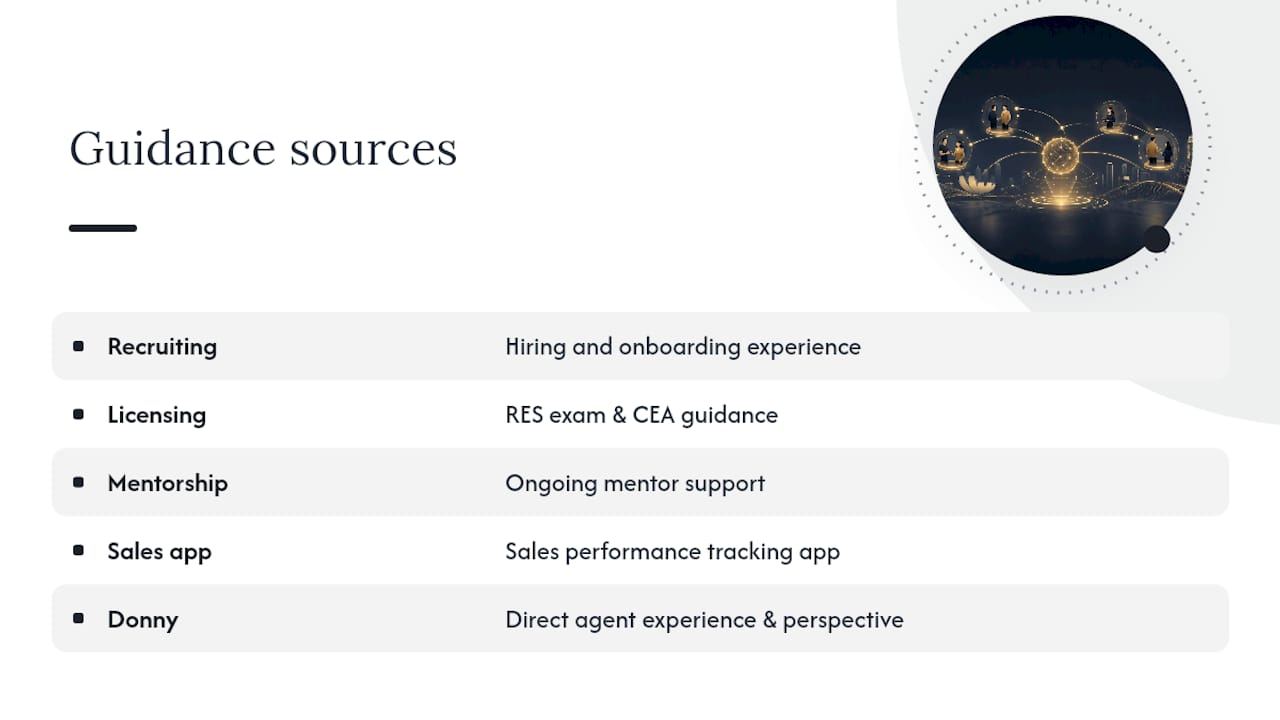
This framework draws on work recruiting and onboarding real estate agents, including guidance through the RES exam and CEA licensing requirements, paired with ongoing mentorship and a sales performance tracking app. Donny, who writes the perspective below, has worked directly with new and experienced agents navigating exactly these team-structure decisions.
For deeper reading, the CRM comparison guide covers the technology layer in more depth, while the career progression roadmap is useful for agents weighing whether to join a team, build one, or eventually lead one.
Choosing the Right Size for Your Life, Not Just Your Revenue
Bigger isn’t automatically better. Some of the highest-earning agents I’ve seen stay intentionally small because a lean team fits the life they actually want, not the org chart everyone assumes they should have. The real shift when you scale isn’t headcount. It’s your own mindset moving from doing the work to leading people who do it, and that transition trips up more leaders than any hiring math ever will. Before your next hire, ask yourself three questions: What am I the only person who can do? What’s costing me the most hours for the least return? And would I still want this team at double its current size?
— Donny
Let Myeracareer Handle Your Next Hire
Building the right team structure means nothing without the right people filling each seat, and that’s the harder half of the equation. The service offers recruitment support for finding agents who fit your model, plus ongoing training, mentorship and a sales performance tracking app to get them productive faster than a self-run onboarding process usually allows.

If you’re a new agent working through your RES exam or CEA onboarding requirements, the New Agents page walks through what support looks like from day one. If you’re already leading a team and thinking about your next hire, the Experienced Team Leaders page covers what structured recruitment and leadership support can look like at your stage. Either way, the next step is the same: reach out and talk through where your team actually stands against the models above.
Sources
FAQ
What Is the Hierarchy of a Real Estate Team?
Most teams run a two-tier hierarchy: a team leader at the top overseeing both a sales side (listing agents, buyer’s agents, ISAs) and an operations side (transaction coordinators, marketing, admin), with department heads added once the team grows past roughly 50 transactions a year.
How Does a Team Work in Real Estate?
A team pools leads, brand, and systems under one leader while individual agents handle their own client relationships and negotiations, with support staff handling paperwork, marketing, and follow-up so producers spend more time selling.
What Is the Organizational Structure of a Real Estate Team?
It splits into sales roles (rainmaker, listing specialists, buyer’s agents, ISAs) and operations roles (transaction coordinators, marketing coordinators, admin), organized into one of several models, solo+support, lead-centric, hybrid, pod, or partnership, depending on transaction volume and leadership style.
How Do You Build a Team in Real Estate?
Start by documenting your SOPs and choosing a lead-distribution method, then hire your first support role, usually a transaction coordinator, based on where your current bottleneck actually sits rather than on ambition alone. Myeracareer’s recruitment and onboarding support can help you fill that first seat with a properly trained hire.
Recommended
Comments