
6 Steps to Make Singapore Real Estate Non Compete Clauses Defensible

Singapore courts start from a firm position: a non-compete clause is presumptively unenforceable once employment ends. It only survives if it protects a genuine, provable business interest and is drafted narrowly enough to be reasonable in scope, duration, and geography. For most real estate agencies, that means a blanket non-compete is a weak bet, and a well-built non-solicitation or confidentiality clause is the safer, more defensible tool.
TL;DR:
Enforceability of non-compete clauses in Singapore relies on proving a genuine proprietary interest, often limited to trade secrets or specific client relationships.
Broad restrictions covering entire industries or all clients are typically deemed overreaching and likely to be invalid.
Restraint clauses must be carefully tailored to the actual activity, time period, and geographic area relevant to the protected interest to stand court scrutiny.
Courts tend to sever unreasonable parts of a clause rather than rewrite it, making precise drafting and clear interests crucial.
Non-solicitation, confidentiality, and negotiation-based protections often provide more reliable safeguards than broad non-compete restrictions.
Table of Contents
Is a Non-Compete Clause Real Estate Employers Can Actually Enforce?
Singapore treats every restraint of trade as prima facie void. That’s the starting line, not a technicality. An employer who wants a court to enforce a non-compete carries the full burden of proving the restriction protects a legitimate proprietary interest rather than simply keeping a former agent out of the market.
That burden is heavier than most agency principals expect. Courts have repeatedly struck down non-competes and other restrictive covenants where the employer couldn’t show anything beyond a wish to avoid competition. Simply not liking that a top producer left for a rival brokerage isn’t grounds for a restraint.
Where courts have upheld a real estate non-compete agreement, it’s almost always in a narrow trade-secret context: an agent with direct access to a proprietary valuation system, an unpublished acquisition pipeline, or a confidential negotiation strategy tied to a specific deal. General sales skill, market knowledge, or relationship-building ability picked up on the job doesn’t count. Those belong to the agent, not the agency.
What Counts as a Legitimate Proprietary Interest for a Real Estate Business?
Three categories tend to hold up in practice, and one almost never does.
Trade secrets and confidential systems count when they’re genuinely proprietary. Think a custom-built CRM architecture, an internal lead-scoring model, or a pricing algorithm the agency developed and kept locked down. Generic MLS access or a standard CEA-mandated system doesn’t qualify.
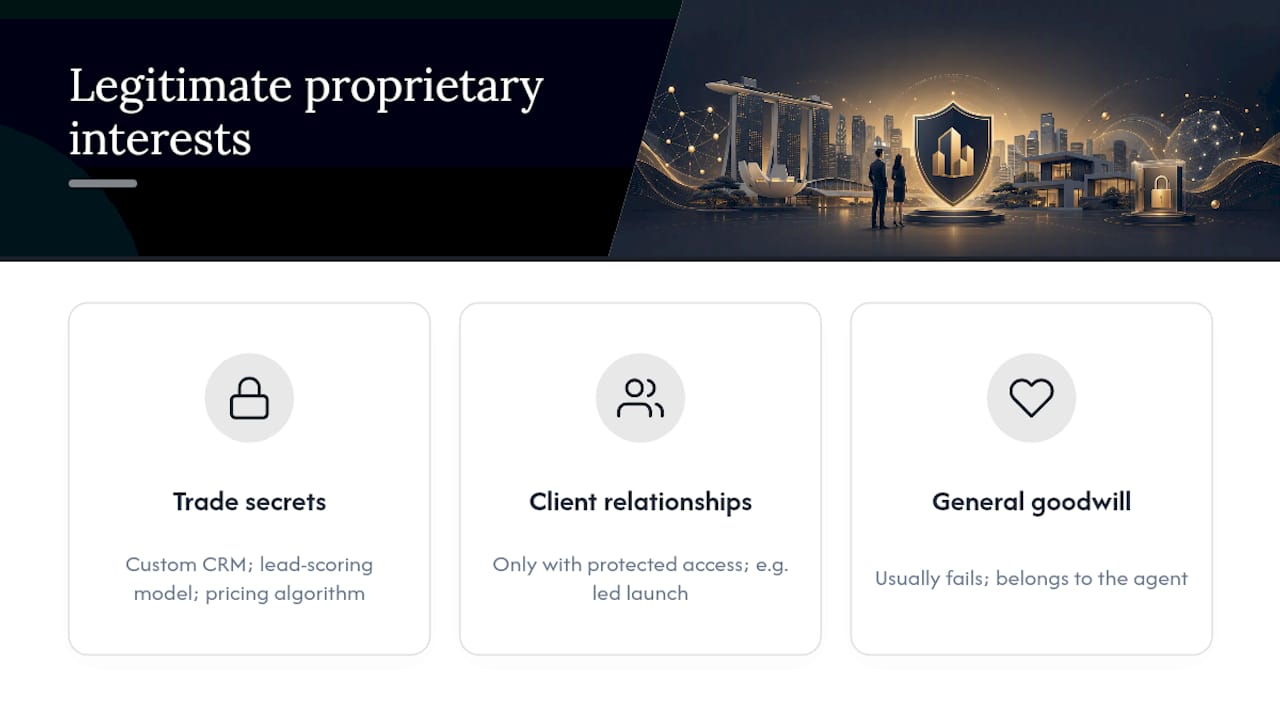
Substantial client relationships can count, but only with evidence the agent had real, protected access. A team leader who personally managed a developer’s launch portfolio has a stronger claim than a junior agent who occasionally fielded walk-in inquiries.
“General goodwill” alone usually fails. Courts have consistently found that an agency can’t claim proprietary interest for every buyer or landlord relationship a personable agent built through their own hustle. If the client followed the agent because they liked and trusted that agent, the goodwill belongs to the person, not the letterhead.
How Do Singapore Courts Test Reasonableness?
Enforceability turns on four dimensions: who is restrained, what activity is banned, how long the restraint runs, and where it applies. Fail anyone and the whole clause is at risk.
Persons restrained: limit the clause to agents who actually had access to the protected interest. A blanket clause applied to every agent in the firm, regardless of seniority or exposure, invites a court to strike it down as overbroad.
Activities restrained: name the actual conduct barred, such as soliciting a defined list of active clients or accessing a specific proprietary system, rather than a vague ban on “engaging in real estate.”
Duration: tie the restraint to the actual shelf life of the interest being protected. A typical restraint duration in Singapore agency practice is often linked to the relevant trade cycle; longer periods require strong, specific justification.
Geography: confine the restraint to the actual districts or property segments the agent worked. A restraint covering all of Singapore for an agent who only sold condos in the East Coast is a textbook overreach.
Special circumstances: courts pay close attention to mass team conversions, franchise or team assignments, and lower-paid junior agents. A junior agent on modest commission facing the same restraint language as a senior team leader is a red flag courts notice quickly.
Pro Tip: Draft the duration and geography clauses around the specific deal cycle in your market segment, not a company-wide template. A one-year, island-wide restraint might be defensible for a luxury project specialist with exclusive developer access; it would likely be excessive for a general HDB resale agent.
What Happens When a Restraint Clause Fails in Court?
Singapore courts generally take one of two paths when a clause is challenged. They may sever the offending language and enforce what remains, or they may strike the entire clause. Courts will not rewrite an unreasonable clause to make it reasonable. Severance only works where the bad language can be cut cleanly, without the court effectively rewriting the deal; where that’s not possible, judges tend to void the whole thing.
Where a valid interest exists, courts can still grant injunctions or damages, but that outcome is rare for pure non-competes in real estate. Most agencies get more practical mileage from parallel protections, like confidentiality obligations, garden-leave arrangements, or negotiated buyouts, than from fighting an uphill injunction battle over a restraint that was too broad from the start.
Drafting Checklist for Enforceable Restrictive Covenants
A defensible clause is built, not copied from a template. Before finalizing any restraint on an agent, agencies should work through this sequence:
Document the specific proprietary interest. Name the trade secret, system, or client relationship you’re protecting, in writing, before the dispute ever arises.
Limit the restrained population. Apply the clause only to agents or team leaders with actual access to that interest.
Narrow the activities barred. Describe the prohibited conduct precisely, such as contacting named clients or using specific proprietary tools.
Match duration and geography to real exposure. Set a time frame tied to how long the protected information stays valuable, and a territory tied to where the agent actually worked.
Provide clear consideration. A restraint imposed without something exchanged for it, extra commission, a signing bonus, or a defined benefit, is easier to challenge.
Add severability and assignment language. Build in a clause allowing a court to cut bad language without voiding the whole agreement, and address what happens if the agent’s team or contract is later assigned to another leader.
Pro Tip: If you’re drafting for a team that regularly gets reshuffled or converted between team leaders, pair your restraint clause with an explicit consent-to-assignment provision. Without documented consent, an assigned restraint can fail even if the original clause was sound.
Alternatives That Hold Up Better in Practice
Non-solicitation and non-dealing clauses succeed where non-competes fail because they restrict specific conduct rather than an entire livelihood. Practitioners increasingly recommend replacing broad restraints with tailored non-solicits that name protected clients or transactions directly.
Confidentiality obligations do the heavier lifting in most agency disputes. An agent can move to a competing brokerage freely; they just can’t take the proprietary database or pricing model with them.
Non-solicit clauses barring contact with specific active clients for a defined period
Non-dealing clauses preventing an agent from transacting with those clients through any channel
Confidentiality and trade-secret protections covering internal systems and pricing data
Short garden-leave periods or negotiated buyouts in place of contested restraints
Commission allocation clauses that reward loyalty commercially rather than through legal compulsion
Recent Case Law and MOM Signals Worth Watching
Judicial scrutiny of restraints has tightened in recent years, with several restrictive covenants struck down for lacking a clear proprietary interest. The Ministry of Manpower has also weighed in through parliamentary Q&A on non-competition clauses, signaling that worker mobility concerns are on the regulatory radar even without new legislation.
Agencies should treat this as a prompt to audit standing agreements now rather than wait for a dispute. Update assignment language, tighten notice provisions, and check that every restraint still traces back to a documented, specific interest.
Legislative Attention to Restraint of Trade Clauses
Singapore hasn’t passed standalone legislation specifically banning or capping non-compete clauses, unlike some jurisdictions overseas that have moved toward outright bans. The governing framework remains common-law restraint-of-trade doctrine, built case by case through the courts rather than a statute.
That doesn’t mean the landscape is static. MOM’s public engagement with the topic through parliamentary responses suggests policymakers are watching how these clauses affect worker mobility, particularly in commission-driven industries like real estate where agents often build careers around portable client relationships. If regulatory intervention comes, it’s more likely to arrive as guidance or a code of practice than an outright statutory ban, given Singapore’s general preference for judicial rather than legislative correction in employment contract disputes.
For agencies, the practical takeaway is to treat every restraint clause as a live legal risk that needs periodic review, not a document drafted once and filed away. A clause written five years ago, before recent judgments narrowed what counts as a legitimate proprietary interest, may already be out of step with how a court would view it today. Reviewing agent contracts alongside your CEA estate agency agreements is a reasonable annual habit, especially for agencies running multiple teams or absorbing agents through mergers.
Non-Competes and the Structure of Real Estate Agency Agreements
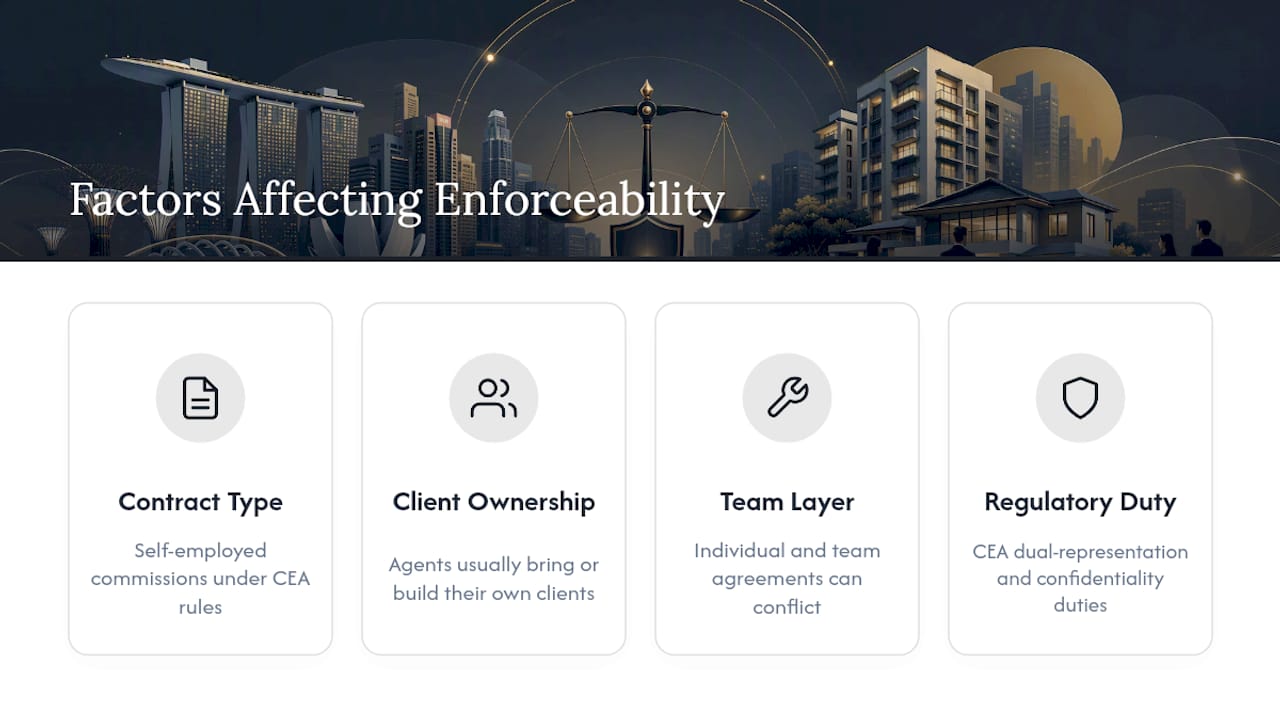
Real estate contracts in Singapore sit in a slightly different position than typical employment relationships. Most agents operate under a self-employed commission model tied to CEA-regulated agency agreements rather than a conventional employment contract, and that distinction matters for how restraints get analyzed.
A restraint of trade clause embedded in an agent’s engagement with a brokerage still gets tested under the same reasonableness framework, but courts also weigh the commercial reality that agents typically bring or build their own client base rather than being handed one by the firm. That makes proving proprietary interest even harder for agencies in property sales than in industries where employees work exclusively with employer-supplied leads.
Brokerage relationships also introduce a layer most employment contracts don’t have: team structures and co-broking arrangements. When an agent operates under a team leader, both the individual agent’s contract and the team’s internal agreement may carry restraint language, and the two don’t always align. An agent leaving a team but staying at the same agency can trigger a different set of contractual questions than an agent leaving the agency entirely, and restraint clauses drafted without that distinction in mind tend to create confusion during disputes.
Dual representation obligations add another wrinkle, since agents already carry confidentiality duties tied to their CEA dual representation rules independent of anything the agency contract says. That existing duty often does more real protective work than a poorly drafted non-compete ever could.
Mitigating Enforcement Risk as a Real Estate Professional
Agents and agencies can both reduce dispute risk with a few concrete habits, and the most effective ones focus on documentation rather than aggressive contract language.
Geographic market segmentation helps on both sides. An agency that can show an agent worked a specific, defined territory, say, a cluster of condo developments in one district, has a much stronger case for a narrow, enforceable non-solicit tied to that area than one trying to claim island-wide protection. Agents benefit from this too: documenting your actual working area protects you if a future employer tries to enforce an overly broad restraint against you later.
Client list management matters just as much. Agencies that keep clear, timestamped records of which clients were sourced through company leads versus an agent’s personal network are in a far stronger position if a dispute arises. Agents should keep their own parallel records for the same reason. When client origin is disputed after a departure, whoever has better documentation usually wins the argument, not whoever has the more aggressively worded contract.
Before signing anything, agents should also check how their agreement treats notice periods and exit mechanics, since restraint disputes almost always start at the moment of departure, not before.
Negotiating an Exit Without Losing Career Mobility
Before signing your next contract, or handing in notice on your current one, read the restraint language line by line: who it covers, what conduct it bars, and what notice obligations attach. If the clause looks broad, ask for it to be narrowed to a specific non-solicit list rather than a blanket ban, and request consideration, such as a short garden-leave payment, in exchange for agreeing to any restriction at all. A well-negotiated exit protects your income and your next move.
— Donny
Get Contract-Ready Before You Switch Teams
Some recruitment and training services offer agents support to navigate contract complexities beyond standalone legal advice. Whether you’re studying for your RES exam, onboarding under CEA licensing rules for the first time, or negotiating an exit from your current team, having a structured program behind you changes the leverage you walk into that conversation with.

New agents get the RES Course Registration and career pathway with ERA, covering exam prep and onboarding requirements from day one. Experienced agents weighing a switch can build stronger negotiating footing through #Toolkit Training, which sharpens the sales and client-management skills that make you worth negotiating for. Team leaders evaluating a bigger move should look at the PG Success Road Map for a structured framework built around leadership and growth. If you’re facing a restraint clause on your way out the door, get your career foundation solid first: start with the new agent pathway.
Primary Sources and Legal Commentary
This article is general information, not a substitute for advice from a qualified lawyer. Consult a qualified legal professional about your own circumstances before acting on anything here.
Sources
FAQ
Are non-compete clauses legal in Singapore?
Yes, they’re legal to include in a contract, but they’re presumptively unenforceable unless the employer proves the clause protects a legitimate proprietary interest and is reasonable in scope, duration, and geography.
What should I say if asked “Do you have a non-compete?” during a job move?
Answer honestly and pull your actual contract before you answer definitively. Many agents have a clause that sounds restrictive but would likely be unenforceable in Singapore, so knowing the exact wording matters more than a quick yes or no.
Can you get around a non-compete clause?
Often, yes, because most broad non-competes in Singapore don’t survive the reasonableness test courts apply. A narrowly drafted non-solicit tied to a specific client list is much harder to challenge than a blanket ban on working in the industry.
What is considered a non-compete clause?
A non-compete clause is a contractual restriction preventing someone from working for a competitor or starting a competing business for a set period after leaving a role. It differs from a non-solicit clause, which only restricts contacting specific former clients or colleagues.
Does Myeracareer help agents review contracts before switching teams?
Myeracareer focuses on training, RES exam preparation, and career onboarding rather than legal review, but its programs for experienced agents help you build the negotiating position and skill set to handle a move on stronger terms.
Recommended
Comments