
Avoid CEA Penalties: Scripts & Checklists for Singapore Agents on Inducements

No. Inducements, whether cash, vouchers, gifts, or any benefit in kind offered to win a client’s business, are prohibited under the Estate Agents (Estate Agency Work) Regulations 2010 and enforced by the Council for Estate Agencies (CEA). The prohibition covers agents, salespersons, and the estate agencies that employ them. Breach it, and you risk a letter of censure, a financial penalty, disciplinary hearings, or in serious cases, prosecution.
TL;DR:
Cash, vouchers, or gifts tied to securing or retaining a client’s business violate regulations even if requested by the client and outside lawful commission agreements.
All estate agents, salespersons, and agency leaders are responsible for preventing inducements, with violations risking penalties, disciplinary action, or license suspension.
Common inducement scenarios include cashback offers, gift cards, referral fees, or disguised discounts, often appearing as innocent marketing but breaching the rules.
Refusal and documentation of inducement requests should be clear, prompt, and kept in writing to protect both agents and clients from regulatory scrutiny.
Building a compliance-focused culture from onboarding through ongoing training helps agents avoid breaches and sustain long-term career integrity.
Table of Contents
Understanding Inducement Rules Under the CEA
The prohibition sits squarely inside the Estate Agents (Estate Agency Work) Regulations 2010, which forbids estate agents and salespersons from advertising or offering any cash or in-kind benefit designed to induce a party to engage their services. That single clause does most of the heavy lifting in Singapore’s cea compliance requirements. It doesn’t matter whether the benefit is called a “rebate,” a “welcome gift,” or a “loyalty perk.” If the intent is to sway a buyer or seller’s choice of agent through payment or gift, it falls foul of the rule.
CEA fills in the operational detail through practice circulars and the Code of Ethics & Professional Client Care, which give agents concrete examples of what crosses the line. These circulars are the mechanism CEA uses to update expectations as new tactics emerge in the market, from cashback schemes to disguised marketing credits.
The legal test for a breach generally comes down to three questions:
Was a benefit, cash or otherwise, offered or promised?
Was it connected to securing or retaining the client’s business?
Did it happen outside the properly disclosed and lawful commission structure?
If the answer to all three is yes, you have a textbook inducement. Lawful commission negotiated transparently between agent and client, as covered in buyer agent commission arrangements, is not the same thing. The distinction matters, and confusing the two is one of the most common ways well-meaning agents stumble into trouble.
Who Must Follow These Inducement Regulations In Cea
The rule applies broadly across the licensed real estate ecosystem, not just to the salesperson standing in front of the client.
Registered Estate Salespersons (RES): every individual salesperson conducting estate agency work is bound by the prohibition, regardless of transaction size.
Estate Agents (EAs): the licensed agencies themselves carry direct responsibility for the conduct of their salespersons.
Key Executive Officers (KEOs): the KEO named on an agency’s license answers for supervisory failures, including tolerated inducement practices.
Here’s the detail agents often miss: the prohibition applies even when the client is the one asking for the inducement. A buyer requesting a cash rebate for signing with you, or a seller asking for a “discount” disguised as a gift, does not create an exception. Agreeing to that request is still a breach, according to the same Estate Agents (Estate Agency Work) Regulations 2010. CEA’s licensing guidance also ties fit-and-proper standards for EAs and KEOs to how well they police this exact behavior inside their own teams, which means tolerating inducements can jeopardize an entire agency’s license, not just one salesperson’s career.
What Common Inducement Scenarios Actually Breach The Rule
Most breaches don’t look like bribery on paper. They look like ordinary marketing until you check them against the regulation.
Cashback for signing an exclusive agreement. Offering a buyer $2,000 back at closing in exchange for using you as their agent is a textbook inducement.
Vouchers or gift cards tied to listing decisions. A seller who lists with you “gets” a $500 renovation voucher. Same problem, different wrapping.
Third-party incentives. Arranging for a renovation contractor or interior designer to kick back a referral fee to the client in exchange for the listing crosses the same line.
Advertising a benefit before any transaction occurs. Even the advertisement itself, promising a reward for engaging your services, can trigger a breach before a single dollar changes hands.
Waiving legitimate fees as a disguised gift. Structuring a “discount” that has nothing to do with actual cost or service value often gets scrutinized the same way as a straight cash payment.
CEA’s enforcement toolkit runs from a formal letter of censure through financial penalties, disciplinary hearings, and, in the more serious matters, referral for court prosecution.
Enforcement in numbers: CEA publishes enforcement statistics and case summaries specifically to make the seriousness of these breaches visible and to deter repeat conduct across the industry.
The pattern in most published disciplinary notices isn’t a single dramatic bribery case. It’s small, repeated inducement offers that agents assumed were harmless marketing until CEA disagreed.
How Agents Should Refuse, Document, And Advise Clients
Refusing an inducement request doesn’t have to sound like a legal lecture. A calm, direct line works best: “I can’t offer cash or gifts tied to signing with me. What I can do is walk you through exactly how my commission and service work, so you know precisely what you’re paying for.” That framing turns a potentially awkward moment into a professionalism conversation rather than a confrontation.
Documentation matters just as much as the refusal itself. Keep records of:
Any inducement request from a client, with date and details
Your written or verbal refusal, ideally confirmed in a follow-up message
The agency agreement and disclosed commission terms, referencing the standard agency agreement forms used across Singapore transactions
Any advertising materials tied to the listing, checked against CEA’s advertising disclosure requirements
Pro Tip: Save refusal conversations in writing, even a short text message confirming you declined a rebate request. That single paper trail is often the difference between a quick dismissal and a drawn-out disciplinary review.
Presenting compliance as a strength, not a limitation, tends to land well with clients. Telling a buyer plainly that you don’t offer rebates because it protects your independence as their advocate can actually build more trust than a discount would. If you’re ever unsure whether a specific arrangement crosses the line, check the latest Estate Agents Act guidance or raise it with your agency’s KEO before acting, not after.
What Buyers And Sellers Should Watch For
Accepting a cashback offer might feel like a win, but it puts you on the wrong side of a regulatory breach too, and it can complicate a transaction if CEA later investigates the agent. Before engaging any agent, verify their registration and check for enforcement history through CEA’s licensing and ACEAS system.
If you’re offered a suspicious cash or gift incentive:
Note the date, amount, and exact wording of the offer
Keep any written communication (texts, emails, listing ads) as evidence
Report it directly through CEA’s official channels rather than relying on informal complaints
An agent’s willingness to explore genuine ways to attract buyer interest, such as the staging and presentation ideas covered by property marketing specialists, says more about their professionalism than any rebate ever could.
Building A Compliance-First Culture From Day One
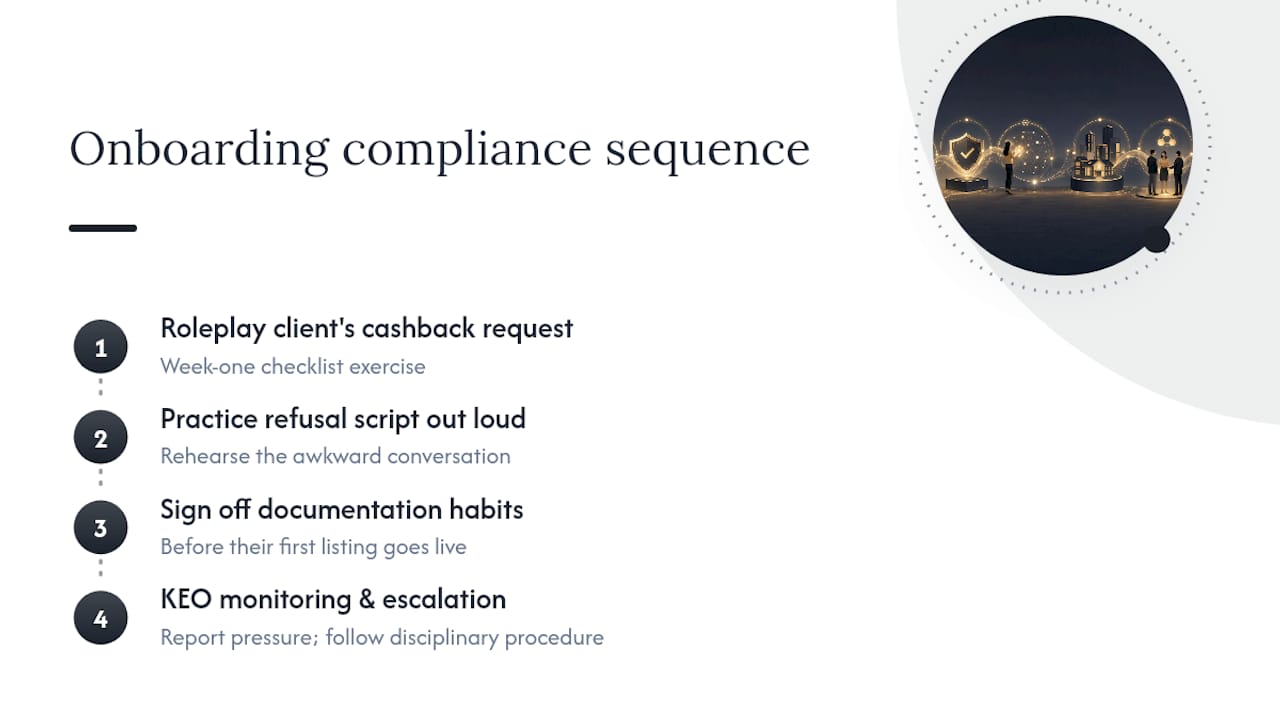
Every new RES we bring through onboarding gets a week-one checklist built around inducement scenarios: roleplay a client’s cashback request, practice the refusal script out loud, and sign off on documentation habits before their first listing goes live. That repetition matters more than any lecture. Agents who rehearse the awkward conversation early stop treating it as awkward.
Training also covers how a licensed KEO monitors team conduct and what escalation looks like when a salesperson reports pressure from a client. Pairing that structure with clear guidance on disciplinary case procedure gives new agents a real reference point instead of guesswork.
Start Your Career With Compliance Built In
Understanding how inducement rules work is only half the job. Building habits around them from your first transaction is what actually protects your license. Myeracareer’s onboarding for new agents folds this kind of compliance training directly into RES exam preparation and early mentorship, so refusal scripts and documentation habits aren’t an afterthought bolted on after a mistake. For agency leaders and team heads managing salesperson conduct across a growing roster, the experienced team leaders program builds the same governance discipline into leadership frameworks, which matters given how directly KEO oversight ties into an agency’s fit-and-proper standing.
A Note On Why This Actually Matters Long Term
Agents who cut corners on inducements rarely see the real cost until years later, when a disciplinary record follows them into every license renewal and every team they try to join. Integrity here isn’t abstract. It’s the single habit that protects a twenty-year career from a one-time bad decision. If you take one thing from this: treat every inducement request as a test of whether your business can survive scrutiny, not just whether it can close a deal.
— Donny
This article is general information, not a substitute for advice from a qualified lawyer. Consult a qualified legal professional about your own circumstances before acting on anything here.
Sources
FAQ
Are Cash Rebates To Buyers Ever Allowed Under CEA Rules?
No. Any cash or in-kind benefit offered to induce a buyer to engage an agent’s services breaches the Estate Agents (Estate Agency Work) Regulations 2010, regardless of who requested it.
What Happens If A Client Insists On An Inducement?
Agreeing to a client’s request for cash or gifts is still a breach; the rule applies even when the client initiates the request, so agents must refuse and document that refusal.
What Penalties Can CEA Impose For Inducement Breaches?
CEA can issue a letter of censure, financial penalties, disciplinary hearings, or refer a case for court prosecution depending on severity.
How Can I Check If My Agent Is Properly Licensed?
Verify registration status and enforcement history through CEA’s licensing system before signing any agency agreement.
Does Legitimate Commission Count As An Inducement?
No. Commission disclosed and agreed upfront as part of a lawful agency agreement is not an inducement; the rule targets undisclosed cash, gifts, or benefits used to win business outside that structure.
Recommended
Comments