
90 Day Real Estate Coaching Plan for Agents With Copyable Templates

A real estate coaching plan is worth the investment when it’s built around measurable KPIs and run as a focused 90-day sprint, not an open-ended subscription to pep talks. Start by setting a GCI target, running the production math backward from that number, and matching the coaching format to your experience level. Frameworks exist that provide new and growing agents with a ready structure to plug into on day one.
TL;DR:
A successful coaching plan should focus on a clear GCI goal, production math, and measurable KPIs, backed by documented processes and weekly reviews.
The coaching format must match the agent’s career stage, with one-on-one for targeted refinement, group for scaling, and leadership coaching for team roles.
Cost-effectiveness depends on whether the coaching can realistically accelerate activity and closings, calculated through the 90-day production math.
Agents must verify the coach’s experience, specific deliverables, and the presence of role-based SOPs, scripts, and KPI dashboards before committing financially.
Maintaining consistent habits like daily prospecting, weekly KPI reviews, and weekly role-play is crucial, especially within structured 90-day sprints, to see measurable progress.
Table of Contents
What Is a Real Estate Coaching Plan, and What Should It Include?
Coaching, mentoring, and training get used interchangeably, but they aren’t the same thing. Training teaches a skill once. Mentoring pairs you with someone experienced who answers questions as they come up. Coaching is different: it’s an ongoing, structured system built around your specific numbers, with accountability built into the calendar rather than left to chance.
A real coaching plan is a document, not a feeling. If your coach can’t hand you a written version of it in the first meeting, that’s worth noting before you sign anything. According to Tom Ferry’s breakdown of coaching program types, effective programs combine four elements: strategy, skills training, accountability, and performance measurement. Miss any one of those and the program tends to collapse into motivational content with no teeth.
A plan worth paying for should include:
A specific GCI (gross commission income) goal for the coaching period, not a vague “grow your business” aim
Production math connecting that GCI goal to the closings, appointments, and conversations needed to hit it
A weekly cadence, typically a one-on-one call plus a monthly alignment huddle with the broader team
Playbooks and scripts for the conversations you’ll actually have (objection handling, listing presentations, follow-up sequences)
Role success profiles that define what “good” looks like at your specific stage
A defined tech stack for tracking activity, not a spreadsheet you’re expected to build yourself
Documented processes with a set cadence do more than keep you organized. Investor Fuel’s research on real estate SOPs found that weekly one-on-ones covering priorities, key numbers, obstacles, and training gaps, paired with monthly huddles, create a feedback loop that catches problems before they become quarters of lost production.
Which Coaching Format Fits Your Career Stage?
The format matters as much as the content. An agent two years in with a lead-conversion problem needs something different from a team leader trying to design roles for a growing group, and picking the wrong format wastes both time and money.
One-on-one coaching gives you individualized accountability and a plan built entirely around your gaps. This format suits agents who know exactly where they’re stuck, whether that’s cold calling, negotiation, or time management, and want direct, weekly pressure on that specific weakness. It’s also the most expensive format per hour, so it works best when you already have a baseline of activity and need refinement rather than a complete rebuild.
Group or mastermind coaching trades some individualization for peer accountability and a lower price point. Mid-career agents who are already generating some business but want to scale their activity level often do best here, because hearing how five other agents solve the same lead-generation problem tends to surface tactics a solo coach might not think to mention. The tradeoff: your specific situation gets less airtime.
Team and leadership coaching targets a different problem entirely. If you’re a team leader or planning to become one, coaching here isn’t about your personal production. It’s about role design, standard operating procedures, and hiring. This is the format built around what Investor Fuel calls role-first documentation: building processes tied to job titles rather than the specific person currently sitting in the seat, so the business doesn’t collapse when someone leaves. Team leaders scaling from a handful of agents to a real brokerage arm should weight their coaching dollars toward this format over individual production coaching.
Online, self-paced, and hybrid programs fill the gap for agents who can’t justify the cost of live coaching yet, or who want to supplement a live program with on-demand material for slower weeks. These rarely replace live accountability entirely, but they’re a reasonable way to absorb scripts, playbooks, and foundational skills training at a lower price point.
A few quick fit checks:
New agent, first 12 months: one-on-one or a structured group program with heavy script and role-play components
Restarting after a slow stretch: one-on-one coaching with production math front and center, to rebuild activity discipline fast
Team leader: leadership or role-based coaching focused on SOPs and hiring, not personal prospecting
High-volume agent plateauing: group or mastermind coaching for fresh tactics, or a short one-on-one sprint to fix a single bottleneck
What Does Coaching Cost, and How Do You Calculate the ROI?
Coaching pricing generally falls into three structures: monthly retainers, per-session rates, and quarterly packages sold as a bundle. Monthly retainers suit agents who want ongoing accountability without re-committing every few weeks. Per-session pricing works for agents who know they need a tune-up on one specific skill and don’t want a long-term arrangement. Quarterly packages, often built around a defined sprint like the 90-day model below, tend to fit agents who want a start and end date with a measurable outcome at the finish line.
Whatever the pricing model, the real question isn’t “can I afford this,” it’s “does the math work.” Here’s the production-math approach that turns a vague coaching decision into an actual budget calculation.
Statistic Callout: A 90-day lead-generation framework built around the standard 30 to 60 day lead-to-close cycle uses a stepwise formula: your GCI goal determines how many closings you need, closings determine appointments, appointments determine conversations, and conversations determine your daily activity count. If you need a certain number of closings in 90 days and your appointment-to-close ratio runs around 1 in 3, you need about three times as many appointments. If your conversation-to-appointment ratio is roughly 1 in 5, that means several dozen conversations over the quarter, or about one a day.
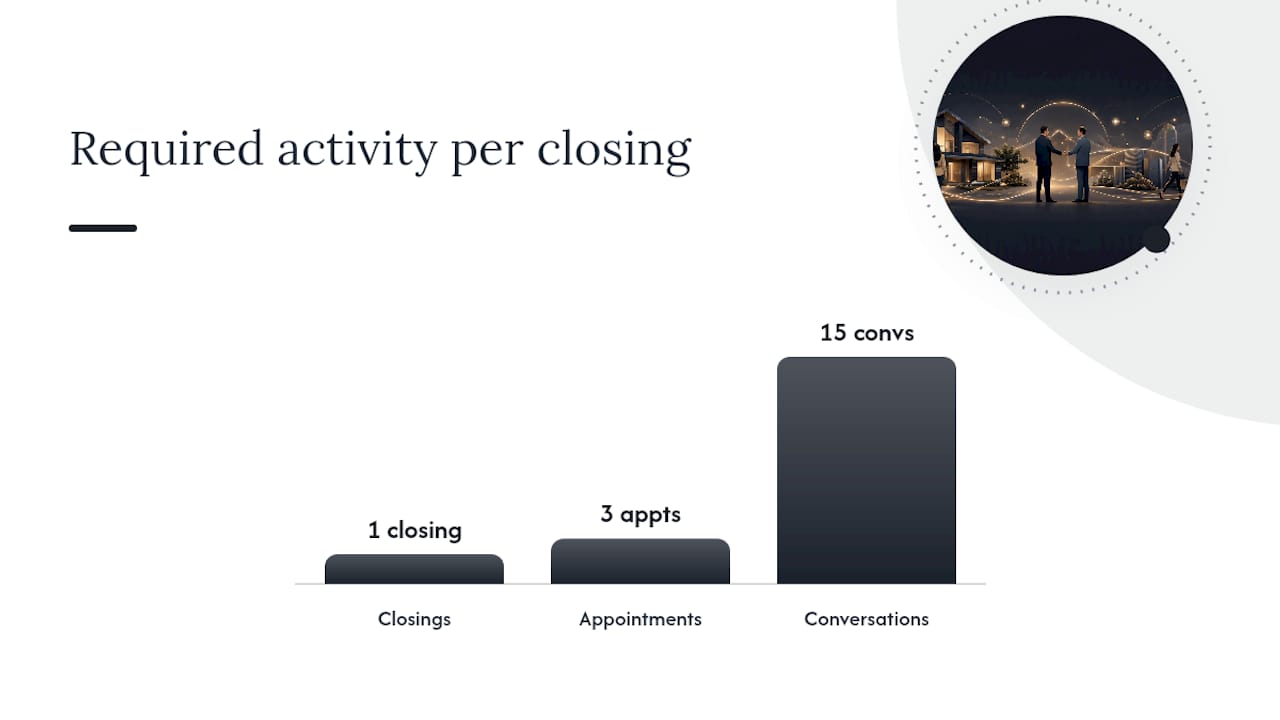
Run that math before you evaluate any coach’s price tag. A program costing several hundred dollars a month is expensive if it can’t move your conversation count, and cheap if it gets you to your GCI goal a quarter faster than you’d get there alone.
A few more things worth factoring into the ROI decision:
Expect early wins in activity metrics (calls made, appointments set) within the first 30 days; expect GCI movement closer to day 60 or 90, given the sales cycle lag
Watch conversion rate at each stage of your funnel, not just total activity, since a coach who only pushes volume without improving conversion isn’t solving the real problem
Self-study and peer accountability groups can be sufficient if you already have strong self-discipline and just need script libraries and community, but they rarely replace structured accountability for agents who’ve struggled to hit activity targets solo
How Do You Choose the Right Coaching Program?
Selecting a coach comes down to one question: can this person show you exactly how they’ll move your numbers, or are they selling you on energy and testimonials alone? Run every program through the same checklist before you commit any money.
Alignment to your goals. Does the plan start with your GCI target and back into activity numbers, or does it start with a generic curriculum everyone gets?
Format fit. Confirm the delivery model (one-on-one, group, hybrid) matches the career-stage guidance above, not just whatever the coach happens to sell.
Measurable KPIs. Ask what five to seven numbers you’ll be tracking weekly and how they map to your GCI goal.
Coach experience and track record. Ask how long they’ve coached, how many agents they currently coach, and whether they can share a case study with real names attached.
Sample week or cadence. Request an actual example of what a typical week looks like, including call length and homework between sessions.
Tech and support. Confirm what dashboard or tracking tool you’ll use, and whether support exists between scheduled calls.
Contract terms. Read the cancellation clause before you read the pricing page.
During the discovery call, ask direct questions and pay attention to how specific the answers are. “How many closings has your average client added in the first 90 days?” should get you a number or a range, not a story. “What happens if I don’t hit my activity targets in week three?” should get you a process, not a shrug. “Can I talk to two current clients?” should get you names, not a delay.
A handful of red flags mean you should walk, regardless of how polished the sales pitch sounds: vague KPIs that never get more specific than “grow your business,” no references or case studies available on request, no playbooks or scripts provided in writing, and contract terms that lock you in for a year with no exit before you’ve seen results.
On the other side, trust signals worth requiring before you pay: role-based SOPs rather than generic advice, a KPI dashboard you can actually see, real case studies with names and numbers, and either a trial session or some form of guarantee. Programs offering playbooks, scripts, and documented processes with KPI tracking consistently outperform coaching that only delivers motivational sessions with no measurable deliverable attached.
Pro Tip: Ask every coach candidate for a written sample of their weekly one-on-one agenda before you sign anything. If they can’t produce one on the spot, they’re probably building it live with you, and you’re paying tuition for their template design, not your coaching.
A Copyable 90-Day Coaching Plan You Can Run Yourself
Start with the same production math from the ROI section: pick a GCI target for the quarter, work backward to closings, appointments, and conversations, then divide that into a daily number. That single calculation should sit at the top of every week’s review for the full 90 days.
Phase 1: Days 1 to 30, foundation and baseline
Set up or clean your CRM so every contact from your sphere is logged with a follow-up date.
Reactivate your sphere of influence with a structured outreach sequence, not a mass text blast.
Launch one lead-generation channel fully before adding a second. Trying to run five channels at once in week one is how most 90-day plans die by week three.
Establish your KPI baselines: how many contacts, conversations, and appointments you’re generating right now, before any coaching intervention.
Phase 2: Days 31 to 60, conversion focus
Shift attention from lead volume to appointment conversion. If you’re generating conversations but not converting them to appointments, the problem is in your script, not your funnel.
Add a second lead channel now that the first is stable, since a short 90-day window is exactly long enough to reveal which lead sources are actually profitable before you commit real ad budget to either one.
Run weekly KPI reviews every Friday, tracking five numbers: contacts, conversations, appointments, contracts, and closings.
Role-play objection handling once a week, using a real script rather than improvising.
Phase 3: Days 61 to 90, compound and close
Double down on whichever channel is producing the best conversion, and quietly wind down whatever isn’t.
Push hard on converting appointments to signed contracts, since this is typically where agents lose the most ground in a 90-day window.
Track closings as they land, and start drafting your next 90-day sprint based on what actually worked this quarter, not what you assumed would work in Phase 1.
Hold a formal 90-day review with your coach or on your own, comparing every KPI against your original production-math targets.
Statistic Callout: A structured 90-day plan recommends protecting a daily prospecting window, ideally two or more hours before noon, and reviewing five weekly numbers every Friday: contacts, conversations, appointments, contracts, and closings. Agents who skip the Friday review tend to notice their activity has quietly dropped only after the quarter is already over.
Non-negotiables that don’t change week to week:
Protect your morning prospecting block on the calendar like it’s a client appointment, because it’s the highest-leverage hour of your day
Run the Friday KPI review even in weeks when the numbers are ugly, especially in weeks when the numbers are ugly
Role-play at least once weekly using a real objection-handling script, since winging it live with a client is a bad place to discover your script has a hole in it
Track your five weekly KPIs against a simple dashboard so trends show up before they become a crisis, and keep a written career progression roadmap nearby so the 90-day sprint connects to where you’re actually trying to go over the next few years.
How coaching plans and role-first documentation can be structured
Publisher frameworks give you a starting point instead of a blank page, and Several frameworks have been built around the structure described in this article.
If you want to run your own version of the plan above without building every document from scratch, these templates cover the gaps:
A set of coaching questions built for discovery calls and weekly check-ins, so you’re asking the right thing in week one and week eleven
A career progression roadmap that maps role success profiles across different stages of an agent’s career
A performance review template for the weekly and monthly documentation this plan depends on
A 90-day CEA-aligned coaching framework built specifically for onboarding and team leader development
The underlying principle behind all of it is role-first documentation: build the process against the job title, not the person currently doing it. That means writing a role success profile first (what this seat is responsible for, and which single KPI it owns), then following a four-stage sequence: innovate a process, prove it works over a few weeks, document it in writing, then trim it quarterly to remove whatever’s gone stale. Team leaders coaching agents using such frameworks follow a sequence to keep onboarding materials current instead of relying on outdated scripts.
Three Habits That Actually Move the Needle in the First 90 Days
Coaching plans fail less often because the content is wrong and more often because agents skip the boring parts. The production math, the weekly review, the role-play, none of it is complicated, but all of it requires doing the same unglamorous thing on a schedule.
Certain habits can help agents finish a 90-day plan with real momentum rather than ending with unused scripts. First, block your morning prospecting window and defend it the way you’d defend a listing appointment, not the way you’d defend “something I’ll get to.” Second, run the Friday KPI review even when the numbers are discouraging, since that’s exactly when the review matters most. Third, role-play once a week with a real script, because the gap between reading an objection-handling line and saying it out loud under pressure is bigger than most new agents expect.
The most common mistake isn’t picking the wrong coach. It’s picking a good coach and then treating the plan as optional the moment a slow week hits.
— Donny
Ways to help start your coaching plan
Reading a 90-day framework is one thing. Having support to build role success profiles, KPI dashboards, and weekly cadences tailored to your specific goal can help agents at every stage.

If you’re new to the industry or preparing for the RES exam, RES Course Registration and new agent onboarding walks you through licensing requirements alongside the first phase of a coaching plan, so you’re not building your CRM and studying for an exam with no structure around either. Experienced agents looking to sharpen conversion and add a second lead channel can start with #Toolkit training, which maps closely to the Phase 2 work in the 90-day sprint above. Team leaders designing roles and hiring into a growing group should look at the PG Success Road Map, built around the same role-first documentation principles covered in the frameworks section.
A discovery session typically covers your current GCI goal, a production-math calculation, and determination of which coaching format fits your career stage, similar to the groundwork outlined earlier. If you’d rather sample the training style before committing, digital training via Zoom webinar is a low-friction way to see the coaching approach firsthand before choosing a full program.
Sources
FAQ
What Is the Best Real Estate Coaching Program?
There’s no single best program; the right choice depends on your career stage and specific gap. New agents typically benefit most from one-on-one or structured group coaching with heavy script work, while team leaders need role and leadership-focused coaching, and a program like MyEraCareer’s PG Success Road Map is built specifically around that team-leader stage.
What Are the 5 C’s of Coaching?
Definitions vary across coaching frameworks, and no single version applies universally in real estate coaching. Rather than force-fitting a generic acronym, focus on the elements that actually predict results in a coaching plan: clear KPIs, cadence, accountability, documented playbooks, and coach experience.
What Is the 70/30 Rule in Coaching?
The 70/30 rule generally refers to spending most coaching time on execution and accountability, with less time on strategy and mindset work. In practice, this shows up as more time reviewing your actual weekly numbers than discussing theory.
What Are the 7 P’s of Coaching?
Like the 5 C’s, the 7 P’s framework isn’t a fixed industry standard, and different coaches define it differently. What matters more than memorizing a specific acronym is whether your coaching plan includes the concrete components covered above: a GCI goal, production math, weekly KPIs, playbooks, and a defined cadence.
How Much Does Real Estate Coaching Cost?
Coaching pricing varies by format, with monthly retainers, per-session rates, and quarterly packages all common structures in the industry. Rather than comparing price alone, run the production-math calculation from the ROI section to see whether a program’s cost is justified by the closings it would need to generate to pay for itself.
Recommended
Comments