
Mentor First for 90 Days, Then Coach: Checklist for Real Estate Agents

A mentor gives you long-term, experience-based guidance and deal-level help when you get stuck; a coach gives you structured, timeboxed accountability that changes what you actually do every day. New agents usually need a mentor first, for compliance questions and deal troubleshooting. Producing agents with a working pipeline tend to get more out of a coach. Team leaders often need both, running side by side.
TL;DR:
Mentors are usually experienced agents who provide informal, deal-specific guidance, ideal for new agents aiming to close their first few deals.
Coaches run structured, goal-oriented programs focusing on measurable KPIs, best suited for agents with an established pipeline seeking performance growth.
Mentorship tends to be unpaid and ongoing, while coaching involves paid, time-limited engagements with clear start and end points.
Combining a mentor for deal advice and a coach for pipeline systems helps high-performing agents continuously improve their overall production.
Agents should start with mentorship if they have zero to a few closed deals and consider adding coaching once their pipeline is steady and measurable.
Table of Contents
Mentor vs Coach Real Estate: The Practical Differences
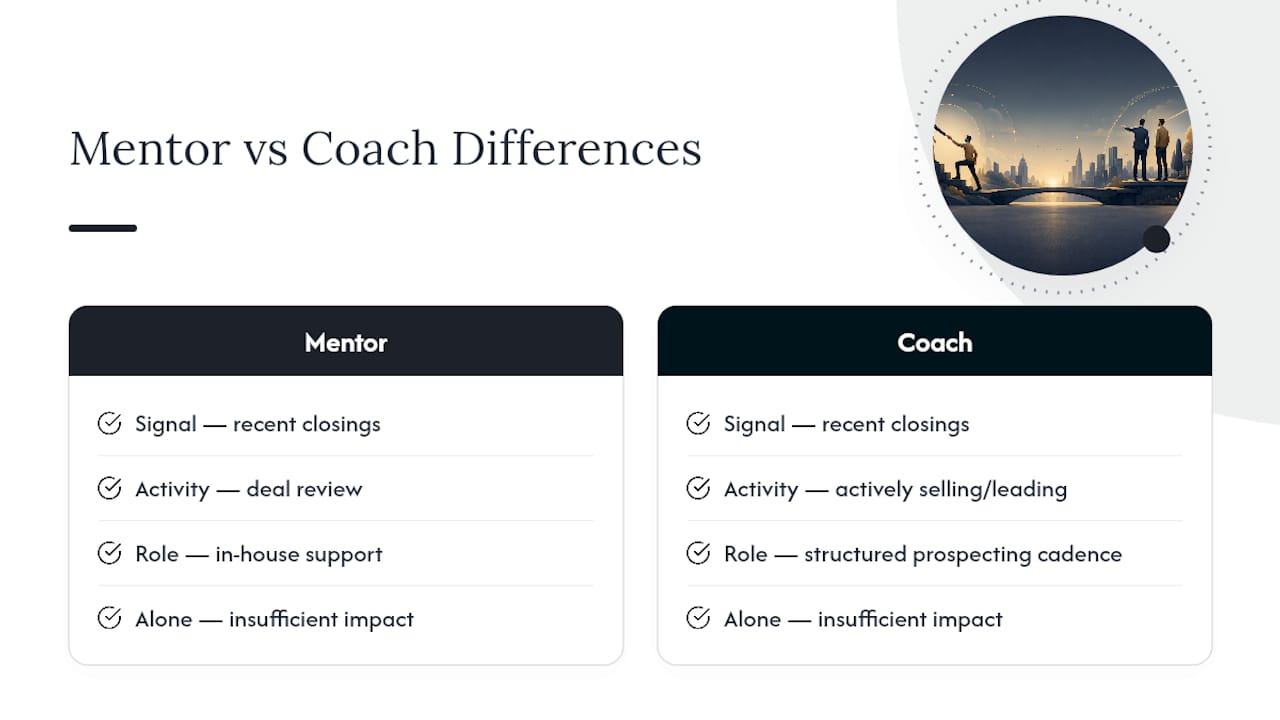
The confusion between these two roles costs agents money and time, mostly because both titles get used loosely inside brokerages. A mentor is typically a more experienced agent who shares career wisdom informally, often without a fee, and helps you work through the specific deal sitting on your desk right now. A coach runs a structured program with sessions, targets, and a defined end date, and gets paid to hold you accountable to numbers.
The distinction that matters most is behavior versus experience. Coaching changes what you do; mentorship shapes who you become as a professional, drawing on someone else’s years in the trenches, according to The Luxury Playbook. A mentor has closed deals like the one confusing you. A coach has a system for making sure you close more deals, period.
Here’s how the two roles break down across the factors that actually affect your day-to-day:
Purpose: Mentors shape long-term career judgment and problem-solve specific deals. Coaches drive short-to-medium-term performance lifts tied to measurable KPIs.
Structure: Mentoring is usually informal and ad-hoc, a phone call when you hit a wall. Coaching follows a scheduled agenda, often weekly or biweekly, with homework between sessions.
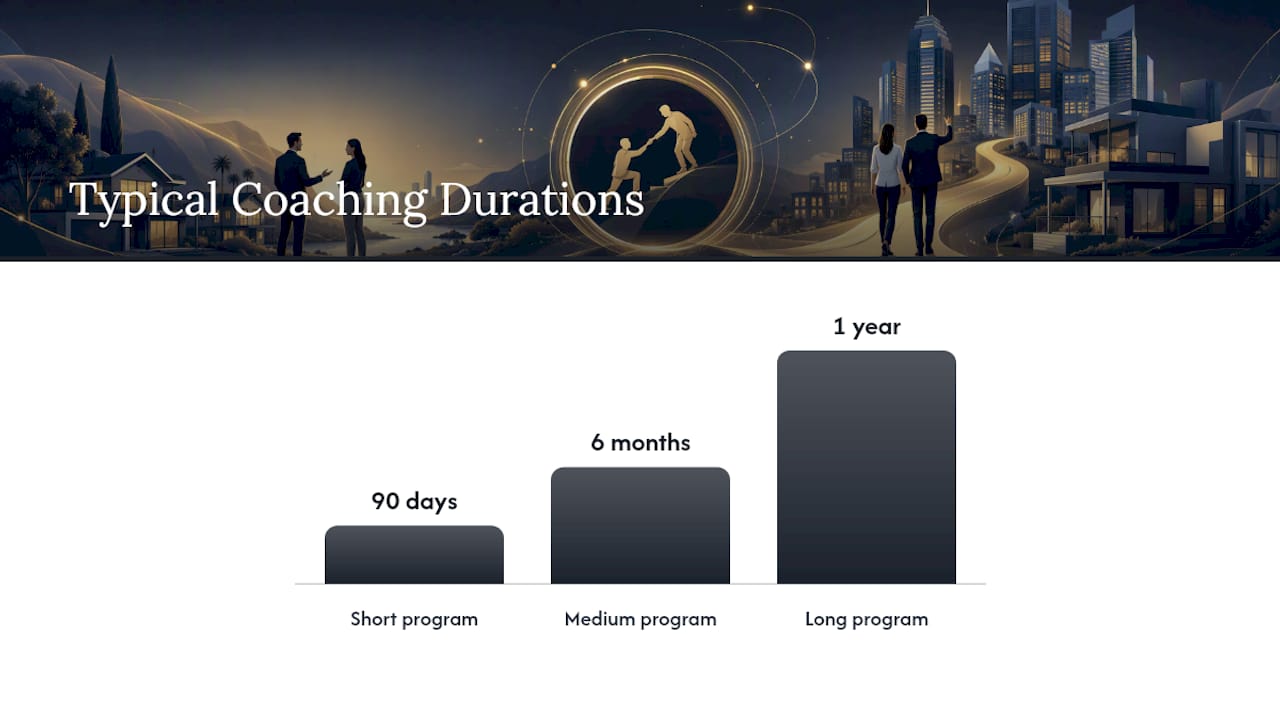
Duration: Mentorships tend to run indefinitely, sometimes for a whole career. Coaching engagements are typically timeboxed, running 90 days, six months, or a year with a clear renewal decision.
Who fills the role: Mentors are almost always agents actively closing deals in your market right now. Coaches may or may not be currently selling, but the best ones are actively leading teams or transacting, so their tactics reflect the current market rather than a playbook from a decade ago.
Cost: Mentorship inside a brokerage is frequently informal or built into your onboarding, with no separate invoice. Coaching is a paid service, and entry-level programs commonly start in the hundreds of dollars per month, according to The Luxury Playbook, with more comprehensive programs running well beyond that depending on depth and access.
Real activities: A mentor reviews a tricky contract clause, walks you through a difficult negotiation, or tells you how to handle a buyer who’s cold feet before signing. A coach audits your pipeline weekly, tracks your call volume, runs role-play on objection handling, and reviews your scorecard metrics against targets.
Coaching fees vary widely depending on program depth, group versus one-on-one access, and how much personalized pipeline review is included. Treat any published number as a ballpark, not a fixed rate, and confirm exactly what’s included before signing anything.
Training, mentoring, and coaching are three different things that often get conflated. Training changes what you know. Coaching changes what you do. Mentorship shapes who you become as a professional, based on the distinction laid out by Jamil Academy. Most agents need training first to build baseline knowledge, then coaching to install consistent execution on top of it.
How to Choose Between a Mentor and a Coach
Start with an honest look at your production baseline before you spend a dollar on either. If you don’t have a functioning pipeline yet, coaching often delivers poor return on investment because there’s nothing consistent to coach against. Mentorship, frequently available inside your own office at no separate cost, solves the more urgent problem: getting your first few deals across the finish line without a compliance misstep.
Run through this before committing to either relationship:
Check your production baseline. Zero to a handful of closed deals usually points to mentorship first. A steady pipeline with inconsistent conversion points to coaching.
Assess your coachability honestly. Coaching only works if you’ll actually do the homework between sessions. If you resist structure, a mentor’s looser format may suit you better for now.
Confirm who pays and how. Ask directly whether the brokerage subsidizes the arrangement, whether it’s a flat fee, or whether it’s tied to a revenue share on your future closings.
Ask for transaction evidence. A mentor or coach worth your time should be able to show recent deals, not just a slide deck of testimonials.
Define the exit point up front. Good coaching engagements have a stated end date and a renewal decision, not an open-ended commitment that never gets evaluated.
When you interview a prospective coach or mentor, ask pointed questions: Show me a recent transaction you handled personally. How do you measure my progress week to week? Who actually pays for this, and what happens if I don’t hit targets?
Watch for red flags. Vague, unmeasurable metrics (“we’ll build your mindset”) without a linked KPI is one. A program that exists mainly to funnel you into a specific brokerage’s recruiting pipeline, rather than to develop your skills, is another worth real scrutiny. Guarantees of a specific number of closings in a fixed window are rarely realistic and deserve a skeptical follow-up question about how that number was calculated.
Pro Tip: Ask any coach how many active listings or closings they personally handled in the last 90 days. If they can’t answer specifically, their advice is likely theoretical rather than current.
Using a Mentor and Coach Together
The strongest agents don’t pick one and abandon the other. High-performing teams commonly pair a transactional mentor, who manages deals happening right now, with a productivity coach, who focuses on building the systems that generate tomorrow’s deals, according to The Real Estate Trainer.
A workable model for a small team looks like this:
One senior agent as transactional mentor, handling contract questions and negotiation strategy as deals arise.
One coach or team leader running weekly pipeline reviews, call tracking, and habit-building sessions.
Clear role separation so agents know which person to approach for which kind of problem.
Sequencing matters here. Add a coach once you’ve established a baseline of closed deals and a repeatable process, not before. Mentorship should stay primary until that baseline exists, based on the sequencing principle from This is Real Estate. On the compensation side, teams typically fold mentoring into an override or shared-incentive structure rather than a direct fee, while coaching runs as either a salaried role or a separate paid engagement.
What Actually Separates a Good Mentor from a Good Coach
The clearest signal of a mentor worth your time is recent transaction history, not tenure. Someone who closed forty deals a decade ago and none since is a different resource than someone who closed six in the last quarter. Effective coaches share that same trait: they’re usually actively selling or leading a team right now, which keeps their tactics current rather than borrowed from a market that no longer exists.
If you’re mapping your own development, MyEraCareer’s career progression roadmap lines up each career stage with the kind of support that fits it, and the real estate coaching questions guide gives you a concrete list to bring into your next coaching conversation. One agent working through a stalled pipeline paired an in-house mentor for deal review with a structured coaching cadence for prospecting habits. Closings picked up within two quarters once both pieces were running together, not from either one alone.
What Most Agents Get Wrong
The most common mistake is hiring a coach before you have a pipeline worth coaching. Coaching personalizes to your numbers, and if your numbers don’t exist yet, there’s nothing to personalize against. One agent I’ve seen described spent months paying for a coaching program before ever closing a deal, then found more traction from a single in-house mentor in a matter of weeks. Try mentorship for 90 days first. Add coaching once your pipeline is stable enough to measure.
— Donny
How MyEraCareer Supports Both Paths
Where you start depends on where you stand. New agents preparing for licensing should begin with RES Course Registration and career opportunities with ERA, which pairs exam prep with hands-on mentorship for the deal-level questions that come up in your first year. Producing agents looking to sharpen execution have access to #Toolkit Training, a set of skill modules built to work alongside coaching once your pipeline is steady.
Team leaders managing a growing roster should look at the PG Success Road Map, a leadership framework for building the mentor-plus-coach model at scale. And if you need flexibility around your schedule, Digital Training via Zoom webinar delivers the same coaching structure remotely.

The right starting point is simple: if you’re new or still building your first pipeline, start with mentorship and onboarding support. If you’re already closing deals but want to close more of them consistently, layer in structured coaching from there. Reach out through MyEraCareer’s new agent page to find out which track fits where you stand today.
Sources
FAQ
Is a Real Estate Mentor Better Than a Coach for New Agents?
For new agents, mentorship is usually the better starting point because it addresses immediate compliance and deal-level questions without a separate fee. Coaching becomes more valuable once you have a working pipeline to personalize against, according to Jamil Academy.
How Much Does Real Estate Coaching Cost?
Entry-level coaching programs commonly start in the hundreds of dollars per month, with more comprehensive programs costing significantly more depending on access and depth, according to The Luxury Playbook. Always confirm exactly what a program includes before signing.
Can I Have a Mentor and a Coach at the Same Time?
Yes, and high-performing teams often run both together, with a mentor handling current deals and a coach building future pipeline systems, according to The Real Estate Trainer. Role clarity between the two prevents overlap and confusion.
Does MyEraCareer Offer Mentorship or Coaching Support?
MyEraCareer supports new agents through RES Course Registration paired with onboarding mentorship, and offers structured skill development through #Toolkit Training for producing agents. Team leaders can access the PG Success Road Map for building mentor and coaching structures across a team.
What Questions Should I Ask a Potential Coach Before Hiring Them?
Ask to see a recent transaction they personally handled, how they measure your progress, and who pays for the engagement. Vague answers to any of these questions are a red flag worth taking seriously.
Recommended
Comments