
3-Month Cap: CEA Estate Agency Agreements in Singapore — Map Forms 1–8

Use the Council for Estate Agencies’ prescribed estate agency agreement templates, Forms 1 through 8, for any residential sale, purchase, or lease. Sign the correct form before your agent advertises the property or arranges viewings. Commission belongs to the licensed agency named on the form, never to the individual salesperson, regardless of how well you know them.
TL;DR:
Signed prescribed forms clearly specify scope, commission, and validity periods, reducing misunderstandings and making breaches easy to prove in disputes.
Exclusive agreements have a maximum validity of three months and require mutual consent for early termination; liabilities remain even if you find a buyer independently during this period.
Commission is always paid to the licensed agency, not individual salespersons, and the agreement’s precise terms determine liability if you sell privately or breach the contract.
Non-exclusive forms allow multiple agents, while exclusive forms restrict listing to one agency, with the liability to pay commission lasting for the appointment’s entire validity period.
Using the official templates from CEA ensures standardization and enforceability, preventing disputes caused by vague or inconsistent contractual terms.
Table of Contents
Which CEA Prescribed Forms Exist and What Each One Covers
The Council for Estate Agencies publishes eight numbered templates, and the split between them comes down to one question: are you giving one agency exclusive rights, or keeping your options open?
Forms 1 to 4 are the non-exclusive versions. You can appoint multiple agents at once, and only the one who closes the deal earns commission.
Form 1: sale of residential property by the seller
Form 2: purchase of residential property by the buyer
Form 3: lease of residential property by the landlord
Form 4: lease of residential property by the tenant
Forms 5 to 8 mirror those same four transaction types but under exclusive appointments, meaning you commit to a single agency for the engagement period.
Not every deal falls under these templates. The Estate Agents (Estate Agency Work) Regulations 2010 carve out specific exclusions in the Third Schedule: commercial property, property located outside Singapore, direct developer sales, and collective (en bloc) sales don’t require these prescribed forms. If your transaction sits in one of those categories, the agency should still put terms in writing, just not on a CEA template.
Exclusive vs Non-Exclusive: Understanding the 3-Month Rule
An exclusive agreement hands one agency sole rights to market and transact your property. A non-exclusive agreement lets you work with several agents simultaneously, or even sell the property yourself without owing anyone commission.
The catch with exclusive appointments is liability. If you sign an exclusive agreement and then find a buyer through your own network during the validity period, you can still owe commission to the agency you appointed. The CEA notes that this liability runs for the full length of the appointment, which by law cannot exceed a limited period set by regulation. Agencies can renew the agreement, but each renewal restarts that validity period.
Exclusive: one agency, sole rights, commission owed even if you sell privately
Non-exclusive: multiple agents allowed, commission only to whoever closes the deal
Maximum validity: 3 months per appointment, renewable
Pro Tip: Ask your agent to walk you through what happens if you find your own buyer during an exclusive term. Under the Code of Ethics, agents are required to explain this consequence before you sign, so if they skip it, ask directly.
Key Clauses to Check Before You Sign
Every prescribed form covers the same handful of items, but the details inside those fields are where disputes actually start.
Scope of work. Don’t accept vague language like “market the property.” Insist the agent specifies advertising channels, open house frequency, and any professional photography or staging included.
Commission structure. Confirm whether it’s a percentage or flat fee, whether GST applies on top, and that the payment instruction names the licensed agency, not an individual. This detail matters more than most buyers realize; a breakdown of buyer agent commission structures shows how easily this gets misunderstood when it’s left unwritten.
Validity and renewal. Note the start and end dates and any automatic renewal clause. Some agreements include a “tail” period, protecting the agency’s commission if a buyer they introduced during the term completes the purchase shortly after expiry.
Conflict-of-interest declarations. The form requires the agent to disclose any relationship with the counterparty and prohibits representing both buyer and seller without your informed consent.
Addendums. Any extra promises, like a marketing budget or a specific listing price floor, go in the addendum space (often called the “pink sheet”). Make sure nothing there contradicts the mandatory prescribed clauses; it should add detail, not override the form.
How to Sign and Negotiate an Estate Agency Agreement
Timing is the first thing to get right; understanding when buyers should check completion and defects timelines can help you know the optimal moment to sign agreements. Sign before your agent lists the property anywhere or books a single viewing. The CEA’s guidance for consumers treats this as standard practice precisely because it removes ambiguity over what work was authorized and when.
Confirm the exact scope of services in writing, not verbally.
Lock in the commission percentage or flat fee and ask whether GST is included or added separately.
Check the validity start and end dates against your own selling or buying timeline.
Ask how expenses like professional photography or paid ad placements are billed.
Verify the agency’s name and bank account for commission payment before you ever transfer funds.
Write any additional commitments into the addendum section or a signed attachment. Never rely on a text message or verbal promise for something like a guaranteed number of viewings.
Pro Tip: Even if you’re signing with a friend or relative who happens to be your agent, use the prescribed form anyway. It converts an informal favor into an enforceable contract, which protects both sides if the deal gets complicated later.
Keep copies of every signed form and any commission receipts. If a dispute surfaces months later, that paper trail is often the deciding factor.
What to Do If a Dispute Comes Up
Start with the agency directly, in writing, and keep a dated record of every exchange. Most disagreements over commission or scope get resolved at this stage once both sides can point to the actual clause in question.
Raise the specific clause you believe was breached, not a general complaint.
CEA’s Dispute Resolution Scheme applies only when a signed prescribed agreement exists and the dispute concerns terms within that agreement.
If the agency ignores you or the amount in dispute is significant, consult a lawyer or consider Singapore’s Small Claims Tribunals, depending on the sum involved.
Regulation also works in your favor here: agents who become unable to perform the agreement for any reason are required to notify you immediately, an obligation built into the Estate Agents (Estate Agency Work) Regulations 2010.
Where to Download the Official Templates
Get the templates directly from CEA’s agreements and checklists page or the consumer-facing buying or selling page, never from a secondhand copy an agent hands you.
Form 1: non-exclusive sale of residential property
Forms 2 to 4: purchase and lease equivalents, non-exclusive
Forms 5 to 8: exclusive versions of the same four transactions
Rental checklists: separate PDFs exist for HDB and private rentals to cover landlord and immigration compliance
Each PDF includes addendum space near the end. Save a signed digital copy the moment you sign, and file it with your other transaction records.
Legal Implications of Breaching an Estate Agency Agreement
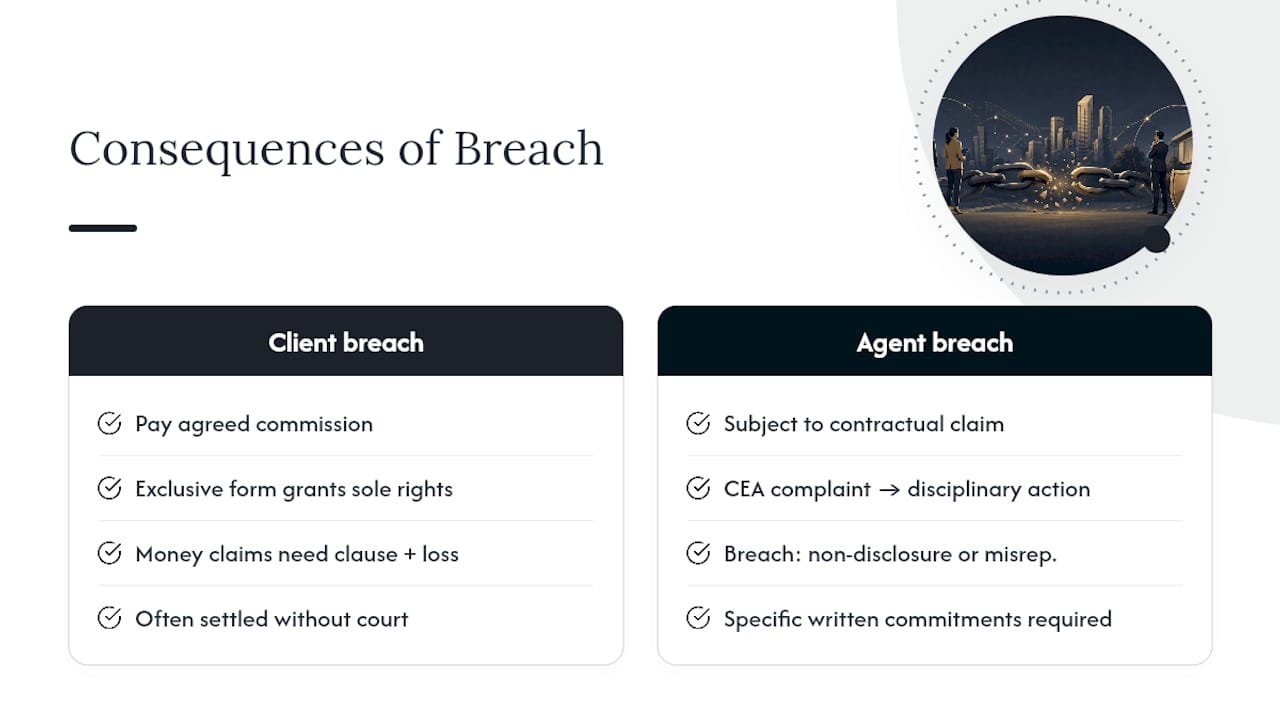
Breaching a signed prescribed agreement carries real financial consequences, and they cut both ways. If you’re the client and you sidestep an exclusive appointment, say, by accepting an offer from a buyer your own agency never introduced, you can still be pursued for the commission specified in the contract. That liability exists precisely because the exclusive form grants sole rights for the validity period, and courts generally treat a signed prescribed agreement as a binding contract like any other.
Agencies carry obligations too. If an agent fails to disclose a conflict of interest, misrepresents the scope of work, or fails to notify you when they can’t perform the agreement, that’s a breach on their end, and it can trigger both a contractual claim and a complaint to CEA about professional conduct. Agents found in breach of the Code of Ethics face disciplinary action separate from any civil claim for damages.
Where the breach involves money already paid, the injured party typically has to demonstrate the specific clause violated and any resulting loss. This is exactly why vague scope-of-work language causes so much trouble. A contract that just says “market the property” gives you almost nothing to point to if the agency does the bare minimum. Specific, written commitments are what make a breach claim actually provable.
Most disputes never reach a courtroom. They get resolved once both parties reread the clause in question and one side realizes the paper trail doesn’t support their position.
Termination Conditions and Procedures
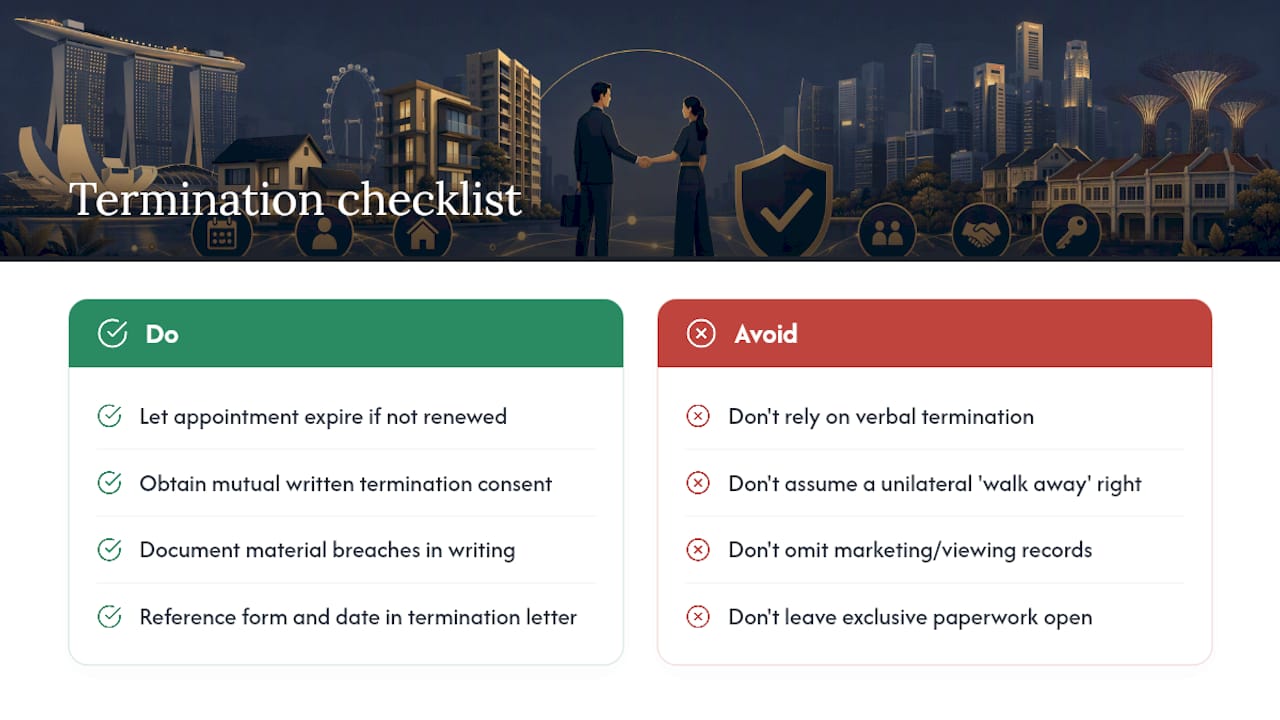
Prescribed agreements aren’t designed to be broken casually, but they aren’t permanent either. The built-in exit is time itself: every appointment, exclusive or non-exclusive, expires automatically at the end of its validity period, capped at three months for exclusives. If neither party renews, the relationship simply ends with no further obligation.
Early termination before that date is possible but needs to be handled carefully. Most prescribed forms don’t include a unilateral “walk away anytime” clause, so ending the agreement early typically requires mutual written consent from both the client and the agency. Some agents will agree to a mutual termination letter if the relationship clearly isn’t working, particularly if no marketing spend or viewings have happened yet.
Where one side breaches a material term, such as the agency completely failing to market the property as agreed, the other party may have grounds to terminate for cause rather than by mutual consent. That’s a stronger legal position than simply wanting out, and it’s worth documenting the failure in writing before declaring the agreement over.
Practically, termination should always happen in writing, referencing the specific form and date signed. Verbal agreements to “just stop working together” leave both sides exposed if a commission dispute surfaces later, especially under an exclusive appointment where liability can persist even after informal termination if the paperwork was never closed out properly.
How Singapore’s Approach Compares to Other Common Law Markets
Singapore’s system stands out for one reason: the government mandates the actual contract language through prescribed forms. In much of the United Kingdom and Australia, estate agency agreements are governed by general contract law and industry codes of practice, but agencies draft their own terms, subject to consumer protection statutes rather than a numbered template like Forms 1 to 8.
That difference matters more than it sounds. In jurisdictions without prescribed forms, commission disputes often hinge on interpreting whatever wording an agency’s in-house lawyer drafted, which varies wildly from firm to firm. Singapore standardizes the mandatory clauses, scope of work fields, and conflict-of-interest declarations, so a buyer comparing two agencies is comparing the same contractual skeleton, not two entirely different documents.
The three-month exclusivity cap is also distinctly Singaporean. Many common law markets allow exclusive listing periods of six months or longer with no statutory ceiling, leaving it entirely to negotiation between client and agency. Singapore’s shorter cap, paired with mandatory renewal rather than automatic extension, gives clients a built-in checkpoint to reassess the relationship every few months.
What Singapore shares with other common law systems is the underlying contract principle: a signed agreement is enforceable, and breach carries financial consequence. The prescribed form just removes the guesswork over what was actually agreed.
Practical Note from Career With ERA
Clear agreements prevent most of the disputes we see in this industry. When scope, commission, and validity are spelled out on a prescribed form rather than assumed, both agents and clients avoid the kind of misunderstanding that damages a deal and a reputation. Agents trained through programs like Career With ERA’s onboarding for new agents learn to walk clients through every clause before a signature happens, not after a dispute starts. Understanding these agreements from the agent’s side, including exactly how commission flows to the licensed agency, makes for a far smoother transaction on both sides of the table.
— Donny
Sources
This article is general information, not a substitute for advice from a qualified lawyer. Consult a qualified legal professional about your own circumstances before acting on anything here.
Recommended
Comments