
AI for Real Estate: The 2026 Agent's Practical Guide

AI for real estate is defined as the application of artificial intelligence technologies to property marketing, client engagement, transaction management, and market analysis. Adoption is accelerating fast. 36% of agents use AI tools weekly as of 2026, and McKinsey estimates AI could generate $110–180B in annual global value across the property sector by 2030. For agents and investors in Singapore’s competitive market, where every listing and every lead counts, understanding how to apply AI strategically is no longer optional. It is the clearest path to a stronger portfolio and a more productive career.
What are the main AI applications in real estate workflows?
Artificial intelligence in property now covers five distinct workflow lanes. Each one addresses a specific pain point agents and investors face daily.
Lead qualification. Conversational AI replaces static contact forms by capturing budget, timeline, and financing status upfront. Conversational AI intake generates 2–4x more qualified appointments than traditional forms. That means fewer wasted calls and more time with buyers who are ready to act.
Listing marketing. AI-generated property descriptions and virtual staging tools produce listing content faster and at lower cost. Listings featuring AI-assisted descriptions get 38% more saves. That is a direct impact on visibility and buyer interest.
Buyer-side search. 82% of homebuyers now use AI tools for real estate insights, preferring natural language, conversational search over keyword-based filters. Platforms like Realtor.com’s RealAssist™ guide buyers from first inquiry to closing using this approach.
Transaction coordination. AI monitors deadlines, flags missing documents, and sends automated reminders across the closing process. This reduces the administrative load that consumes hours of an agent’s week.
Market analysis. Predictive analytics and pricing AI process neighborhood trends, comparable sales, and demand signals faster than any manual method. Investors use these tools to identify undervalued assets and time their entry or exit with greater confidence.
Pro Tip: Start with one workflow lane, not all five. Agents who try to automate everything at once rarely see strong results in any area.
How does agentic AI differ from generative AI?

Generative AI produces content on demand. You give it a prompt, and it writes a listing description, drafts an email, or summarizes a report. That is genuinely useful, but it is also passive. You still manage the workflow around it.
Agentic AI operates differently. Agentic AI automates multi-step workflows and monitors complex tasks independently, without requiring a prompt for every action. It handles CRM follow-ups, schedules showings across multiple calendars, runs compliance checks, and tracks transaction deadlines. The agent sets the parameters once, and the system executes.
“Agentic AI is not a futuristic concept. It is a growing industry standard that enables autonomous, multi-step workflows to enhance agent productivity in ways generative AI alone cannot achieve.”
Here is how the two types compare in practice:
Generative AI use case. You ask the tool to write a property description for a three-bedroom unit in Buona Vista. It produces a polished draft in seconds. You review and publish.
Agentic AI use case. After a lead submits an inquiry, the system qualifies the lead through a conversational intake, updates your CRM, schedules a viewing, sends a confirmation, and flags the lead’s financing status for your review. All of this happens without you initiating each step.
Compliance monitoring. Agentic AI tracks regulatory deadlines and flags documents that need signatures or updates, reducing the risk of costly errors in high-volume transactions.
Calendar coordination. Agentic AI deployment can coordinate showings across multiple agent and client calendars, often deployable in under 15 minutes of setup.
The practical implication is significant. Agentic AI expands your capacity for long-horizon tasks. You can manage more clients, more listings, and more complex transactions without adding headcount.
What practical steps should agents take to implement AI?
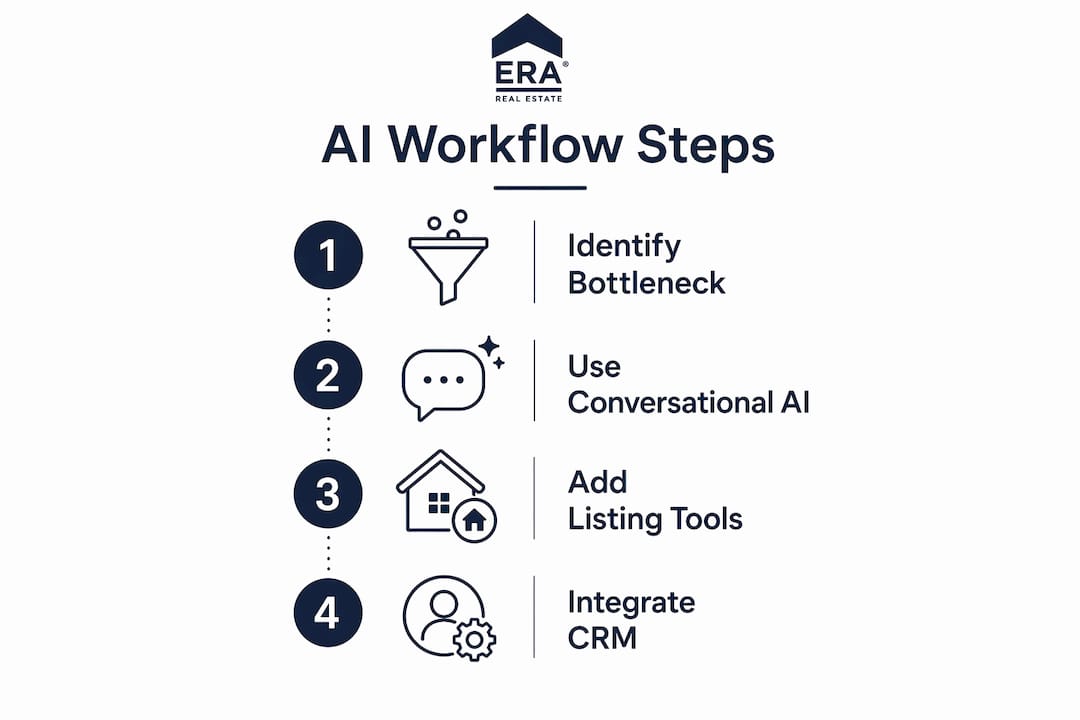
The most common mistake agents make is buying an AI tool before identifying the specific bottleneck it needs to solve. Most agents who purchase AI tools without mapping their workflow first see slow returns and low adoption. The fix is straightforward: identify your biggest pain point first, then match the tool to it.
Step 1: Map your workflow bottleneck
Ask yourself where you lose the most time or the most leads. Is it the first contact stage, where unqualified inquiries consume your mornings? Is it listing content, where you spend hours writing descriptions? Is it transaction admin, where deadlines slip because no one is tracking them? Your answer determines where AI delivers the fastest return.
Step 2: Prioritize conversational AI for lead intake
Replacing contact forms with conversational AI is the single biggest near-term revenue opportunity for most agents and brokerages. It captures buyer intent that static forms discard. A conversational intake can reduce lead triage time from 15-minute phone calls to under three-minute asynchronous chats, while collecting more detailed information.
Step 3: Layer in listing and CRM tools
Once lead intake is working, add AI-generated listing content and CRM automation. These two layers compound the gains from better lead qualification. You spend less time writing and following up, and more time in front of qualified buyers.
Workflow area | AI tool category | Expected outcome |
Lead intake | Conversational AI intake | 2–4x more qualified appointments |
Listing content | AI writing and virtual staging | 38% more listing saves |
CRM follow-up | Agentic AI automation | Fewer missed follow-ups |
Market analysis | Predictive analytics platforms | Faster, data-driven pricing |
Transaction admin | Deadline and compliance AI | Reduced closing errors |
Pro Tip: Top-performing agents run 2–4 specialized AI tools matched to their workflow, not one all-in-one suite. Specialized tools outperform generalist platforms in every workflow category.
What are the benefits and limitations of AI for agents and investors?
AI changes the agent’s role more than it threatens it. AI cannot replace licensed agents in high-stakes negotiations or relationship-driven decisions. What it does is remove the manual, repetitive work that prevents agents from doing what they do best.
Benefits for agents:
AI automates lead triage, freeing agents to focus on qualified buyers and active negotiations.
AI-generated listing content and virtual staging reduce marketing production time significantly.
CRM automation maintains consistent follow-up without manual effort, improving client retention.
Real estate data analytics tools surface pricing trends and comparable sales faster than manual research.
Benefits for investors:
Predictive analytics identify neighborhoods with rising capital growth potential before the broader market reacts.
Seller identification tools flag motivated sellers based on behavioral and financial signals.
Portfolio analysis AI models net worth scenarios across multiple properties, supporting long-term planning.
Property management AI offers strong ROI for landlords managing 50 or more units by triaging maintenance and tenant requests at scale.
Limitations to understand:
AI tools require clean, connected data. Disconnected IDX, MLS, and CRM systems reduce accuracy and limit automation.
Regulatory complexity in markets like Singapore means AI-generated compliance outputs still need human review.
AI supplements expert judgment. It does not replace the licensed expertise required for contract negotiation, valuation disputes, or client trust.
The clearest way to think about it: AI handles the volume work, and you handle the judgment work. That division produces better outcomes for both clients and your business.
Key Takeaways
AI for real estate delivers the strongest returns when agents match specialized tools to specific workflow bottlenecks rather than adopting broad, all-in-one platforms.
Point | Details |
Lead intake is the top priority | Conversational AI generates 2–4x more qualified appointments than static contact forms. |
Listings with AI content perform better | AI-assisted descriptions produce 38% more saves, directly improving listing visibility. |
Agentic AI expands agent capacity | Multi-step automation handles CRM, scheduling, and compliance without manual prompting. |
Specialized tools outperform suites | Top agents run 2–4 focused AI tools matched to their specific workflow gaps. |
Human expertise remains non-negotiable | AI automates volume tasks; licensed judgment drives negotiations and client relationships. |
My honest view on AI and the future of real estate careers
I have watched a lot of agents approach AI the same way they approach a new property listing app: they download it, play with it for a week, and then abandon it when it does not immediately produce results. That is the wrong frame entirely.
AI is not a shortcut. It is a capacity multiplier. The agents I have seen gain real competitive advantage from machine learning real estate tools are the ones who spent time understanding their own workflow first. They knew exactly where they were losing leads, where they were spending too many hours, and where their clients were getting a slower response than they deserved. Then they matched a tool to each of those gaps.
The fear that AI will replace agents is understandable, but it is misplaced. What AI actually does is raise the floor for every agent who uses it well. Your clients get faster responses, better-researched recommendations, and more consistent communication. You get more time for the conversations that actually close deals.
My advice is to resist the pull of flashy, all-in-one platforms that promise to do everything. Start with conversational AI for lead intake, because that is where the revenue impact shows up fastest. Then build from there. Treat AI adoption the same way you treat portfolio building: deliberate, incremental, and anchored to a clear goal.
The agents who will look back on 2026 as a turning point are the ones who started experimenting now, not the ones who waited for a perfect solution.
— Donny
ERA agents are already using AI to grow their business
ERA’s approach to agent development puts real technology in your hands from day one. Whether you are building your first client base or managing a high-volume portfolio, the tools and training available through Myeracareer are designed to match the way the market actually works in 2026.

New agents at ERA get structured guidance on integrating AI tools into their workflow from the start, so they build good habits before bad ones form. Experienced agents gain access to advanced market analytics and agentic AI resources that support higher transaction volumes without adding overhead. If you are ready to build a career where technology works for you rather than around you, Myeracareer is where that career starts.
FAQ
What is AI for real estate?
AI for real estate is the use of artificial intelligence technologies to automate and improve property marketing, lead qualification, market analysis, and transaction management. It covers tools ranging from conversational lead intake to predictive pricing analytics.
How does AI improve lead generation for agents?
Conversational AI replaces static contact forms and captures budget, timeline, and financing status upfront, generating 2–4x more qualified appointments. It also reduces lead triage time from 15-minute calls to under three-minute chats.
What is agentic AI and how does it differ from generative AI?
Generative AI produces content when prompted. Agentic AI executes multi-step workflows autonomously, handling CRM updates, scheduling, compliance checks, and deadline tracking without requiring a new prompt for each action.
Are there limitations to using AI in real estate?
AI cannot replace licensed expertise in negotiations, valuations, or complex client relationships. It also requires clean, integrated data across IDX, MLS, and CRM systems to function accurately.
How many AI tools should a real estate agent use?
Top-performing agents typically run 2–4 specialized AI tools matched to their specific workflow bottlenecks, rather than one all-in-one platform. Specialized tools consistently outperform generalist solutions in each workflow category.
Recommended
Comments