
Notice Period for Property Agents in Singapore: A Switching Guide
- donnylee532
- 1 day ago
- 4 min read

Your notice period is not set by the Council for Estate Agencies. It’s set by whatever you signed with your estate agency. The CEA has no mandatory notice period for RES resignations, full stop. Instead, CEA runs ACEAS (Advanced CEA Estate Agencies System) to process two very different things: switching agencies or canceling your registration entirely. A complete switching application typically takes two to three weeks to clear. If you’re an employee under a contract of service rather than a commission-only associate, the Employment Act sets statutory minimum notice tied to your length of service, and that floor applies regardless of what your contract says.
Start by pulling out your associate agreement and finding the notice clause. Then put your resignation or transfer intent in writing to your current EA.
Pro Tip: Never submit a cancellation application when you actually mean to switch. Cancelling your RES registration by mistake can force you through re-registration later, while a switching application preserves your continuity.
Key Takeaways
Your notice period is a contract matter, not a CEA rule, and getting the ACEAS timing right matters more than the notice length itself.
Point | Details |
Check your contract first | Notice length comes from your associate agreement, not from CEA rules. |
Switch, don’t cancel | File a switching application through ACEAS if you intend to keep working; cancellation is only for leaving the industry. |
Plan around a few weeks | Build ACEAS processing time into your move so you’re not caught mid-transition during a Renewal Exercise period. |
Know your statutory floor | If you’re under a contract of service, Employment Act notice minima apply regardless of what else your contract says. |
Get onboarding support | ERA helps agents prepare complete ACEAS submissions and handover plans for a switch with minimal disruption. |
Table of Contents
ERA’s Best Practices for Resigning or Switching Agencies
Timing beats speed; for agents planning their career timing, understanding Singapore property market trends can help map your move strategically. Map your move against ACEAS processing windows and the annual Renewal Exercise before you hand in notice, not after. The 2025 exercise required switching submissions by September 30 to start clean with a new EA on January 1, 2026, and late filings risked missing that window entirely.
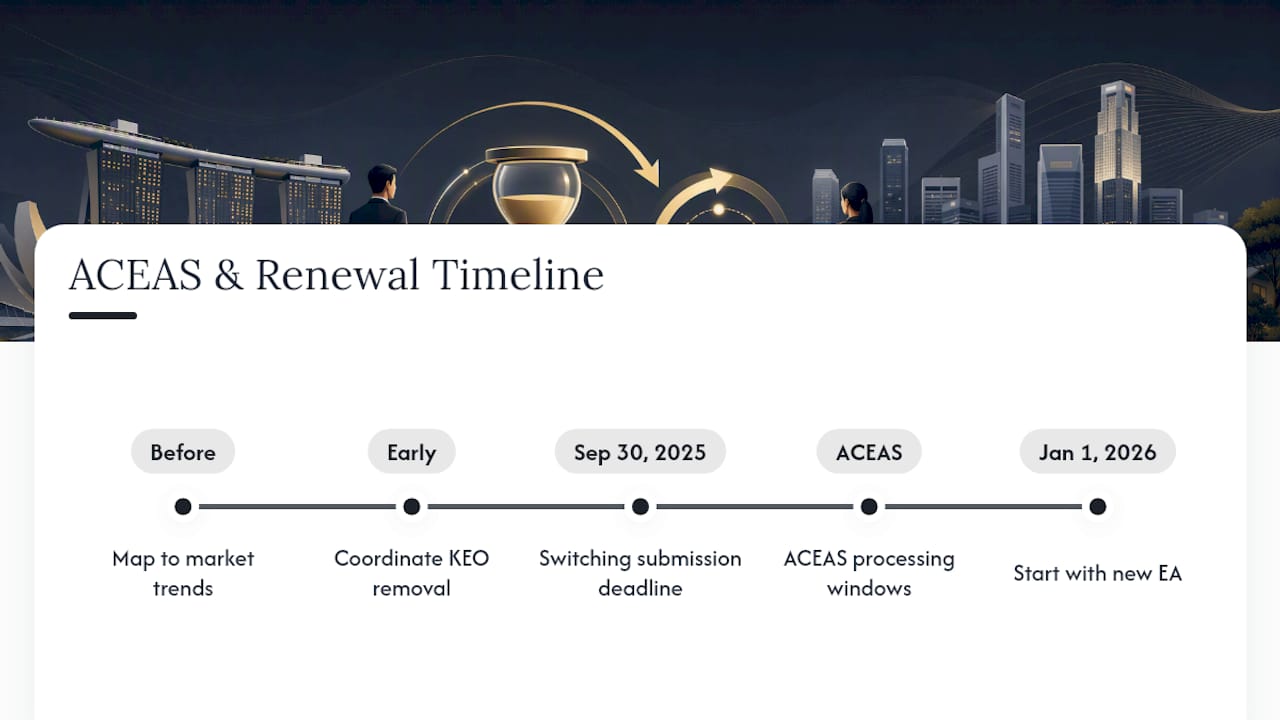
Put everything in writing and keep copies. Agree on a handover plan for active listings, document outstanding commissions before you leave, and confirm who owns which client relationships going forward. If you hold a Key Executive Officer role, coordinate KEO removal with your EA’s admin team early. Those processes run on separate ACEAS timelines than a standard salesperson switch, and they can take agencies by surprise if raised too late. Most agreements allow room to negotiate notice length when both sides act professionally.
How ERA Helps Agents Switch Safely
Switching agencies without a plan is how agents end up with a registration gap, a stalled deal, or a scramble during renewal season. ERA works with agents through exactly that transition, offering ACEAS switching guidance, onboarding checklists, and handover frameworks built around the two to three week processing window CEA outlines.

That means help preparing complete documentation before submission, so your application doesn’t stall on a missing form, and advice on timing your move around the Renewal Exercise so you’re not left unable to practice while approval is pending. Whether you’re new to the industry or an experienced salesperson weighing a switch, ERA’s new agent and experienced agent resources cover onboarding, mentorship, and the practical side of moving your registration without losing momentum on active deals. If you’re planning a switch, reach out through ERA’s experienced agents page to talk through your timeline before you give notice.
Resources to Confirm Before You Submit
Before filing anything, verify the current rules directly rather than relying on secondhand summaries.
CEA’s switching estate agent page confirms current processing times and required documents.
The cancellation of salesperson registration page explains when cancellation applies versus switching.
CEA’s renewal of salesperson registration page lists current Renewal Exercise dates and cutoffs.
The Employment Act’s notice of termination provisions set statutory minimums for agents under a contract of service.
CEA’s estate agent licensing matters page covers KEO removal and EA notification duties.
ERA’s experienced agents page and RES exam guide cover onboarding and re-registration if you’ve been away from the industry.
Keep a dated copy of every ACEAS submission and every email you send your EA. If a processing delay ever gets disputed, that paper trail is what protects you.
Frequently Asked Questions
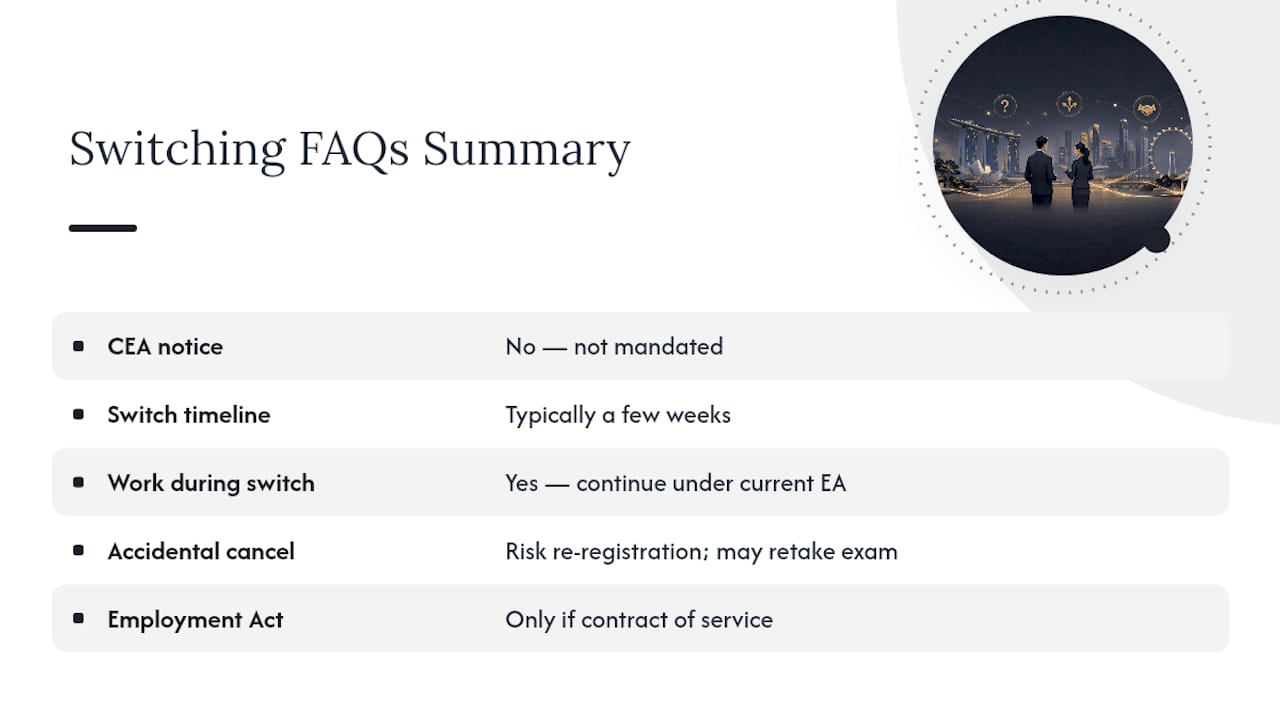
Does CEA require a minimum notice period for real estate agents? No. CEA does not mandate a notice period for RES resignations. Your notice length is whatever your signed associate or employment agreement specifies.
How long does switching agencies actually take? A complete ACEAS switching application typically processes in a few weeks. Incomplete submissions or missing documents extend that timeline.
Can I keep working while my switch is being processed? Yes. You can continue practicing under your current EA while CEA processes your switching application, and CEA notifies both agencies once it’s approved.
What happens if I submit a cancellation instead of a switch by mistake? You risk having to re-register as a new RES later, including retaking the exam if you’ve been out of the industry long enough. Always confirm you’re filing a switch, not a cancellation, if you intend to keep working.
Does the Employment Act override my contract’s notice period? Only if you’re employed under a contract of service, in which case the Act’s statutory minimum applies as a floor. Most commission-based associate agreements aren’t structured this way, so check your specific arrangement.
This article is general information, not a substitute for advice from a qualified lawyer. Consult a qualified legal professional about your own circumstances before acting on anything here.
Sources
Recommended
Comments