
Listing Presentation Real Estate: Singapore Agent Guide


A winning listing presentation must accomplish three things inside a single appointment: establish a defensible price backed by real data, demonstrate a concrete marketing plan with visible examples, and close with a clear next step. Recruiters and sellers alike judge your readiness by how confidently you do all three.
TL;DR checklist:
Meeting length: 30–60 minutes, with slide delivery in 15–20 minutes
Three recruiter-facing trust signals: CEA registration displayed, URA-backed comps, and ERA Sales+ app or Myeracareer training referenced
Recruiter expectation: clarity on pricing, visible marketing examples (photo/video), and a clear next step — sign or set a firm follow-up
Table of Contents
What a professional listing presentation looks like and the ideal meeting flow
Comparative Market Analysis: the analytical heart of your presentation
Visual marketing that wins: photos, video, floorplans and where to show them
Handling common seller objections and how to ask for the listing
Tools, templates, and training resources for Singapore agents
What hiring managers actually look for in a candidate’s listing presentation
ERA and Myeracareer: training and Sales+ onboarding for new agents
Useful Singapore sources, templates, and links to keep on hand
A perspective on what actually separates strong listing presentations from forgettable ones
What a professional listing presentation looks like and the ideal meeting flow
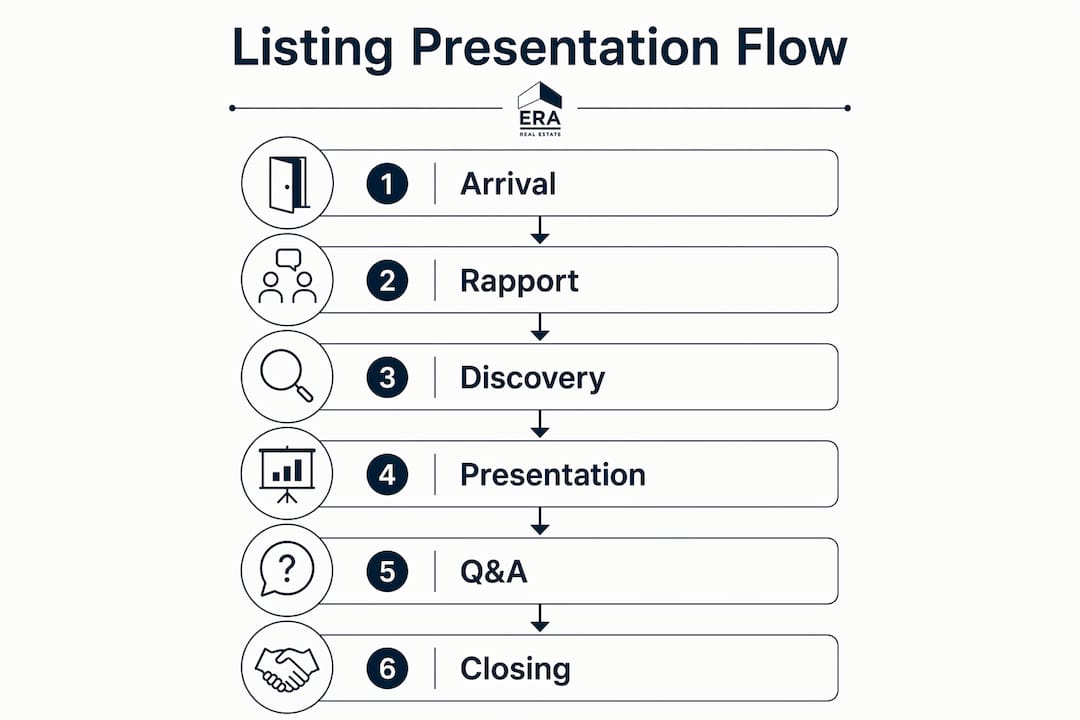
A well-structured appointment follows a deliberate sequence, not a freestyle pitch. Arrive five minutes early, spend the first ten minutes on discovery, then move into your slide deck.
Phase | Time | Purpose |
Arrival and rapport | — | Build trust, observe the property |
Discovery questions | 5–15 min | Understand seller priorities and timeline |
Price recommendation | 5–10 min | Lead with CMA-backed range early |
Marketing plan | — | Show visual assets and portal strategy |
Q&A and objections | — | Address concerns with data |
Listing agreement | 30–60 min | Ask for the signature or set follow-up |
Delivery formats matter in Singapore’s market. In-person with a printed deck works well for older sellers who prefer tangible materials. A tablet or laptop suits younger HDB upgraders who respond to embedded video. For overseas sellers or those in a time crunch, a Zoom session with a live-shareable link keeps comps current up to the meeting.
Pro Tip: Treat the deck as a guide, not a script. Top-performing agents listen more than they speak — discovery questions before the slides reveal what the seller actually cares about, and that shapes which slides you linger on.
Comparative Market Analysis: the analytical heart of your presentation
The CMA is the data foundation of every effective listing presentation. Arriving without one signals inexperience; arriving with a short, annotated visual comparison signals analytical credibility.
CMA build checklist for Singapore:
Pull 3–6 sold comparables from URA caveats within the past six months, same district, similar floor area (within 10%)
Adjust for floor level, facing, renovation condition, and tenure (freehold vs. leasehold)
Calculate price per square foot for each comp and note days on market
Compute the sale-to-list ratio to show how close sellers achieved their asking price
Present a defensible price range, not a single number, with a brief written rationale
Display your CEA registration number on the CMA cover page — it confirms you are a licensed professional
Statistic callout: A short, visual CMA with annotated adjustments is scanned and trusted more readily than a long spreadsheet. Compact, evidence-first formatting respects the seller’s time and keeps the conversation on strategy, not data overload.
Use PropertyGuru and 99.co to show active-listing context alongside your sold comps. Sellers want to know where their home sits relative to current competition, not just past sales.
Visual marketing that wins: photos, video, floorplans and where to show them
A strong marketing plan is the most common reason sellers choose one agent over another. Pricing establishes credibility; marketing wins the listing.

Asset | Why it matters | Singapore note |
Professional photos (HDR) | First impression on portals | Required for PropertyGuru and 99.co featured listings |
Video walkthrough | Increases inquiry volume | Drone footage permitted with CAAS approval |
3D virtual tour | Reaches overseas buyers | Effective for Sentosa Cove units |
Floorplan with dimensions | Reduces unqualified viewings | Mandatory disclosure for HDB resale listings |
Neighborhood map | Contextualizes amenities | MRT proximity is a key buyer filter in Singapore |
Show actual examples in your deck, not promises. Bring before/after photo samples from past listings, short video clips, and screenshots of social posts with real reach numbers. Listings with video and 3D tours receive substantially more inquiries than photo-only listings.
Pro Tip: Include a simple one-page budget format showing what you cover (professional photography, portal listings) versus what the seller may optionally contribute (staging, drone). Transparency here builds trust before the commission conversation.
Pre-meeting preparation: what to send 24–48 hours before
Send your pre-listing packet 24–48 hours before the appointment. Sellers who review background materials arrive at the meeting ready to discuss strategy, not introductions, which means the appointment becomes about signing rather than explaining.
Pre-listing packet contents:
Short agent bio with CEA registration number and license class
One-page CMA summary with 3–5 sold comps and a price range
Marketing one-pager showing your portal strategy (PropertyGuru, 99.co) and visual asset examples
Proposed timeline from listing launch to expected offer review
Walk-through checklist: items you will need access to (utility bills, title deed, renovation records)
Seller research checklist before you arrive:
Ownership history and estimated outstanding loan (check URA caveats)
Likely motivation: upgrade, downsize, relocation, or investment divestment
On-the-ground notes from a pre-walk or video tour of the building and surroundings
Active competing listings in the same development or street
If you send the packet as a trackable digital link, you can see who opened it and how long they spent on each page. That intelligence shapes which slides you emphasize.
Slide-by-slide sample deck you can copy
A 15–20 slide deck, delivered in about 15–20 minutes, leaves room for discovery and Q&A inside a 30–60 minute appointment.
Slide | Content | Time |
1 | Cover: property address, agent name, CEA number | 30 sec |
2–3 | Agent credentials and ERA affiliation | 1 min |
4 | Singapore market snapshot (URA price index, recent volume) | 1 min |
3–6 | CMA: 3–5 sold comps with adjustments and price range | 4 min |
10 | Active competition (current listings on PropertyGuru/99.co) | 1 min |
11 | Price recommendation and net-proceeds estimate | 2 min |
12–13 | Marketing plan with photo/video examples and portal placement | 3 min |
— | Staging recommendations | 1 min |
15 | Timeline: listing to offer review | 1 min |
— | Communication plan (weekly updates, showing feedback) | 30 sec |
— | Testimonials or sold case studies | 1 min |
— | Listing agreement and next steps | 30 sec |
Print slides 5–11 as a one-page CMA handout the seller can keep. Keep slides 12–13 digital so embedded video plays. For virtual delivery, share your screen and use a live-shareable link so comps stay current up to the meeting.
How to present pricing, fees, and a realistic timeline
Lead with pricing in the first 5–10 minutes. Sellers who hear the price recommendation early stay engaged with the rest of your plan; those who wait for it spend the entire deck wondering.
A simple net-proceeds layout for Singapore transactions:
Item | Amount (SGD) |
Recommended list price | Seller’s target range |
Less: agent commission (negotiated) | Deducted from proceeds |
Less: legal fees (estimated) | Deducted from proceeds |
Less: outstanding loan (if any) | Deducted from proceeds |
Estimated net proceeds | Balance to seller |
Statistic callout: Agents who introduce pricing within the first ten minutes of the appointment consistently report stronger seller engagement through the marketing and process sections that follow — the price anchors the conversation.
For the timeline, a typical Singapore resale transaction runs: listing launch → photography within 3 days → live on PropertyGuru and 99.co within 5 days → open houses in weeks 1–2 → offer review at 3–4 weeks. HDB transactions carry additional timelines tied to HDB approval, so flag that clearly.
On commission: be transparent and direct. A phrase that works well is, “My fee reflects the full marketing package I just showed you — professional photography, portal placement, and dedicated follow-up. Here is exactly what that covers.”
Handling common seller objections and how to ask for the listing
Acknowledge first, then reference a specific comp or marketing example. Generic reassurance loses credibility; a named comparable wins it.
Common objections and reframes:
“Your price is too low” — Return to the CMA adjustments and show the sale-to-list ratios of recent comps
“Your commission is too high” — Walk through the marketing budget slide and the net-proceeds estimate
“We want to wait” — Show current active competition and days-on-market trends from URA data
Closing checklist:
Confirm the seller’s top priority (price, speed, or certainty)
Restate your recommended price range and the rationale
Outline immediate next steps: photography date, staging walkthrough, portal go-live
Present the listing agreement and ask directly
Pro Tip: Ask for the listing immediately after covering price and marketing — not at the very end after Q&A. Confidence in the ask signals confidence in the plan.
Tools, templates, and training resources for Singapore agents
Recruiters expect you to name the tools you use, not just describe what you do.
Tool categories and Singapore-relevant resources:
CMA and market data: URA’s e-Caveats portal for transaction history; CEA’s Public Register to verify your own registration and display it credibly
Presentation builders: Canva or PowerPoint for slide decks; ERA-provided templates through the onboarding program
Photography and video vendors: Engage a licensed drone operator (CAAS-approved) for aerial shots; use Matterport-compatible cameras for 3D tours
Portal placement: PropertyGuru and 99.co for active-listing context and buyer reach evidence; both platforms offer agent dashboards showing listing performance
CRM and follow-up: ERA’s Sales+ app integrates CMA workflows, marketing collateral generation, and client follow-up tracking in a single platform
For new agents, the ERA onboarding program covers pre-listing packet templates, CMA workflows, and marketing collateral standards. CEA’s mandatory continuing professional development (CPD) courses also cover ethical marketing and disclosure obligations relevant to listing presentations.
Key Takeaways
A professional listing presentation wins listings by leading with a URA-backed price recommendation, demonstrating visible marketing collateral, and closing with a clear, immediate next step.
Point | Details |
Price first, always | Introduce your CMA-backed price range within the first 5–10 minutes to anchor seller engagement. |
CMA from primary sources | Use URA caveats and CEA-registered data for 3–6 sold comps; adjust for floor, facing, and tenure. |
Show marketing, don’t promise it | Bring actual photo samples, video clips, and portal screenshots — evidence beats generic claims. |
Send the pre-listing packet early | Deliver your packet 24–48 hours before the appointment so sellers arrive ready to decide. |
Myeracareer and ERA Sales+ | ERA’s Sales+ app and onboarding templates give new agents a recruiter-ready CMA and marketing workflow from day one. |
What hiring managers actually look for in a candidate’s listing presentation
When I review a candidate’s mock listing presentation, the first thing I check is whether their CEA registration is visible on the deck cover. It takes five seconds and signals that the agent understands compliance from the start.
The second check is the CMA. A candidate who pulls three URA comps, adjusts for floor level and tenure, and presents a price range with a rationale demonstrates analytical discipline. A candidate who quotes a round number without data shows they are guessing.
Soft skills matter just as much. I watch for whether the candidate listens during the discovery phase or rushes to the slides. Agents who treat the deck as a guide rather than a script tend to adapt to the seller’s actual concerns, and that adaptability is what converts appointments to signed listings.
The checklist I use mentally during a mock presentation:
CEA number displayed on slide one
Price recommendation delivered within the first ten minutes
At least one concrete marketing example (photo, video, or portal screenshot)
Transparent commission conversation without defensiveness
Clear ask for the listing before leaving the room
Same-day follow-up summary with price range, timeline, and deck link promised
Candidates who check all six are ready to list on day one.
ERA and Myeracareer: training and Sales+ onboarding for new agents
Knowing the framework is one thing. Walking into a listing appointment with a polished, recruiter-ready deck on your first week is another — and that gap is exactly where ERA’s onboarding closes the distance.

Myeracareer’s ERA onboarding program maps directly to every skill covered in this guide: pre-listing packet templates, CMA workflows built on URA data, marketing collateral standards, and the Sales+ app that integrates all of it into a shareable deck you can produce before the appointment. New agents get access to ERA’s library of proven slide templates and case studies, so you are not starting from a blank slide on your first listing appointment.
For agents ready to build a team and scale listing workflows, the experienced team leader pathway provides leadership frameworks and performance tracking tools that extend these skills across an entire team.
If you are preparing for your RES exam or ready to be recruited, start your ERA career and get access to the Sales+ app, onboarding templates, and mentorship from day one.
Useful Singapore sources, templates, and links to keep on hand
Resource | What it provides | Where to access |
URA e-Caveats | Transaction history for sold comps | ura.gov.sg |
CEA Public Register | Agent license verification and CPD records | cea.gov.sg |
PropertyGuru | Active-listing context and buyer reach data | propertyguru.com.sg |
99.co | Portal placement and listing performance dashboard | 99.co |
ERA onboarding templates | Pre-listing packet, CMA, and slide deck templates | myeracareer.com/newagents |
ERA experienced agents | Case studies and marketing collateral standards |
A perspective on what actually separates strong listing presentations from forgettable ones
Most agents spend the bulk of their preparation time on slide design. The agents who consistently win listings spend it on evidence: actual sold comps with adjustments, real marketing examples from past campaigns, and a net-proceeds estimate the seller can verify. The deck is just the container.
There is a tendency among new agents to defer the price recommendation until the end of the presentation, as if building suspense creates buy-in. It does the opposite. Sellers who wait thirty minutes for the number spend those thirty minutes skeptical of everything before it. Lead with price, back it with URA data, and the rest of the presentation becomes a confirmation of your competence rather than a defense of it.
The cultural dimension in Singapore is worth naming directly. Sellers here respond to evidence-first communication, clear timelines, and respectful directness. Ambiguity on pricing or commission reads as evasiveness, not politeness. State your recommendation clearly, show your reasoning, and trust the data to carry the conversation.
The agents I have seen grow fastest are those who treat every listing appointment as a structured argument, not a personality contest. The personality matters, but it is the argument that gets signed.
Recommended
Comments