
0–100 Lead Scoring Rubric for Agents and Recruiters in One Week

Lead scoring for agents works by ranking every buyer, seller, and recruiting prospect on their real probability of closing soon, so your calendar reflects priority instead of chronology. The fix is a points-and-grades rubric: assign points for readiness and behavior, sort leads into A/B/C tiers, and call your A-grade leads before anything else each morning. Below is the exact structure to build it, adapt it for recruiting, and automate it in your CRM.
TL;DR:
Most teams see significant improvements in conversion rates and reduced cost-per-appointment by prioritizing top-scoring leads within five minutes of crossing the A threshold.
Linking automated data sources such as website activity, email responses, and pre-approval status ensures lead scores stay current and relevant.
For recruiting, signals like experience, engagement with content, and responsiveness carry higher weights than behavioral signals used for property leads.
Regular monthly review of closed deals and KPIs like conversion rate and time-to-first-contact helps recalibrate scoring weights and maintain accuracy.
Compliance requires explicit consent and limited data storage, with sensitive lead information stored securely and purged after a defined decay period.
Table of Contents
Copyable Points-Based Scoring Rubric Agents Can Implement This Week
How to Score Recruiting Leads: Signals, Weights, and Routing
Automation and Wiring: Capture Signals and Trigger Actions in Your CRM
Measure and Recalibrate Monthly: KPIs and When to Reweight Signals
Privacy and Compliance Considerations When Collecting Lead Data
What Does Lead Scoring for Agents Actually Do?
Lead scoring for agents converts a messy contact list into a ranked queue, and the ranking is what changes outcomes. Teams that call top-scored leads first, instead of working leads in the order they arrived, see conversion climb on their top-tier segments and cost-per-appointment drop, according to Ranksquire’s lead scoring architecture guide. That gap exists because attention is finite. Every minute spent chasing a cold lead is a minute a hot one sits unanswered, and in residential real estate, a hot lead goes cold fast.
The standard industry term for this is predictive lead qualification, though most brokerages just call it “lead scoring.” Whatever you call it, the mechanics are the same: score readiness signals heavier than casual browsing, decay the score over time, and route by grade rather than gut feel.
Copyable Points-Based Scoring Rubric Agents Can Implement This Week
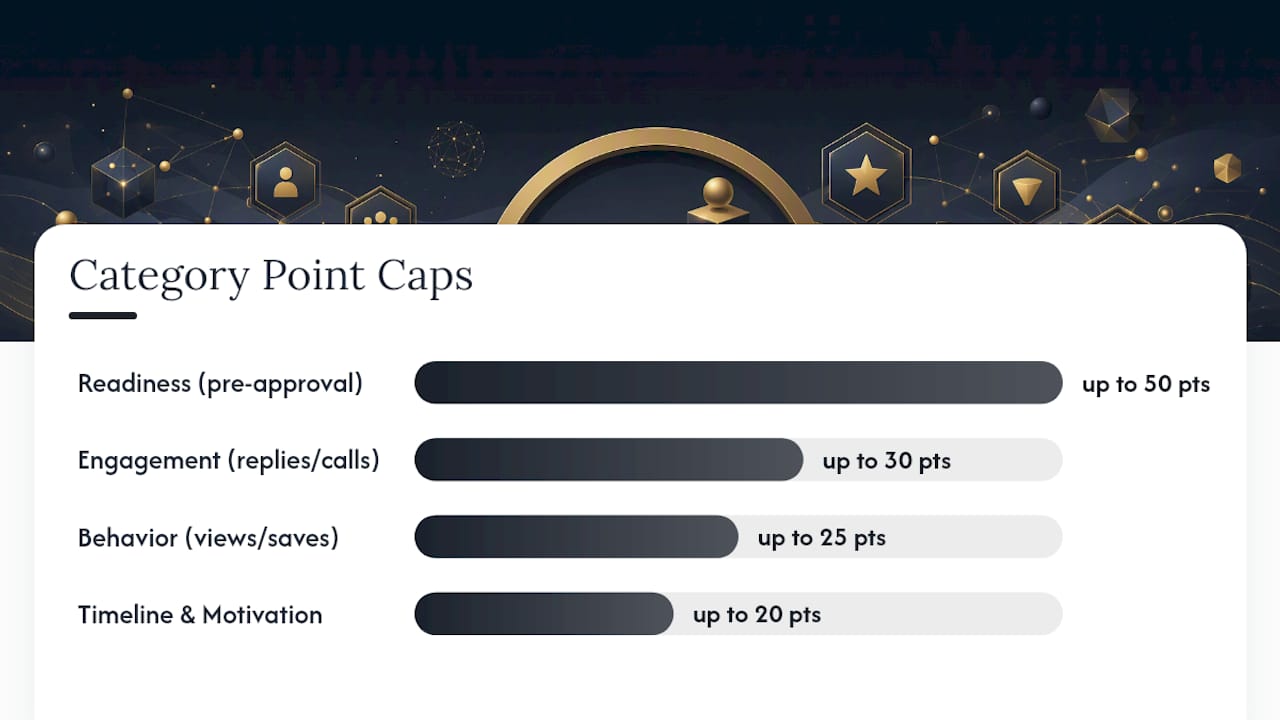
Build your rubric around four signal categories: readiness, behavior, engagement, and recency. Readiness signals, like a verified pre-approval letter or a stated move-in timeline, predict near-term transactions far better than demographic data ever did, and verified pre-approval should carry the heaviest single weight in your model according to US Tech Automations’ intent-scoring framework. Behavioral signals, like repeat listing views and saved searches, come next. Engagement, meaning replies and booked calls, rounds out the model.
Here’s a workable 0 to 100 scale broken into rough category caps: timeline and motivation up to 20 points, engagement up to 30, behavior up to 25, and readiness (pre-approval) able to swing up to 50 on its own in some frameworks, per rAIn Automation’s lead prioritization model. Adjust the caps to fit your market, but keep pre-approval as your anchor signal.
Signal | Example Points | Why It Matters |
Verified pre-approval | 30–50 | Strongest predictor of a near-term closing |
Stated move timeline (under 60 days) | 15–20 | Confirms urgency, not just interest |
Repeat listing views (3+ in a week) | 10–15 | Shows narrowing focus, not casual browsing |
Saved search or favorited listings | 5–10 | Signals intent to keep shopping seriously |
Replies to agent outreach | 10–15 | Confirms the lead is reachable and responsive |
Booked a showing or call | 15–20 | Highest-intent action short of an offer |
Grade the total: a high score range corresponds to an A grade, a middle range corresponds to a B grade, and lower scores correspond to C grade. Call your highest-grade leads first, work mid-grade leads by end of day, and drop lower-grade leads into a drip campaign rather than a phone queue. Build in decay too: subtract 10 points after 14 days of silence and another 15 after 30, per the decay logic in US Tech Automations’ guide. Without decay, a lead who went cold three weeks ago keeps hogging your morning call list.
How to Score Recruiting Leads: Signals, Weights, and Routing
Recruiting leads don’t behave like property leads, so scoring them the same way misreads the prospect entirely. A licensed agent browsing your career page twice in a week is a much stronger signal than a first-time visitor filling out a generic form, because experience level and career-page return visits predict readiness to switch teams better than the behavioral signals you’d track for a buyer.
Build your recruiting rubric around these categories:
Experience and production history (up to 30 points): years licensed, transaction volume, current brokerage size.
Career-page and content engagement (up to 20 points): repeat visits to your recruiting pages, downloaded compensation guides.
Event and webinar attendance (up to 15 points): RSVPs to recruiting events, attendance at info sessions.
Responsiveness (up to 25 points): how fast a prospect replies to recruiter outreach, whether they book a call unprompted.
Stated dissatisfaction or timeline (up to 10 points): explicit comments about wanting more support, training, or leadership.
Grade the same way, A at 70 plus, and route A-grade recruiting leads straight to a senior recruiter for a same-day call. MyEra Career’s own agent scorecard metrics give recruiters ready-made weight templates so teams don’t have to build this from scratch, and pairing that with a recruiting strategy built around engagement signals tends to fill a roster faster than generic outreach.
Automation and Wiring: Capture Signals and Trigger Actions in Your CRM
A rubric only works if the data feeds itself. Manually re-scoring leads every night is how good systems die within a month.
Connect these sources so signals update automatically:
Website or listing portal — track page views, saved searches, and showing-request clicks.
CRM contact record — store every score, grade, and timestamp centrally.
Email and SMS platform — log opens, replies, and click-throughs as behavioral points.
Showing-scheduling tool — flag booked or completed showings as high-value readiness signals.
Pre-approval or mortgage-partner integration — auto-add readiness points the moment a lender confirms approval.
Set a rule that fires a call task the instant a lead crosses the A threshold, so no human has to notice the score change manually. Automated capture and nightly decay are what keep a scoring model honest instead of drifting stale, a point echoed in rAIn Automation’s breakdown of lead prioritization. A tool like AgentWrite can also template your first-touch messages so the moment a lead crosses into A-grade, the outreach goes out with consistent, personalized copy instead of a generic blast.
Pro Tip: Store the “score reasons,” not just the score itself. When a lead hits 82 points, log which signals fired, pre-approval, two showings, a fast reply, so you can coach agents on which conversations actually moved the needle, not just tell them the number.
Operational Playbook: Morning Triage, Routing, and SLAs
Scoring only matters if it changes what agents actually do at 8 a.m. Build your day around the grade, not the inbox.
Morning triage: call every A-grade lead first, before checking email or prepping listings.
Afternoon sweep: work B-grade leads by end of business day, batched by neighborhood or specialty.
Overnight drip: C-grade leads go into automated nurture, no live call required until they re-score.
Assignment rules: route by geography or property type first, then by score, so the right specialist gets the hottest lead in their zone.
Override authority: agents can bump a lead’s grade manually, but must log why, so the reason feeds next month’s calibration.
Set explicit SLAs: call A-grade leads within five minutes when a live rep is available, and within 24 hours for B-grade. Track SLA adherence as a coaching metric alongside conversion rate, not as a separate compliance checkbox. A practical guide to prioritizing Singapore property leads walks through how one team structured this daily rhythm without adding headcount.
Measure and Recalibrate Monthly: KPIs and When to Reweight Signals
Run a monthly review against closed-deal history, not gut feel. Pull every lead that closed in the last 30 days and check what grade it carried when it converted. If a chunk of your closings came in as B or C leads, one of your weights is miscalibrated.
Track three KPIs by grade: conversion rate, average time-to-first-contact, and cost per appointment. Teams that consistently call top-scored leads first report conversion gains on their top segment and lower cost-per-appointment than teams working leads in arrival order, according to Ranksquire’s guide to lead scoring models.
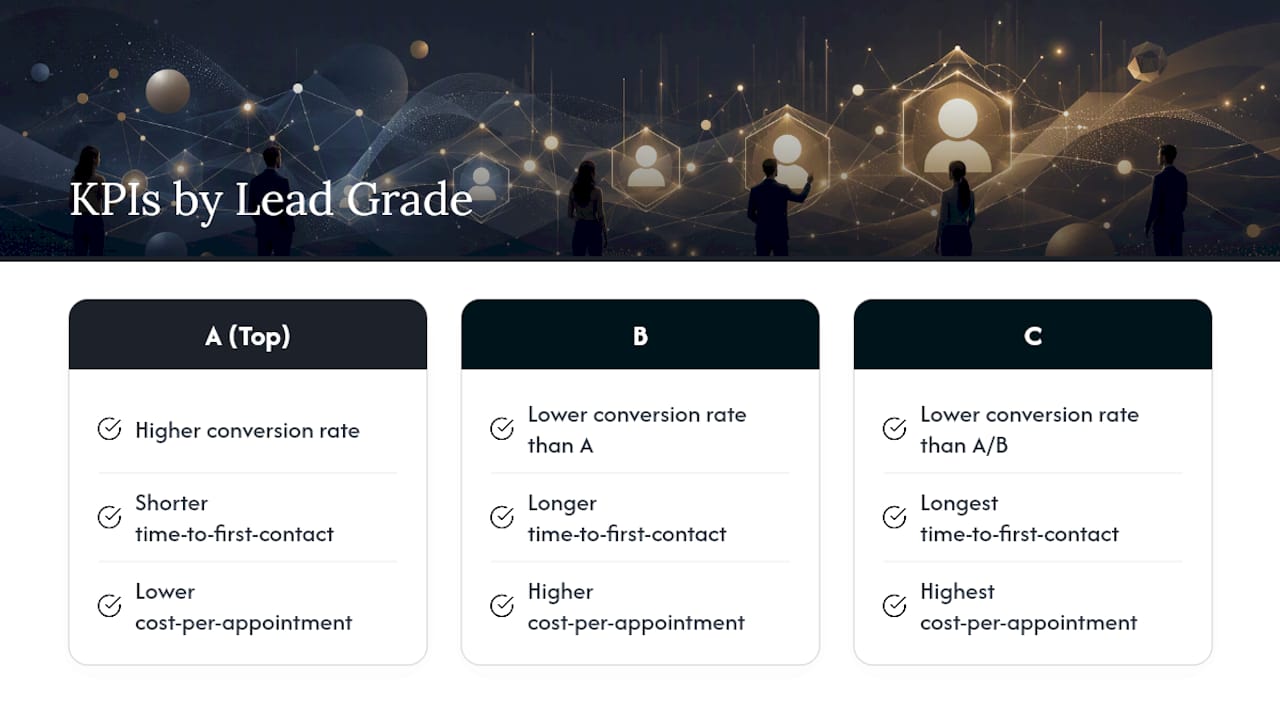
Statistic in context: cost-per-appointment tends to fall specifically because agents stop spending call time on leads unlikely to convert, not because lead volume changes.
If your top three signals (usually pre-approval, timeline, and behavior) aren’t tracking with real closes after two full months, adjust their point values before adding anything more complex. Most brokerages never need a predictive AI layer. A well-tuned rule-based rubric, reviewed monthly against a sales pipeline tracker, covers the vast majority of what a machine-learning model would add.
Privacy and Compliance Considerations When Collecting Lead Data
Every signal in your rubric, page views, showing requests, pre-approval status, is personal data, and collecting it carries real obligations. Before you wire up automated capture, confirm your CRM and marketing platforms have explicit consent language covering how lead behavior gets tracked and stored, not just a generic privacy policy buried in a footer.
Store only what you actually use for scoring. A pre-approval letter’s dollar amount might matter for routing, but keeping full financial documents in a general CRM field creates risk without adding scoring value. Strip or restrict access to sensitive fields, and limit who on your team can see raw contact data versus just the score and grade.
Recruiting leads deserve the same discipline. A prospective agent’s current production numbers or brokerage details are sensitive career information, and treating that data casually, forwarding it in unsecured email threads, for instance, can damage trust before a recruiting conversation even starts.
Set a data retention rule tied to your decay logic: if a lead has scored zero engagement for six months, archive or purge the record rather than let it sit indefinitely in an active database. Review your consent and storage practices whenever you add a new signal source, since each new integration point, a showing tool, an event platform, is another place personal data lives and another place it needs to be secured properly.
A Recruiter’s View on What Scoring Actually Changes
The biggest shift observed isn’t the scoring model itself, but what happens once recruiters trust the score enough to act on it without second-guessing. Recruiters who kept manually re-ranking their pipeline “by feel” alongside the score consistently lost time to prospects who looked promising on paper but never replied.
The operational lesson: a score only works if your team stops arguing with it. Build the rubric carefully, then let it run the morning triage. First-hand case studies from teams using scorecard templates will be added here as more rollouts complete.
— Donny
How MyEra Career Helps You Score and Route Recruiting Leads
Some platforms offer team leads shortcuts past the months it usually takes to build a recruiting scorecard from scratch, with ready-made weight templates and performance dashboards instead of spreadsheets to maintain. Our agent performance dashboard surfaces top-scored candidates and property leads side by side, so recruiters and agents work from the same prioritized queue instead of separate systems that never sync.

If you’re a licensed agent weighing a move to a team that actually tracks readiness signals instead of guessing, the new agents page walks through what onboarding and mentorship look like. If you’re leading a team and want help standing up recruiting-specific scoring and dashboards, the experienced team leaders page is the place to start that conversation.
Sources
FAQ
How Long Does It Take to Set Up Lead Scoring?
Most teams get a basic rubric running within a week using a spreadsheet or CRM tags, then spend the following 60 days tuning weights against real closings.
Which CRM Features Matter Most for Lead Scoring?
Look for custom scoring fields, automated task triggers on score thresholds, and integration with your listing portal and showing-scheduling tool, since manual re-scoring breaks down within weeks.
How Is Recruiting Lead Scoring Different From Property Lead Scoring?
Property scoring weighs pre-approval and showing behavior heaviest, while recruiting scoring weighs experience, career-page engagement, and responsiveness to recruiter outreach, and MyEra Career’s agent scorecard metrics are built specifically for the recruiting version.
How Often Should Scores Decay?
Subtract points after 14 days of silence and again at 30 days, then review your full model monthly against closed deals to confirm the weights still match reality.
Can a Small Team Run Lead Scoring Without AI?
Yes. A rule-based points-and-grades rubric, reviewed monthly, handles the vast majority of prioritization needs without any predictive modeling layer.
Recommended
Comments