
Gong vs Chorus: The 2026 Revenue Intelligence Verdict
- donnylee532
- Aug 6
- 13 min read

For most U.S. sales organizations, Gong is the stronger standalone choice for deep deal intelligence, forecasting, and multi-meeting pattern analysis. Chorus (ZoomInfo) earns its place when your team already runs ZoomInfo enterprise contracts and wants bundled conversation intelligence at lower incremental cost.
Choose Gong if forecasting accuracy, advanced deal boards, and a broad integrations ecosystem is your primary outcome. It holds a strong market share in the revenue intelligence category and connects with a broad ecosystem of third-party tools.
Choose Chorus (ZoomInfo) if your org is already inside the ZoomInfo stack and vendor consolidation matters more than best-of-breed analytics depth.
Consider alternatives if your team has fewer than 50 reps or your core need is call recording plus summaries. At that scale, Gong’s advanced forecasting features often go underused, and the cost math rarely works in your favor.
One-line use-case map: enterprise forecasting teams go Gong; ZoomInfo-native stacks go Chorus; sub-50-rep teams on tight budgets should pilot a lighter-weight tool first.
Table of Contents
How do Gong and Chorus compare side by side?
Dimension | Gong | Chorus (ZoomInfo) | ZoomInfo (Ecosystem/Bundle) |
Best for | Enterprise forecasting, long sales cycles | ZoomInfo-native teams wanting bundled CI | Vendor consolidation with intent + enrichment data |
Pricing model | Per-seat, ~$1,200–$1,600/user/year; ~50-seat floor | Bundled in ZoomInfo enterprise contracts | Enterprise contract; CI is incremental add-on |
Transcription accuracy | High; strong multi-language support | Good; optimized for English | Dependent on Chorus engine |
Analytics depth | Advanced deal boards, trend detection, pattern recognition | Useful call summaries; lighter deal intelligence | Enrichment + intent data; CI analytics via Chorus |
Forecasting / revenue intelligence | Predictive forecasting, deal warnings, cross-funnel insights | Basic; not a forecasting-first platform | Not a native forecasting tool |
Coaching & real-time assistance | Scorecards, playlists, manager workflows | Real-time coaching for newer reps; solid onboarding tool | Relies on Chorus coaching layer |
Integrations & CRM automation | ~162 third-party connectors; deep CRM writebacks | ~45 connectors; strong ZoomInfo data enrichment | Pre-call enrichment + intent data natively |
Ease of deployment | 2–3 months typical implementation | 2–4 weeks when bundled with ZoomInfo | Deployment tied to ZoomInfo contract rollout |
Security & compliance | SOC 2 Type II, enterprise access controls | SOC 2; governed by ZoomInfo compliance framework | ZoomInfo enterprise compliance umbrella |
Customer support | Dedicated CSM; enterprise-grade onboarding | Support via ZoomInfo account team | ZoomInfo account management |
Winner callouts by dimension:
Forecasting: Gong, by a clear margin
Deployment speed: Chorus, when bundled
Integrations breadth: Gong (~162 vs. ~45 connectors)
Cost efficiency for ZoomInfo shops: Chorus
Coaching for new reps: Chorus holds its own; Gong wins on manager-level analytics
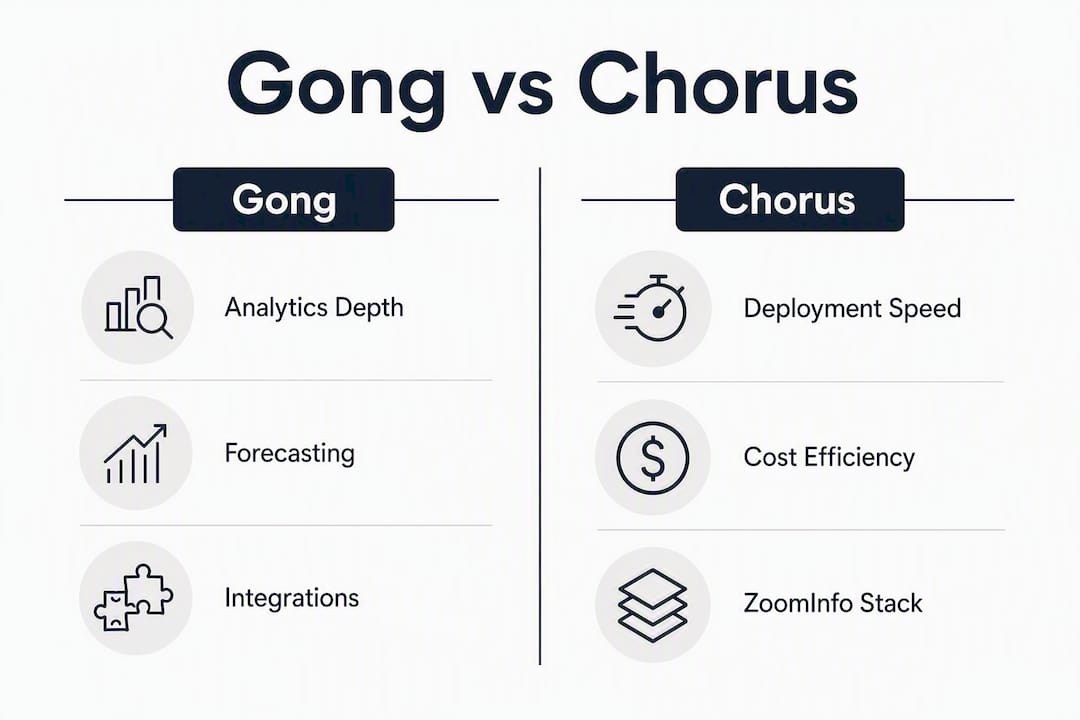
The top three product differences come down to analytics depth, integrations breadth, and pricing shape. Gong charges a per-seat premium that requires organizational scale to justify. Chorus trades analytics depth for procurement simplicity inside a ZoomInfo bundle. Stack strategy, not feature parity, drives the right call.
How are Gong and Chorus positioned in 2026?
The ownership picture matters here. Gong operates as an independent, enterprise-grade revenue intelligence platform. Chorus was acquired by ZoomInfo and has since been repositioned as a conversation intelligence layer inside ZoomInfo’s broader go-to-market suite, often appearing as a bundled feature in enterprise ZoomInfo contracts rather than a standalone SKU.
What that means in practice:
Gong (best-of-breed): Roadmap investment goes entirely into revenue intelligence. You get faster feature iteration on deal analytics, AI-driven forecasting, and integrations. Vendor negotiation is a direct conversation with one platform.
Chorus via ZoomInfo (bundled): Procurement and deployment are faster when Chorus is already in your ZoomInfo contract. The tradeoff is that Chorus’s roadmap is now shaped by ZoomInfo’s broader platform priorities, not solely by conversation intelligence innovation.
ZoomInfo as ecosystem: When you buy ZoomInfo for contact data, intent signals, and outreach automation, Chorus becomes an incremental add-on rather than a primary investment. The value proposition shifts from “best CI tool” to “CI included in the data platform you already pay for.”
Analysts frame the 2026 buyer choice as a decision between a best-of-breed revenue intelligence investment and a bundled data-plus-intelligence stack. Neither is wrong. The question is whether your primary outcome is strategic forecasting or vendor consolidation.

What are the real feature differences between Gong and Chorus?
Transcription accuracy and language support
Gong’s transcription engine handles multiple languages and accents with high reported accuracy, which matters when your reps work international accounts or your team is geographically distributed. Chorus performs well in English-primary environments. For CRM logging and call search, transcription quality directly affects how reliably reps can pull up a specific moment or keyword from a recorded call. A fragile transcript means your CRM data is only as good as the error rate baked into every logged note.
Analytics depth
Gong’s deal boards give managers a multi-meeting view of how a deal is progressing, flagging engagement drops, talk-time imbalances, and competitive mentions across the entire opportunity lifecycle. Chorus offers useful call summaries and keyword tracking, but its pattern recognition across deals is lighter. For a sales leader running a 90-day enterprise cycle, that difference in analytics depth translates directly into earlier deal warnings and fewer late-stage surprises.
Forecasting and deal intelligence
Gong’s predictive forecasting layer pulls signals from call activity, email engagement, and CRM data to surface at-risk deals and cross-funnel trends. Chorus does not position itself as a forecasting-first platform. If your RevOps team needs a single source of truth for pipeline health, Gong is the more defensible choice. Chorus is better understood as a coaching and recording tool that happens to sit inside a data-rich stack.
Coaching and enablement
Chorus still delivers solid real-time coaching for newer reps, making it a practical onboarding tool for teams with high rep turnover or distributed training needs. Gong’s coaching layer goes deeper: scorecards, playlists, and manager workflows that connect call behavior to pipeline outcomes. For a sales manager who wants to coach on patterns rather than individual calls, Gong’s toolset is more complete.
Pro Tip: Build your coaching scorecards before you go live on either platform. Teams that define what “good” looks like before launch see faster adoption and more consistent manager feedback loops.
Integrations and CRM automation
Gong’s extensive third-party connectors include deep Salesforce and HubSpot writebacks, Slack notifications, and a broad set of dialer and engagement platform integrations. Chorus connects with fewer tools, with its strongest integration being ZoomInfo’s own data enrichment layer. Pre-call enrichment, where a rep sees contact intent and firmographic data before dialing, is a genuine Chorus/ZoomInfo advantage that Gong does not replicate natively.

Security, compliance, and admin controls
Both platforms carry SOC 2 Type II certification. Gong offers enterprise-grade access controls, data residency options, and governance features suited to large, regulated sales organizations. Chorus inherits ZoomInfo’s compliance framework, which is enterprise-grade but governed at the ZoomInfo contract level. For IT and security teams, the practical question is whether you want a dedicated security conversation with a single CI vendor or whether you prefer to manage compliance through your existing ZoomInfo relationship.
What does Gong vs Chorus actually cost, and how long does rollout take?
Pricing and total cost of ownership
Gong’s per-seat pricing runs at a premium rate for Revenue Intelligence, with a practical minimum seat requirement that impacts smaller teams. That floor matters: a 20-rep team paying for 50 seats to meet the minimum faces a materially different cost equation than an enterprise team spreading the fee across 200 reps.
Total cost of ownership components to budget for:
Platform license: Per-seat annual fee plus any platform base fee
Implementation and configuration: Salesforce or HubSpot integration setup, SSO, and data governance configuration
CSM and consulting: Gong typically includes a dedicated customer success manager at enterprise tiers; Chorus support runs through the ZoomInfo account team
Integrations: Custom connector work for non-standard CRMs or dialers
Renewal inflation: Multi-year contracts often carry annual escalators; negotiate a cap upfront
Chorus pricing is not publicly listed as a standalone SKU. It surfaces as a line item inside ZoomInfo enterprise contracts, which makes direct price comparison difficult. The effective incremental cost for a ZoomInfo customer adding Chorus is typically lower than buying Gong separately, but the full ZoomInfo contract value needs to be part of the TCO calculation.
Implementation timeline
Chorus deploys in roughly 2–4 weeks when bundled with an existing ZoomInfo contract. Gong typically requires 2–3 months for a full enterprise rollout. A phased approach reduces risk for both:
Weeks 1–2: Integration setup (CRM, calendar, dialer), admin configuration, and governance sign-off
Weeks 3–6: Pilot with a defined rep cohort (10–20 reps); baseline metrics capture
Months 2–3: Manager training, scorecard configuration, and coaching workflow activation
Month 3+: Full team rollout, adoption tracking, and first forecasting review cycle
Which platform fits your team profile?
The right choice depends on four variables: team size, sales cycle length, your existing CRM and data stack, and the primary outcome you are buying for.
Enterprise teams (50+ reps, 60-day+ sales cycles, Salesforce-primary): Gong. The forecasting depth and deal intelligence justify the per-seat cost, and the integrations breadth supports a complex tech stack. AI-powered sales tools deliver the most value when the underlying process is mature.
ZoomInfo-native teams of any size: Chorus. The bundled deployment, pre-call enrichment, and lower incremental cost make it the logical choice if ZoomInfo is already your data foundation.
Inbound SMB teams (under 50 reps, shorter cycles): Neither platform may be the right first investment. Consider lighter-weight alternatives for call recording and summaries, then graduate to Gong when the team and process are ready.
Field sales with long, consultative cycles: Gong’s multi-meeting pattern recognition and deal boards are built for exactly this motion. Chorus’s coaching tools help, but the analytics depth is not there for complex, multi-stakeholder deals.
Teams with high rep turnover or distributed onboarding needs: Chorus’s real-time coaching and faster deployment make it a practical starting point, especially when paired with a structured onboarding program.
Purchasing a complex revenue intelligence platform without an established sales process is one of the most common pitfalls in this category. Defined pipeline stages, CRM discipline, and manager execution are prerequisites, not nice-to-haves.
How should you evaluate these platforms before buying?
Selection checklist
Forecasting accuracy: Ask the vendor for a documented forecast accuracy benchmark from a comparable customer. Vague claims about “AI-driven forecasting” are not evidence.
CRM writeback fidelity: Confirm which fields auto-populate, how often they sync, and what happens when a rep edits a field manually.
Integration depth: Test the Salesforce or HubSpot connector in a sandbox before signing. A native connector that breaks on custom objects is not a native connector.
Admin controls: Verify role-based access, recording consent workflows, and data retention policies before IT sign-off.
AI explainability: Ask how the platform surfaces deal risk signals. A black-box score is harder to coach from than a signal tied to a specific call behavior.
Demo questions by role
For RevOps:
How does the platform handle pipeline coverage changes between forecast submissions?
What is the data model for deal stages, and how does it map to our Salesforce instance?
For Sales Managers:
Show me how I set up a coaching scorecard and assign it to a specific rep cohort.
How does the platform flag a deal that has gone dark for 14 days?
For IT/Security:
Where is call data stored, and what are the data residency options?
How does the platform handle recording consent for multi-party calls across different U.S. states?
Red flags to watch for
Transcription accuracy that degrades on accented English or industry-specific terminology
No native CRM writeback (manual exports are not a substitute)
Opaque bundle pricing that makes it impossible to calculate per-seat cost
Low adoption metrics from reference customers in your industry vertical
Implementation timelines that assume your CRM is already clean and your pipeline stages are locked
What should a 30–60 day pilot look like?
A well-scoped pilot answers one question: does this platform change rep behavior and manager visibility in a way that justifies the annual contract?
30-day pilot steps
Define scope: Select 10–20 reps across two or three deal stages. Include at least one manager who will actively use the coaching tools.
Set baseline metrics: Capture current CRM field fill rate, average forecast accuracy, and time reps spend on call logging before the pilot starts.
Configure integrations: Connect the platform to your CRM and calendar. Do not skip this step; a pilot without CRM writebacks does not test the real product.
Establish governance: Confirm recording consent workflows, data access roles, and who owns the admin seat.
Run the first coaching cycle: Have managers review at least five calls per rep using the platform’s scoring tools by day 21.
Metrics to track
Forecast accuracy lift: Compare pipeline call accuracy at week 4 against the pre-pilot baseline
CRM field fill rate: Measure auto-populated fields vs. manually entered fields
Time saved per rep: Survey reps on call logging time before and after
Coaching completion rate: Track whether managers complete assigned reviews
Adoption rate: Percentage of eligible calls recorded and processed by the platform
Scoring template for the 30-day decision
Expand: Adoption above 80%, measurable CRM fill rate improvement, at least one manager citing a deal save or coaching win
Extend pilot: Adoption 50–80%, integration issues resolved but coaching workflows not yet active
Stop: Adoption below 50%, CRM writeback failures, or transcription quality that reps actively distrust
At 60 days, re-run the same metrics and add a forecast accuracy comparison. If the platform has not moved the needle on at least two of the five metrics above, the ROI case is weak regardless of feature depth.
What is the final verdict on Gong vs Chorus?
Gong is the right choice for organizations where forecasting accuracy and deal intelligence are the primary revenue levers. Its analytics depth, integrations breadth, and AI-driven coaching workflows justify the premium for teams of 50 or more reps with defined pipeline stages and CRM discipline.
Chorus (ZoomInfo) is the right choice when vendor consolidation and pre-call enrichment matter more than best-of-breed analytics. If ZoomInfo is already your data foundation, adding Chorus at incremental cost is a faster, lower-risk path to conversation intelligence.
Concrete next steps for your buying team:
Shortlist one platform based on the team-profile criteria above, not on feature lists alone
Run a 30-day pilot with 10–20 reps before committing to an enterprise contract
Involve RevOps, a sales manager, and IT/security in the vendor demo, not just the sales leader
Negotiate a data residency clause and a renewal escalator cap before signing
Set a re-evaluation checkpoint at six months, or sooner if your CRM stack or data vendor changes
If your organization is still evaluating whether the process maturity is there to support either platform, that is the right question to answer first. A platform that outpaces your process will underperform regardless of its feature set.
Key Takeaways
Gong wins on analytics depth and forecasting; Chorus wins on deployment speed and cost efficiency for ZoomInfo-native teams, and stack strategy is the primary decision axis for U.S. sales organizations in 2026.
Point | Details |
Stack strategy drives the decision | Choose Gong for best-of-breed forecasting; choose Chorus when ZoomInfo is already your data foundation. |
Scale threshold matters | Gong’s practical floor of ~50 reps means smaller teams often cannot justify the per-seat cost of $1,200–$1,600/user/year. |
Deployment speed favors Chorus | Chorus deploys in 2–4 weeks when bundled; Gong typically requires 2–3 months for a full enterprise rollout. |
Process maturity is a prerequisite | Buying either platform without defined pipeline stages and CRM discipline commonly leads to low adoption and wasted spend. |
Myeracareer’s role | Myeracareer’s recruitment and coaching programs help sales teams build the process maturity that makes any CI platform investment pay off. |
What most sales leaders get wrong about this decision
The conversation intelligence category has a procurement problem that rarely gets named directly. Most buying teams evaluate Gong and Chorus as if the decision is about features, when the real decision is about organizational readiness. A platform with predictive forecasting and 162 integrations delivers exactly zero ROI if your pipeline stages are inconsistently defined, your reps log calls manually two days after the fact, and your managers never open the coaching dashboard.
The teams that get the most from Gong are not necessarily the ones with the biggest budgets. They are the ones that treated the platform purchase as the last step in a process improvement project, not the first. They defined what a qualified opportunity looks like before they turned on deal intelligence. They built coaching scorecards before they recorded a single call. They assigned a manager who owned adoption, not just a license.
Chorus, for its part, gets undersold in one specific scenario: the ZoomInfo-native team that wants to move fast. A 2–4 week deployment with pre-call enrichment already baked in is a genuinely different value proposition than a 3-month Gong rollout. The mistake is buying Chorus as a Gong substitute for a team that actually needs Gong’s forecasting depth. Those are different tools solving different problems, and conflating them because they both record calls is how organizations end up with a platform they outgrow in 18 months.
My practical advice: before you issue an RFP, spend two weeks auditing your CRM. If your pipeline stage definitions have more than one interpretation, if your reps are skipping stages, or if your forecast is still built on gut feel and spreadsheets, fix that first. The platform you choose will matter far less than the process discipline you bring to it.
How Myeracareer’s training and recruitment services fit into your CI platform strategy
Gong and Chorus are powerful tools. But the teams that extract the most value from them share one thing: their reps and managers already know how to sell, coach, and execute a defined process before the platform goes live.

Myeracareer offers recruitment, onboarding, and sales coaching programs designed to build exactly that foundation. Whether you are bringing on new agents, transitioning experienced talent, or equipping team leaders with structured coaching frameworks, the goal is the same: reduce the time between platform deployment and measurable ROI. A rep who understands their pipeline stages and knows how to run a structured discovery call will generate better call data, cleaner CRM writebacks, and more useful coaching moments from day one.
If you are a team leader evaluating a CI platform and want to pair it with a structured onboarding and coaching program, explore Myeracareer’s team leader services. New to building a sales team from the ground up? Start with the new agents program to see how recruitment and training can accelerate your platform’s time to value.
Useful sources for this comparison
The sources below back the key claims in this article. Primary evidence sources are marked accordingly.
Gong vs Chorus comparison (Knowlee.ai) — Primary evidence. Frames the 2026 decision as stack strategy (best-of-breed vs. bundled) and supports the use-case mapping throughout this article.
Gong.io vs Chorus comparison (Aeroleads) — Primary evidence. Documents Chorus’s coaching strengths and Gong’s superior pattern recognition and deal intelligence depth.
Gong vs Chorus (Moat Works blog) — Primary evidence. Validates the process-maturity prerequisite and the risk of purchasing without CRM discipline.
Gong vs Chorus (ZoomInfo): Which Is Better in 2026? (SpeakwiseApp) — Primary evidence. Source for market share figures (~45% Gong, ~20% Chorus) and integration counts (~162 vs. ~45 connectors).
Gong Alternatives 2026 (ModernLeads) — Primary evidence. Source for Gong per-seat pricing benchmarks ($1,200–$1,600/user/year) and the ~50-seat practical floor.
Gong vs Chorus: RevOps Comparison (RevOps Report) — Primary evidence. Confirms Chorus’s bundled positioning inside ZoomInfo and the procurement implications for enterprise buyers.
Gong vs Chorus 2026 (Battlecard) — Primary evidence. Source for deployment timelines: Chorus 2–4 weeks vs. Gong 2–3 months.
Best Gong alternatives (Subrupt) — Supplementary. Supports the cost-flip analysis for sub-50-rep teams and the recommendation to pilot lighter alternatives first.
Top Gong Alternatives & Competitors 2026 (Gartner Peer Insights) — Supplementary. Provides verified buyer reviews and competitive context for Gong’s positioning against alternatives in the revenue intelligence category.
Gong Alternatives (2026): An Honest, Job-First Guide (Supered) — Supplementary. Useful for buyers evaluating the broader alternatives landscape, including where Chorus fits relative to other CI tools.
This article reflects general market information and third-party research as of 2026. Pricing, features, and contract terms change; always validate final figures directly with Gong and ZoomInfo before signing.
Recommended
Comments