
CEA CPD Requirements 2026: What RESs and KEOs Need to Know


CEA requires 16 CPD training hours per RES and KEO for each CPD cycle running January 1 through December 31. The 2026 framework, which took effect on January 1, 2026, breaks those 16 hours into two components:
Structured Learning (SL): minimum 12 hours, split between at least 4 hours of Prescribed Essentials (PE) and at least 8 hours of Professional Competencies (PC)
Self-directed Learning (SDL): minimum 4 hours, approved by your Key Executive Officer
The 2026 Prescribed Essential topic is Prevention of Money Laundering, Proliferation Financing and Terrorism Financing (PML/PFTF). All attendance records go into the CPDS (Continuing Professional Development System) at eservices.cea.gov.sg/cpds. Renewal status checks happen through the ACEAS for Individuals portal. Once you fulfill requirements, your status typically updates within two working days.
Table of Contents
How the 2026 CPD framework is structured
The 2026 framework draws a clear line between two types of learning, each serving a different purpose in your professional development.
Structured Learning covers CEA-accredited courses and programs. Within SL, Prescribed Essentials are mandatory topics set annually by CEA — topics where every agent in Singapore needs a consistent, verified baseline. Professional Competencies cover the broader skills map: negotiation, client advisory, property law, market analysis, and related domains drawn from the Professional Development Reference Guide (PDRG). The PDRG functions as a skills map, letting you audit your own gaps and select PC courses that build toward demonstrable competency rather than just logging hours.

Self-directed Learning recognizes that professional growth happens outside the classroom. SDL can include industry seminars, research activities, and other learning formats your KEO approves. The KEO approval requirement is deliberate: it keeps SDL accountable and prevents agents from counting passive activities that don’t advance real competency.
CPD Component | Subcategory | Minimum Hours |
Structured Learning (SL) | Prescribed Essentials (PE) | 4 hours |
Structured Learning (SL) | Professional Competencies (PC) | 8 hours |
Self-directed Learning (SDL) | KEO-approved activities | 4 hours |
Total | 16 hours |
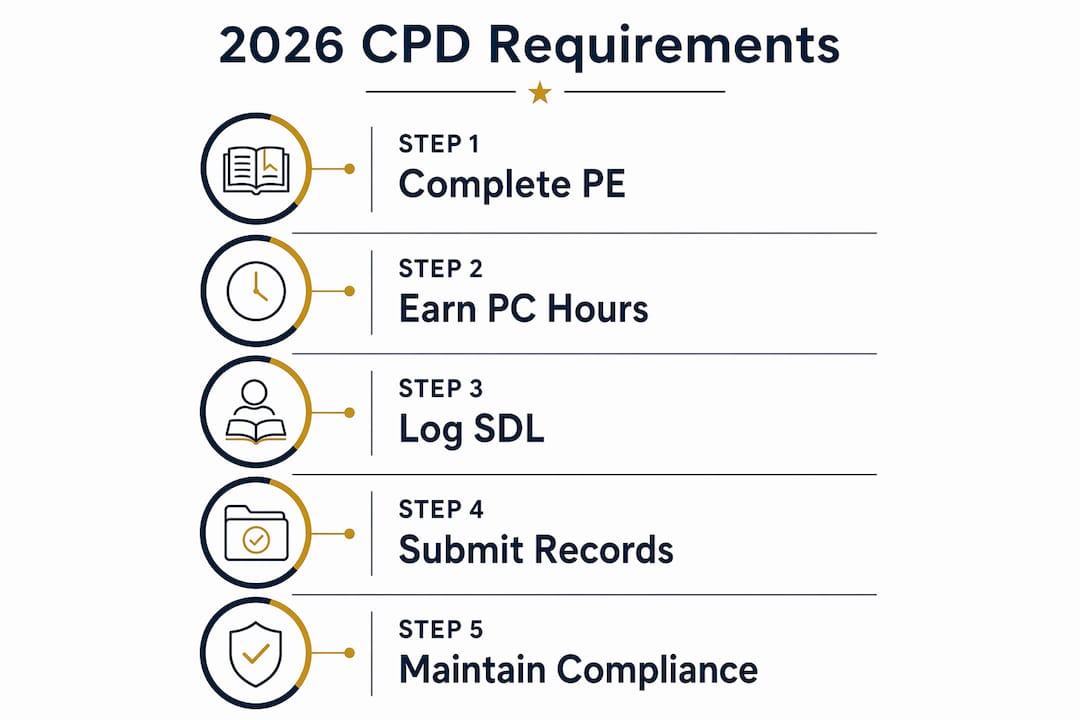
This architecture reflects Project ADEPT, CEA’s deliberate shift away from credit accumulation toward competency-validated learning. The CPD cycle aligns with the RES registration year (January 1 to December 31), which simplifies planning: your training calendar and your renewal window now run on the same clock.
Exactly how many hours you need and what happens if you fall short
The 16-hour annual requirement applies to all RESs and KEOs who wish to renew their registration. Here is how the hours work in practice.
What counts toward each component
Prescribed Essentials (PE): CEA-accredited courses on the designated annual topic. For 2026, that is PML/PFTF. These must be completed through an accredited provider and include a mandatory assessment.
Professional Competencies (PC): Accredited SL courses covering skills in the PDRG — property law, ethics, client advisory, negotiation, digital tools, and related domains.
Self-directed Learning (SDL): KEO-approved activities such as industry conferences, research projects, or relevant seminars. Supporting documents must be submitted to your KEO before recording.
Deadlines and timing
The CPD cycle closes December 31 each year. There is no grace period that carries hours into the next cycle.
CPD cycle alignment with the registration year means your renewal application and your CPD completion window close at the same time.
Processing time after fulfillment: approximately two working days for your status to update in ACEAS.
Consequences of non-compliance
Incomplete CPD hours will block your registration renewal.
If your registration lapses, the path back depends on how long it has been lapsed. Returning RESs with a lapse of under two years must still fulfill 16 hours as if they had remained registered before re-registering.
Lapsed registrations of more than two years carry different re-entry requirements — check directly with CEA for the current rules in that scenario.
How to submit and check your CPD records in CPDS and ACEAS
Submitting records correctly is where many agents lose time. The process splits between two platforms, and knowing which does what saves you from chasing missing hours at renewal.
For Structured Learning: Your course provider submits attendance records directly into the CPDS after each session. You do not need to submit SL records yourself, but you should log in to CPDS after each course to confirm the entry appears correctly.
For Self-directed Learning: You submit supporting documents to your KEO for approval first. Once the KEO approves, the SDL activity can be recorded in the CPDS. Never record SDL before KEO approval — unapproved entries will not count.
Check your renewal status: Log in to ACEAS for Individuals to see your current CPD fulfillment status. This is the same portal used for your renewal application, so the two checks happen in one place.
Allow two working days: After completing a course or getting SDL approved, wait approximately two working days before checking your updated status. Checking immediately after a session will often show an incomplete picture.
Review at least two weeks before your renewal date: Pull your CPDS record and ACEAS status at least two weeks before December 31. That buffer gives you time to chase any missing entries with your provider or KEO before the cycle closes.
The CPDS user guide and video guides for RESs, KEOs, and course providers are available on the CEA website. Download the PDF guide and keep it accessible — it covers every submission scenario, including how KEOs manage SDL approvals for their teams.
Pro Tip: Book your PML/PFTF Prescribed Essential course in the first quarter of the year. PE courses fill up as December approaches, and a fully booked calendar in November means you cannot complete the mandatory 4 hours on time — which blocks your entire renewal regardless of how many PC or SDL hours you have logged.
What course providers and trainers must do under the 2026 rules
The 2026 framework raised the bar for providers, not just agents. If you run or design CPD courses, these are the changes that affect your accreditation and course structure.
Tighter accreditation criteria: CEA has enhanced accreditation standards for providers, with higher eligibility requirements for trainers. Existing accreditations should be reviewed against the updated criteria.
Mandatory assessments: Every accredited SL course must now include a compulsory assessment component. Passive attendance alone no longer satisfies the learning outcome requirement. Assessments verify comprehension, particularly for ethics and regulatory compliance topics like PML/PFTF.
Accurate component labeling: Courses must clearly identify whether they fulfill PE, PC, or SDL-eligible hours. Agents and KEOs rely on this labeling to record hours correctly in CPDS. Mislabeled courses create downstream compliance problems for your participants.
For course design, a practical checklist:
Confirm your trainer meets the updated CEA eligibility criteria before scheduling.
Build the assessment component into the course structure, not as an afterthought at the end.
Submit session attendance records into CPDS promptly after each session — delays affect agents’ renewal timelines.
Label PE, PC, and SDL components clearly in all course materials and on your CPDS submissions.
Who must comply with CEA CPD requirements
Covered roles:
All registered RESs who wish to renew their registration
Key Executive Officers (KEOs)
Practising directors and partners of licensed estate agencies
Exemptions and special cases:
New RESs are exempt from CPD in their first CPD cycle. The requirement kicks in from the second cycle onward.
Returning RESs with a lapsed registration of under two years must fulfill the full 16 hours before re-registering, as if they had remained continuously registered.
Returning RESs with a lapse exceeding two years face different re-entry conditions — confirm the current rules with CEA directly.
If you completed CPD credits in 2024 or 2025, log in to CPDS to check how many SL, PE, and SDL hours those credits translate to under the 2026 framework. This is particularly relevant for agents who were partway through a prior cycle when the January 1, 2026 change took effect.
KEOs carry an additional responsibility: they must actively assess and approve SDL activities for every RES on their team. That approval role is not administrative formality. Unapproved SDL hours will not count at renewal, and the KEO is accountable for the quality of what gets approved.
Key Takeaways
Meeting CEA CPD requirements in 2026 means completing 16 verified training hours per January–December cycle, with at least 4 hours on the mandatory PML/PFTF topic, and submitting records through CPDS and ACEAS before your renewal window closes.
Point | Details |
16 hours per cycle | Complete 4 PE + 8 PC + 4 SDL hours every January–December cycle to qualify for renewal. |
Book PE courses early | PML/PFTF seats fill up; register in Q1 to avoid being locked out of the mandatory 4 hours. |
Use CPDS and ACEAS | Submit and track SL records in CPDS; check renewal status in ACEAS at least two weeks before December 31. |
KEOs must pre-approve SDL | Unapproved SDL hours are rejected at renewal; submit supporting documents to your KEO before recording. |
Myeracareer training support | ERA’s structured training calendars and KEO mentorship help agents plan CPD strategically, not just reactively. |
Why CPD is a career asset, not just a compliance checkbox
The agents I see struggle most with CPD are the ones who treat it as an annual obligation to clear rather than a structured opportunity to sharpen their edge. That mindset leads to last-minute course registrations, rushed SDL approvals, and a portfolio of training hours that doesn’t actually reflect what they can do for a client.
Project ADEPT changed the rules precisely because credit accumulation without competency validation was producing agents who could renew their registration but couldn’t demonstrate real expertise. The shift to assessed learning and the PDRG skills map gives you a framework to build a genuinely differentiated professional profile. An agent who maps their PC courses to specific PDRG competencies, completes PE early, and uses SDL to deepen niche knowledge, such as commercial leasing or luxury residential, arrives at renewal with something more valuable than a compliance receipt. They arrive with a credible, documented skills profile that supports higher-value client conversations.
The practical planning approach is straightforward: schedule your PML/PFTF course in January or February, map your PC course selections to two or three PDRG skill areas you want to develop this year, and discuss SDL options with your KEO at the start of the cycle rather than in November. That sequence turns 16 hours of mandatory training into 16 hours of deliberate career investment.
ERA’s training programs help you meet CPD requirements with purpose
Completing your CEA CPD requirements is more straightforward when you have a structured training calendar, a KEO who actively supports SDL approvals, and mentorship that connects course choices to your actual career goals.

Myeracareer’s training programs are built around exactly this kind of purposeful CPD planning. ERA offers accredited courses covering Professional Competencies aligned with the PDRG, internal training schedules that front-load PE requirements early in the year, and KEO-led mentorship that helps agents identify SDL activities worth pursuing. For new agents, the ERA onboarding pathway includes structured CPD guidance from day one. For KEOs and team leaders, ERA’s leadership development resources include frameworks for managing SDL approvals across your team and aligning group training with the annual PE topic. Whether you are starting your career or leading a team, the goal is the same: CPD that builds real competency and reduces renewal risk. Reach out through Myeracareer to review ERA’s current training schedule and find the courses that fit your 2026 CPD plan.
Official CEA resources for CPD compliance
Keep these pages bookmarked. They are the authoritative sources for every rule, deadline, and submission process covered in this article.
CEA CPD Framework — the primary reference for the 16-hour requirement, component breakdown, PE topics, and exemption rules. Check this page for any mid-year updates to the 2026 PE topic or framework guidance.
CPDS (Continuing Professional Development System) — the authoritative submission and tracking platform for SL and SDL records. Includes the CPDS User Guide (PDF, 2.5 MB) and video guides for RESs, KEOs, and course providers.
ACEAS for Individuals — where you check your CPD fulfillment status and submit your renewal application. Status updates within two working days of fulfillment.
Professional Development Reference Guide (PDRG) — the skills map for self-auditing competency gaps and selecting PC courses with purpose.
Project ADEPT background — explains the rationale behind the 2026 framework shift from credits to competency-based hours.
Save your course completion certificates and KEO SDL approval records for at least the current cycle plus the prior year. CEA conducts audits, and having documentation organized by completion date makes any audit straightforward to resolve.
This article provides general information about CEA CPD requirements and is not a substitute for official CEA guidance. Confirm current rules and your individual compliance status directly with CEA or through the CPDS and ACEAS portals.
Recommended
Comments