
Buyer Agent Commission in Singapore: What Agents Need to Know


In Singapore, buyer agent commission refers to how buyer-side real estate agents earn their income — the commission structures, percentage splits, and co-broking arrangements that determine take-home pay on each transaction. This is not about what buyers pay; it is about how agents on the buyer side get compensated.
Here is what every agent needs to know at a glance:
Co-broking is the dominant model. On private resale transactions, the seller typically pays a commission that industry conventions place near two percent, with the buyer’s agent receiving a co-broke share often between a half and one percent via the listing agency.
Documentation is mandatory. The Council for Estate Agencies (CEA) requires agreed commission rates to be recorded in a signed CEA Prescribed Estate Agency Agreement before any services are rendered.
GST applies only where the agency is GST-registered, at 9% on top of the agreed commission.
Dual representation is an offence. An agent cannot collect commission from both buyer and seller in the same transaction without explicit written consent from both parties.
Industry bodies including the Singapore Estate Agents Association (SEAA) and the Singapore Institute of Estate Agents (SIEA) have issued Best Practice Guides encouraging buyer agents to collect fees from the party they represent.
Myeracareer / ERA Real Estate provides commission transparency, onboarding training, and the Sales+ app to help agents evaluate and maximize their earnings from day one.
Table of Contents
How is buyer agent commission structured in Singapore?
The mechanics depend on transaction type. Co-broking remains the standard arrangement for private resale and rental deals, where the listing agent shares a portion of the seller’s or landlord’s commission with the buyer’s or tenant’s agent.
Transaction Type | Typical Total Commission | Buyer/Tenant Agent Share | Who Pays | GST |
Private resale | Industry-conventional commission around 2% of sale price | Buyer agent usually shares commission between half and one percent via co-broke | Seller (via listing agent) | 9% if agency is GST-registered |
HDB resale | Negotiable; conventions vary | Negotiable co-broke portion | Seller (convention) | 9% if applicable |
New launch | Developer marketing fee | Full agent fee from developer | Developer | Typically included |
Rental (1+ year) | 1 month’s rent (landlord side) | — | Landlord + tenant (split) | 9% if applicable |
Rental (< 1 year) | — | Negotiated | Landlord | 9% if applicable |
For new launches, the developer pays marketing fees directly, so the buyer typically pays nothing out of pocket and the agent receives the full developer-set fee. On private resale deals, the industry pact signed by major agencies from July 1, 2024 onward reinforces the convention of a total commission near two percent with the buyer agent’s co-broke share generally between half and one percent.
Commission becomes payable at the agreed trigger event stated in the Estate Agency Agreement — typically completion of sale, exercise of the Option to Purchase, or commencement of tenancy for rental deals. Only GST-registered agencies may charge the 9% GST, and that obligation must be disclosed upfront.
What are the legal and compliance rules every buyer agent must follow?
CEA’s framework is non-negotiable, and the consequences of getting it wrong range from disciplinary action to loss of registration.
Signed agreement before services. The CEA Prescribed Estate Agency Agreement must be signed and in place before you begin representing a client. Agreed commission rate, GST disclosure, exclusivity period, and validity dates all belong in that document.
No dual representation without written consent. Collecting commission from both buyer and seller in the same transaction is an offence under Singapore law unless both parties have given explicit written consent. Most agencies prohibit it outright.
Best Practice Guide adoption. The SEAA Best Practice Guide encourages buyer agents to collect commission from the party they represent and to finalize fee arrangements in writing before engagement begins. The SIEA reports that over 80 agencies have signed the MOU, though take-up in practice has been gradual.
Co-broking refusal risk. Deliberately blocking a co-broke request without legitimate reason can attract complaints and disciplinary scrutiny. Document all co-broke communications.
Pro Tip: Before accepting a dual-representation arrangement, get the written consent of both parties on file and run it past your agency’s compliance team. The commission is rarely worth the regulatory exposure.
What should you ask recruiters about commission and onboarding?
Recruiters evaluate your transaction pipeline, territory knowledge, and willingness to follow the agency’s co-broking policies. You should be evaluating them just as carefully.
Questions to ask in a recruitment interview:
What is the headline commission split, and does it graduate based on GCI?
Are there desk fees, marketing chargebacks, or training cost deductions?
What is the clawback policy if a deal falls through after commission is advanced?
Does the agency provide leads, and how are they allocated?
What CRM or sales tools are included — for example, does the agency offer a Sales+ app or equivalent?
What does the first 90-day onboarding look like, including mentorship and training milestones?
Onboarding checklist before you sign:
CEA registration number verified and active
Signed Estate Agency Agreement template reviewed
Commission split letter received in writing
Clawback and chargeback policy confirmed in writing
First 90-day training schedule and performance milestones agreed
Lead generation support and marketing tools access confirmed
For agents considering a move, experienced agent resources at Myeracareer cover how ERA structures its split models and what support looks like in practice.
What should your CEA Prescribed Estate Agency Agreement include?
Use this checklist before you start work on any buyer-side transaction:
Client’s full name and NRIC/passport number
Agreed commission rate (stated ex-GST, with GST treatment explicit)
Identity of the paying party (buyer directly or via co-broke)
Exclusivity period and agreement validity dates
Co-broking sharing instructions (if applicable)
Payment trigger event and proof of entitlement (e.g., completion, OTP exercise)
Agent’s CEA registration number and agency name
Sample clause bank:
Buyer representation fee: “The Client agrees to pay a buyer representation fee of [X]% of the purchase price, exclusive of GST at 9% (if applicable), payable upon exercise of the Option to Purchase.”
Co-broke split request: “The listing agent agrees to co-broke [X]% of the total commission to the buyer’s agent upon successful completion of the transaction, confirmed in writing prior to the first viewing.”
GST disclosure: “GST at the prevailing rate of 9% is applicable and will be charged in addition to the agreed commission if [Agency Name] is a GST-registered entity at the time of the transaction.”
Download the official CEA prescribed forms directly from the CEA website and store all signed copies securely — both digital and physical.
Key Takeaways
Buyer-side agents in Singapore earn through co-broking splits and direct buyer fees, and every arrangement must be documented in a signed CEA Prescribed Estate Agency Agreement before services begin.
Point | Details |
Typical co-broke share | Buyer agent commonly receives 0.5%–1% of the sale price on private resale transactions. |
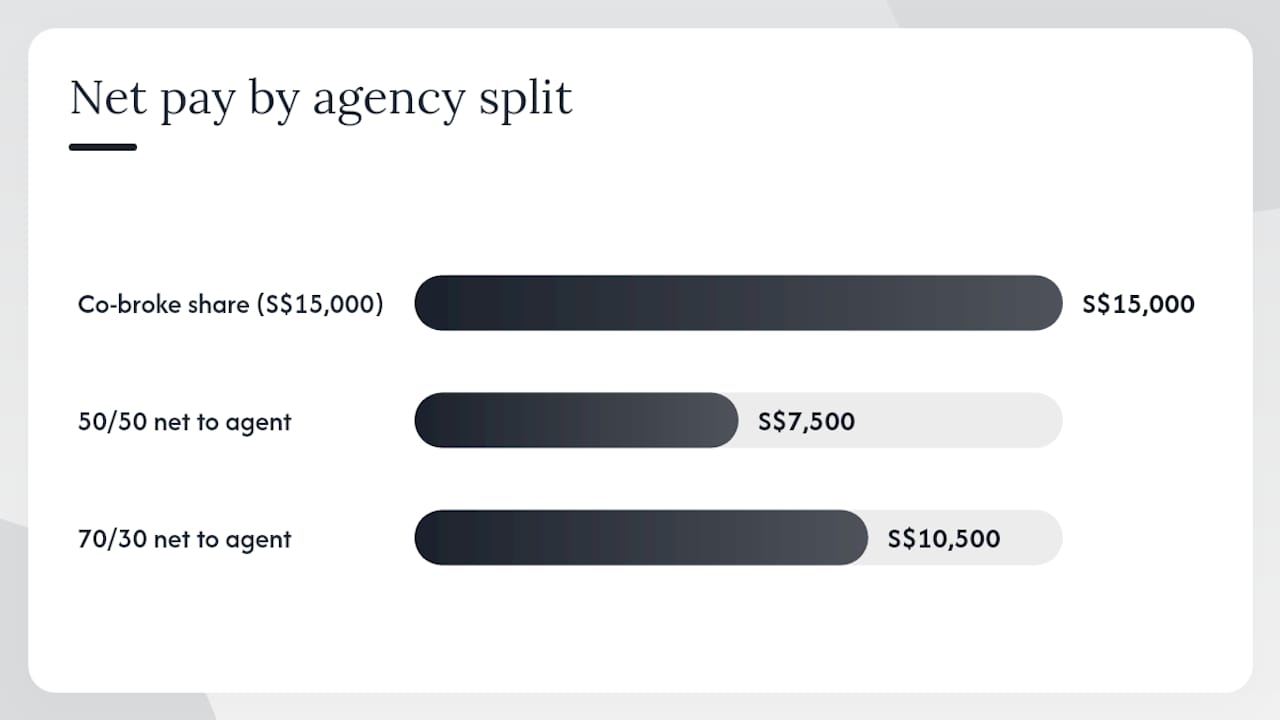
Agency split impact | A 50/50 split on a S$15,000 co-broke share nets S$7,500; a 70/30 split nets S$10,500. |
Mandatory documentation | Sign the CEA Prescribed Estate Agency Agreement — including commission rate and GST disclosure — before starting work. |
Dual representation risk | Collecting from both buyer and seller without explicit written consent from both parties is a legal offence. |
Myeracareer onboarding | ERA’s program includes commission transparency, Sales+ tools, and mentorship to help agents evaluate and maximize take-home pay. |
What recruiters actually see when candidates ask about commissions
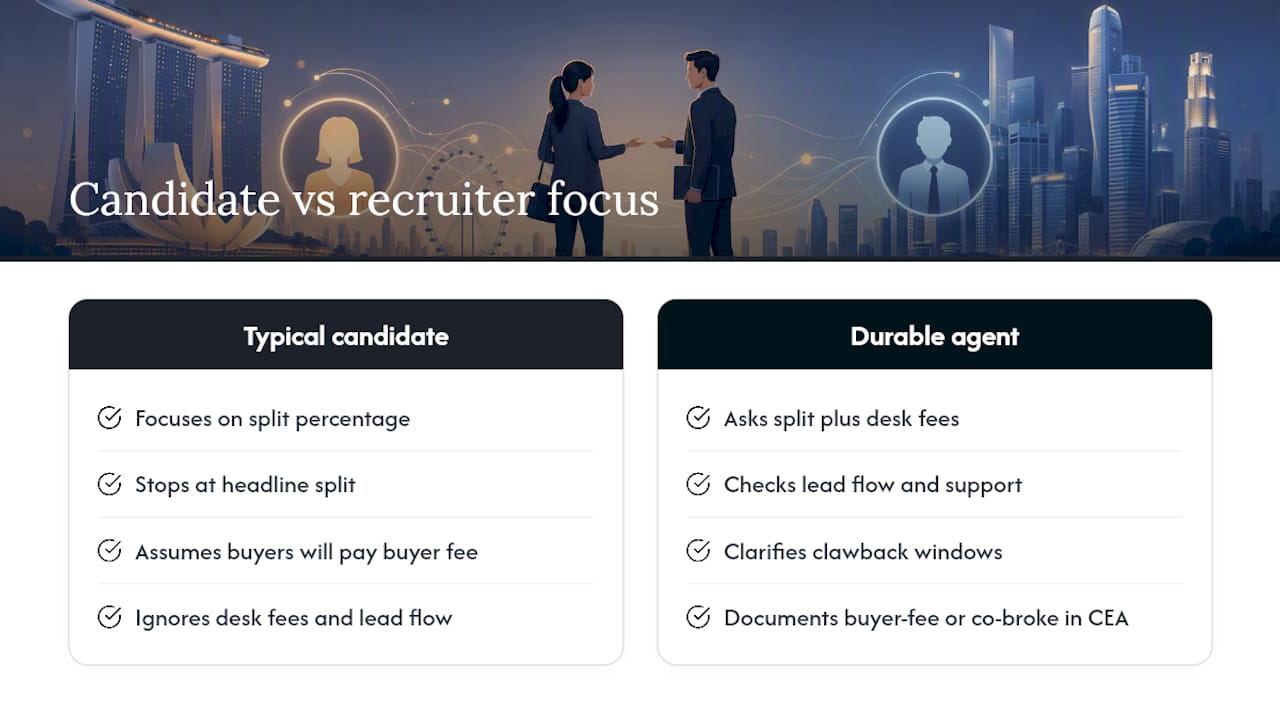
Most candidates who come through ERA’s recruitment process focus on the headline split percentage and stop there. That is the first mistake. The agents who build durable portfolios ask about the full earnings picture: desk fees, lead flow, clawback windows, and what the agency’s co-broking culture actually looks like in practice.
A second pattern worth naming: many prospective agents assume that private resale buyers will simply pay a buyer representation fee because the Best Practice Guide says they should. The reality is more nuanced. Take-up has been gradual, and the co-broking model still dominates most transactions. Agents who understand both routes — direct buyer fee and co-broke — and who can document either arrangement cleanly in the CEA Prescribed Estate Agency Agreement are the ones who close without disputes.
The candidates who stand out are those who arrive with the right questions already prepared: not just “what is your split?” but “what does my first 90 days look like, and how does lead support affect my net income in that window?” That combination of compliance literacy and commercial thinking is what strong recruiters are looking for.
Myeracareer gives you commission clarity before you sign
Most agents spend weeks evaluating offers without a clear picture of what they will actually take home. Myeracareer changes that. As part of ERA Real Estate’s recruitment and onboarding program, you get transparent commission split structures, access to the Sales+ app for pipeline and earnings tracking, and a mentorship framework designed to accelerate your first transactions — whether you are a new licensee or an experienced agent evaluating a move.

The onboarding program covers CEA compliance, co-broking etiquette, and how to present commission arrangements to clients with confidence. For new agents, the ERA new agent program walks you through every step from RES licensing to your first signed agreement. Experienced agents can review how ERA’s graduated split models and team leadership tracks compare to your current arrangement at myeracareer.com/experiencedagents. Reach out today to get a clear, written breakdown of what your earnings could look like under ERA’s commission structure.
Useful sources and further reading
These are the primary regulatory and industry sources used to build this guide:
Recommended
Comments