
Career Progression in Real Estate: A Roadmap for Working Agents


The fastest way to advance is to stop chasing more transactions and start building leverage: through a team, a brokerage role, or specialist authority. Each route scales income differently, but all three demand the same first move. Pick one track and commit to a 90-day plan that pairs mentorship with measurable weekly activity targets, not vague ambition.
Real career progression in real estate rarely comes from grinding harder at the same job you’ve had for three years. It comes from changing what you’re actually doing with your time.
Team leader track: trade personal deals for recruiting, coaching, and pay overrides
Brokerage/operations track: move into compliance, recruiting, or ownership economics
Specialist authority track: dominate one niche and charge premium fees for expertise
Pro Tip: Write your 90-day plan on one page: the track you’re choosing, three weekly activities, and the number you’ll hit by day 90. Agents who skip the paper plan almost always drift back to old habits by week three.
Key Takeaways
Career progression in real estate accelerates fastest when agents pick one track, pair it with mentorship, and measure progress in 90-day cycles rather than annual reviews.
Point | Details |
Choose one track deliberately | Team leadership, brokerage/operations, and specialist authority require different skills; pick based on strengths, not ambition alone. |
Build a measurable roadmap | Set 1-, 3-, and 5-year milestones with quarterly metrics like appointments set and referral percentage. |
Invest beyond the license | Prospecting, negotiation, and financial literacy separate agents who scale from those who plateau. |
Delegate before you hire | Transaction coordinators or virtual assistants often deliver leverage before your first recruit does. |
Use mentorship to shorten the curve | Myeracareer’s New Agents and Experienced Agents programs pair structured mentorship with tools like the Sales+ app to accelerate the roadmap above. |
Table of Contents
How Do You Build a 1-, 3-, and 5-Year Real Estate Career Roadmap?
How Do You Build Specialist Authority in a Real Estate Niche?
What Are the Biggest Obstacles to Career Progression in Real Estate?
How Should You Build Your Personal Brand and Network for Growth?
How Do You Sustain a Real Estate Career Without Burning Out?
What Are the Main Career Progression Paths in Real Estate?
Career progression in real estate splits into three broad tracks, and confusing them is the most common reason agents feel stuck. Each rewards a different skill set and a different appetite for risk.
Team leadership suits agents who already generate strong lead flow and enjoy coaching more than closing. You’ll trade some personal commission for overrides on a growing group’s production. Brokerage and operations fits agents drawn to systems, compliance, and the business side of real estate rather than face-to-face selling. It often means lower short-term income for long-term equity or a management salary. Specialist authority works for agents who’d rather go deep than wide, becoming the go-to name for a specific property type, buyer segment, or transaction complexity.
Team leader: outgoing, delegatory, comfortable with people-management friction
Operations/broker: process-minded, patient, willing to trade glamour for stability
Specialist: focused, research-driven, comfortable saying no to unrelated business
The National Association of REALTORS® notes that real estate careers branch widely, with income generally climbing alongside tenure and specialization. Which track fits depends less on ambition and more on honest self-assessment of what energizes you day to day.
How Do You Build a 1-, 3-, and 5-Year Real Estate Career Roadmap?
Career growth without a timeline is just optimism. A working roadmap ties each stage to numbers you can actually check.
Year 1: foundation. Build repeatable lead flow, document your follow-up process, and enroll in a structured mentorship program rather than improvising alone. Target consistent monthly appointments, not just closed deals.
Year 3: selection. By now you should have steady production and enough margin to test delegation, whether that’s a transaction coordinator or a part-time assistant. This is the year you commit to one of the three tracks instead of drifting between all three.
Year 5: scale. Revenue should come increasingly from systems, not solo hustle: a small team’s overrides, a brokerage role’s salary and equity, or a specialist practice’s premium fees.
Track quarterly metrics like appointments set, listing-to-close ratio, and referral percentage. Agents transitioning into leadership roles often use a structured 90-day action plan at each stage rather than waiting for an annual review to course-correct.
Industry coverage in 2026 has flagged real estate as a sector where motivated newcomers see rapid early earnings, which raises the bar for what a competitive Year 1 should look like.
Which Skills and Credentials Actually Move the Needle?
A license proves you’re allowed to practice. It doesn’t prove you can prospect, negotiate, or retain a client relationship, and that gap is exactly where most agents plateau. Licensing courses cover legal minimums, not the skills that separate agents who last from agents who wash out.
Prospecting systems that generate leads without relying on referrals alone
Negotiation frameworks you can apply consistently, not improvise under pressure
People management basics, even before you hire anyone
Financial literacy, including how commission splits, GST treatment, and CEA fees affect real take-home pay
Continuing education and focused certifications, particularly around negotiation, valuation, and AI-assisted sales tools, help agents stay competitive as the market shifts. Advanced programs, like Cornell’s real estate graduate track, show how targeted education accelerates movement into higher-earning specialist and leadership roles for agents willing to invest the time.
Pro Tip: Budget 30 minutes a day for skill-building rather than a weekend seminar twice a year. Consistency compounds faster than intensity in negotiation and prospecting skills alike.
How Do You Transition From Top Producer to Team Leader?
Moving from solo agent to team leader is a role change, not a promotion in the usual sense. You’re no longer paid primarily for what you sell. You’re paid for what your people sell, which means your calendar has to shift from listing appointments to recruiting calls and coaching sessions.
Accept the income dip. Most new team leaders see a temporary drop in personal production before overrides catch up. Plan your finances for that gap.
Pilot a simple compensation model. A straightforward split with a training fee is easier to manage early than a complex tiered structure.
Hire support before agents. A transaction coordinator or virtual assistant often delivers more leverage per dollar than a first recruit, since documented processes and delegation are prerequisites for scaling, not optional extras.
Run a 90-day launch checklist: recruit two to three agents, set weekly one-on-ones, and track their activity with a structured performance review template.
Agents who skip step one, the mindset shift, usually burn out trying to manage people the same way they managed their own pipeline.
Is Brokerage and Operations the Right Track for You?
Moving into brokerage or operations means trading personal sales for the mechanics that keep an office running: compliance, recruiting infrastructure, financial oversight, and dispute resolution. It suits agents who find satisfaction in systems rather than selling.
Evaluate your appetite for administrative and regulatory responsibility before pursuing a broker-level role
Compare a straightforward commission-split arrangement against ownership or equity models, since the financial mechanics differ substantially
Confirm CEA licensing requirements and continuing professional development obligations for any operations or supervisory role before committing
This track rewards patience over speed. Financial upside often takes longer to materialize than the team-leader path, but it tends to be more durable once established.
How Do You Build Specialist Authority in a Real Estate Niche?
Specialist authority means becoming the obvious choice for one specific type of transaction, whether that’s luxury condos, en bloc sales, commercial leasing, or a particular district. The niche has to be narrow enough to defend and large enough to sustain a practice.
Choose a niche where you already have transaction volume or genuine market knowledge, not just interest
Confirm the niche supports premium fees by checking what comparable specialists charge and why clients pay it
Package your expertise into a clear service, not just a listing sheet, so prospects understand what they’re paying extra for
Promote through content, strategic partnerships, and visible presence at industry events rather than generic ads
Pricing premium services requires confidence backed by results: closed deals in that niche, testimonials, and data you can show a skeptical client. Specialist positioning is also where a pivot toward advisory work becomes viable, and agents exploring that direction often study how property investment strategy is evolving to round out their advisory credibility.
What Resources and Support Actually Accelerate Progression?
You don’t have to build this roadmap from scratch. Structured mentorship consistently shortens the learning curve and improves early revenue outcomes compared to figuring it out alone.
Review how to become a licensed property agent if you’re mapping the full path from RES exam to first year
Study a detailed mentorship guide to understand what a strong program should actually deliver
Benchmark your income expectations against realistic agent income data for your experience level
Strengthen your pipeline using proven lead generation tactics
Action checklist: contact a mentor this week, enroll in one structured course this quarter, and set three measurable activity metrics before the month ends.
What Are the Biggest Obstacles to Career Progression in Real Estate?
The most common obstacle isn’t a lack of leads. It’s staying in the same role too long after outgrowing it. Agents plateau because personal production has a hard ceiling: there are only so many hours to prospect, show property, and negotiate before burnout sets in.
A second obstacle is skill gaps that licensing never addressed. Negotiation, financial literacy, and people management aren’t covered in RES exam prep, so agents who never invest in them beyond year one stall at a predictable point in their income curve.
A third is isolation. Agents who never join a mentorship structure tend to repeat the same mistakes their first cohort made, without a feedback loop to correct course. The fix isn’t complicated, but it does require discomfort: pick a track deliberately, invest in the specific skills that track demands, and find a mentor or structured program willing to hold you accountable to activity targets rather than vague goals. Agents who treat career progression as a passive byproduct of tenure, rather than a deliberate project, are the ones most likely to still be doing exactly the same job five years from now.
How Do Market Cycles Affect Real Estate Career Advancement?
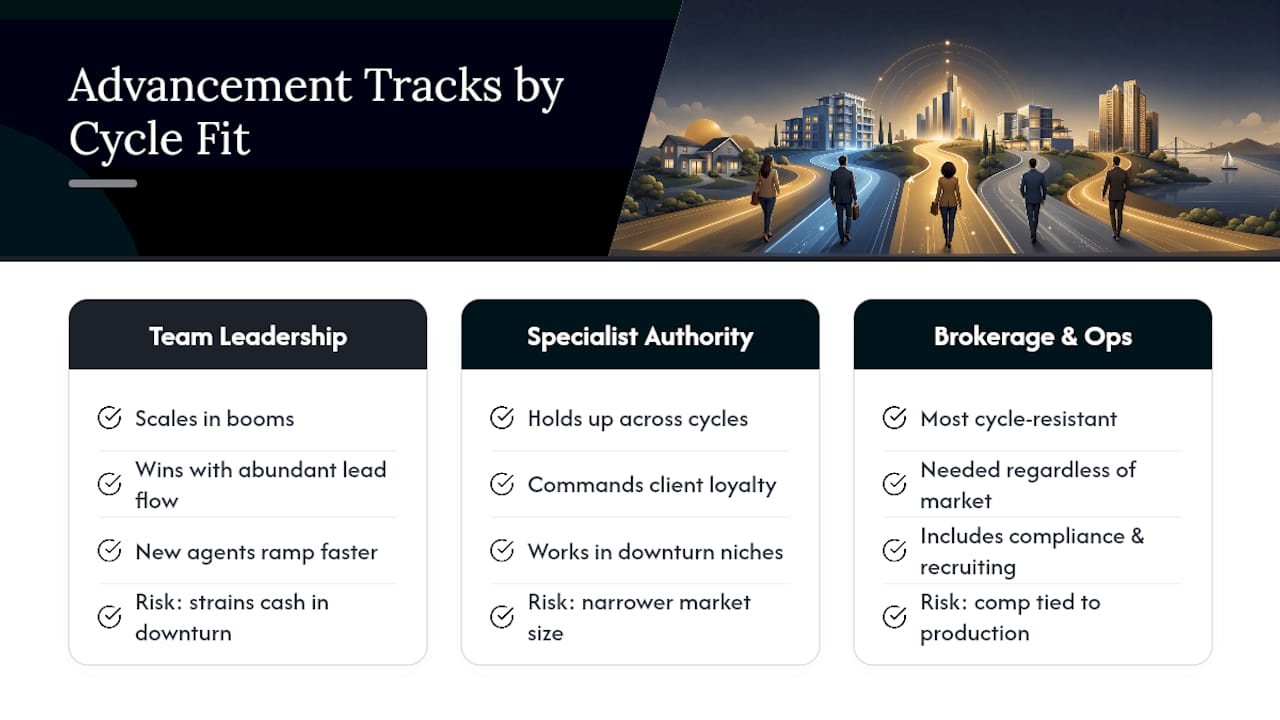
Market cycles don’t just affect transaction volume. They change which advancement track makes sense at any given time. In a rising market, team leadership can scale quickly because lead flow is abundant and new agents ramp up faster. In a slower or cooling market, that same abundance disappears, and hiring aggressively can strain cash flow instead of building it.
Specialist authority tends to hold up better across cycles because niche expertise commands loyalty even when overall transaction counts drop. Clients in a downturn still need specific problems solved, en bloc negotiations, distressed sales, complex commercial leasing, and they’ll pay for someone who clearly knows that terrain.
Brokerage and operations roles are the most cycle-resistant of the three, since compliance, recruiting, and administrative functions are needed regardless of market temperature, though compensation tied to production will still fluctuate.
The practical takeaway: build your roadmap with enough flexibility to shift emphasis when conditions change. An agent who launched a team during a boom should have a plan for retention and cost control when the market softens, rather than assuming the growth curve will continue in a straight line indefinitely.
How Should You Build Your Personal Brand and Network for Growth?
Personal branding in real estate isn’t a logo or a slogan. It’s the consistent, visible reputation that makes clients and other agents think of you first for a specific kind of deal. That reputation compounds over years, which is exactly why starting early matters more than starting polished.
Networking for career growth looks different from networking for a single transaction. It means building relationships with other agents, lenders, lawyers, and property managers who can refer business consistently, not just once. It also means showing up in your niche publicly: contributing insight at industry events, publishing observations about your specific market segment, and being known for a point of view rather than generic listings content.
Document your niche expertise publicly through short-form content or local market commentary
Build referral relationships with adjacent professionals who serve the same client base
Attend industry events with a specific goal, whether that’s meeting three new contacts or learning one new negotiation tactic
Track which relationships actually generate referrals over time, and invest more where the return is real
The agents who advance fastest into leadership or specialist tracks are usually the ones whose name already carries weight in a specific circle before they formally claim the title.
How Do You Sustain a Real Estate Career Without Burning Out?
Career progression that costs you your health or your family time isn’t progression, it’s a trade you’ll eventually regret. Real estate’s flexible hours are a genuine advantage, but that same flexibility can quietly expand into evenings, weekends, and holidays if you never set boundaries.

The agents who sustain long careers, the ones who make it to team leadership or specialist authority without quitting the industry entirely, tend to build systems specifically so the business doesn’t require their constant presence. That’s part of why delegation matters so much in the leadership track: a transaction coordinator or assistant isn’t just about scaling revenue, it’s about protecting your time.
Work-life balance also shapes which track fits your season of life. A specialist niche practice can often run on fewer, higher-value transactions with more predictable hours than a high-volume team-leader schedule during a launch phase. Neither is wrong, but choosing without weighing that trade-off honestly is how agents end up resentful of a career they once loved. Sustainable progression means building in recovery time as deliberately as you build activity targets, because a burned-out top producer helps no one, least of all their clients.
What’s Next for Career Progression in Real Estate?
Technology is reshaping which roles exist, not just how existing roles get done. AI-powered tools now handle lead scoring, listing descriptions, and follow-up sequencing, which frees agents to spend more time on negotiation and relationship management, the skills that still can’t be automated.
New roles are emerging around this shift: agents who position themselves as tech-fluent advisors, comfortable guiding clients through data-driven pricing and virtual tools, are carving out authority faster than generalists. Specialist niches tied to sustainability, institutional investment advisory, and cross-border transactions are also expanding as buyer profiles diversify.
The practical implication for your roadmap: build comfort with sales technology now, whether that’s an app that tracks performance or tools that support lead management, so you’re positioned for whichever track gains momentum next. Agents who treat technology as a threat to their role usually get overtaken by agents who treat it as leverage.
A Career That Doesn’t Plateau by Design
Most plateaus aren’t caused by a bad market or bad luck. They’re caused by agents doing the same activities year after year and expecting a different outcome. Licensing gets you into the room, but it was never meant to be the whole plan.
What surprises agents most is how much permission they need to give themselves to experiment: try delegating before you feel “ready,” try a niche before you feel like an expert, try leadership before you have all the answers. Mentorship exists precisely to shorten that uncomfortable middle stretch, not to eliminate it entirely.
If you take one thing from this roadmap, let it be this: pick a track, find someone who’s already walked it, and start measuring your progress in ninety-day increments instead of annual reviews.
— Donny
Ready to Put a Track and a Mentor Behind Your Next 90 Days?
Choosing a track is theory until someone experienced helps you execute it. Myeracareer runs two distinct paths built around exactly the roadmap above: one for agents starting fresh, one for agents ready to scale. If you’re newly licensed or still weighing whether real estate is the right fit, the New Agents program pairs you with structured mentorship, onboarding support, and the Sales+ app from day one, so your first 90 days build real activity data instead of guesswork.

If you’re an experienced agent eyeing a team leadership or specialist track but frustrated by your current brokerage’s lack of structure, the Experienced Agents program offers personalized leadership frameworks, performance tracking, and mentorship built for agents switching teams, not starting over. Either way, the next step is the same: reach out, walk through where you are against the roadmap above, and leave with a concrete 90-day plan instead of another set of good intentions.
Sources
Recommended
Comments