
8 to 10 Week RES Exam Plan for Singapore: CEA, Case Study Focus


The RES exam is genuinely challenging, not because the content is obscure, but because CEA requires a pass mark of 60 for each paper, and you must clear both. It is passable with disciplined preparation. The two moves that matter most: build timed case-study practice into every study week, and treat mock exams as non-negotiable, not optional extras you get to if time allows.
TL;DR:
The exam’s time pressure makes practicing case studies and applying facts efficiently essential to avoid losing precious minutes.
Paper 1 emphasizes memorization of regulations and terminology, while Paper 2 focuses on application skills like calculations and case analysis.
Property taxes, HDB schemes, property finance calculations, transaction procedures, and marketing rules are the most common sources of errors requiring targeted practice.
Recognizing question traps such as absolute words and complex answer choices improves elimination strategies and accuracy.
A structured 8 to 10-week study plan with full mock exams helps build answering speed and identify weak areas for focused improvement.
Table of Contents
Res Exam Difficulty: Why the Format Itself Works Against You
Most candidates underestimate the RES exam because they picture a standard multiple-choice test. It is not. Each paper runs 2.5 hours and splits into two distinct sections that test different skills entirely.
Section A gives you standalone multiple-choice questions covering discrete topics, from ethics to legislation to transaction mechanics. Section B shifts gears completely: extended case-study scenarios where a single fact pattern feeds several follow-up questions. That shift is where res exam difficulty really shows up, because the skills required change mid-paper.
CEA’s official sample questions are tagged by cognitive level, and this detail changes everything about how you should prepare:
Some questions test pure recall, like naming a regulatory body or citing a rule.
Others test application, asking you to take a messy fact pattern and decide what actually applies.
Case studies lean heavily toward application and interpretation, not memorization.
Time pressure compounds all of this. A case study eats minutes fast if you re-read the scenario for every sub-question instead of extracting the facts once.
Paper 1 vs Paper 2: Different Exams, Different Difficulty
Candidates often assume both papers feel roughly the same. They don’t, and knowing why changes how you allocate study hours.
Paper 1 leans toward law, regulatory frameworks, professional ethics, and terminology. It rewards candidates who know definitions precisely and can spot which statute or rule governs a given scenario. The difficulty here is breadth: there is a lot of terminology to hold in your head accurately.
Paper 2 shifts toward application. Expect heavier weighting on transaction procedures, calculations, HDB rules, and taxation, wrapped inside longer case studies. The difficulty here is depth under pressure: you need to run numbers correctly while the clock runs down.
Practical study adjustments follow naturally from this split:
For Paper 1, drill flashcard-style recall alongside scenario questions that force you to match facts to the correct rule.
For Paper 2, prioritize calculation practice and full case-study run-throughs over passive reading.
Track separately which paper is weaker for you. Many candidates pass one paper comfortably and stumble on the other.
The Syllabus Topics That Cause the Most Wrong Answers
Not every syllabus topic carries equal weight in terms of how often candidates get it wrong. Based on where the official syllabus concentrates complexity, five areas deserve disproportionate attention.
Property taxes and stamp duties. Rates and permutations shift depending on buyer profile and property type, so this topic demands repeated calculation drills, not just reading the rate table once.
HDB eligibility and grants. There are many buyer permutations, singles, families, income ceilings, and each combination changes which grants and schemes apply.
Property finance. Loan quantum, LTV limits, and financing scenarios require you to actually compute figures under exam conditions, not just recognize the formula.
Sale of uncompleted properties and transaction procedures. The step-by-step sequence of a transaction, and where things can legally go wrong, shows up repeatedly in case studies.
Marketing and consumer-protection rules. Advertising restrictions and ethics obligations blend together in questions that test judgment as much as knowledge.
These five topics reward calculation practice and repetition far more than passive re-reading of notes.
Question Types Designed to Trip You Up
The RES exam question types themselves create traps independent of subject knowledge. Recognizing the pattern is half the battle.
“Most appropriate” answer questions often present three plausible options and one best one. Practice elimination: cross out the clearly wrong answers first, then compare survivors against the exact wording of the rule.
Ethics questions rarely have a black-and-white answer. They test professional judgment, not a memorized checklist, so read for what a reasonably prudent salesperson would do.
Small negations and absolute words (“always,” “never,” “must not”) flip the meaning of a statement entirely. Missing one word costs you the question.
Long case scenarios feed multiple follow-up MCQs from a single fact pattern. Extract the controlling facts once before touching the questions.
Pro Tip: Read the case scenario exactly once. Jot down the parties, dates, and the one rule that governs the situation. Then answer every follow-up question against that note instead of re-reading the whole passage each time. This alone can save several minutes per case study.
Build an 8 to 10 Week Study Plan That Targets Weak Spots
A structured 8 to 10 week runway gives you enough time to move from reading to answering under pressure, which is where most candidates actually lose marks.
Weeks 1 to 3: Work through topic drills using 30 to 50 MCQs per topic. Time yourself even at this stage to build speed early, not just accuracy.
Weeks 3 to 5: Introduce case-study practice. Start with single scenarios, then string two or three together to simulate Section B pacing.
Weeks 5 to 7: Run full-length 2.5-hour mock papers under real exam conditions, phone away, no notes, one sitting.
Weeks 7 to 9: Review every wrong answer and categorize the cause: was it a knowledge gap, a comprehension error, or simple time pressure? Each cause needs a different fix.
Final week: Light review only. Revisit CEA’s sample questions and syllabus one last time for calibration, not new material.
Aim for at least three to four full mocks per paper before sitting the real exam. One insight worth internalizing: building a safety margin above the bare 60 pass mark matters because both papers must clear independently, and a narrow pass on one leaves zero room for a bad day on the other. A structured 8 to 10 week syllabus plan can help you map drills to the exact weeks above instead of guessing.
Eligibility, Fees, Registration Choices, and What Happens After
Before you even sit the exam, a few administrative details can trip you up as badly as a tough case study.
You must complete the RES course through a CEA-approved course provider, hit at least 75% attendance, and your course certificate stays valid for two years for exam eligibility.
You can register for a full sitting (both papers together) or a modular sitting (one paper at a time), which suits candidates who already cleared one paper or want to spread the workload.
CEA lists full-sitting fees at S$512.30 and modular sitting at S$283.40, both inclusive of GST for 2026. Always confirm current figures on CEA’s site before registering, since fees are periodically revised.
Results are typically notified within four to six weeks, and appeals must be filed within five working days of release, with an appeal fee attached.
The full CEA registration process walks through recognized qualifications and course-entry steps in more depth if you’re still confirming eligibility.
What Structured Support Looks Like for RES Candidates
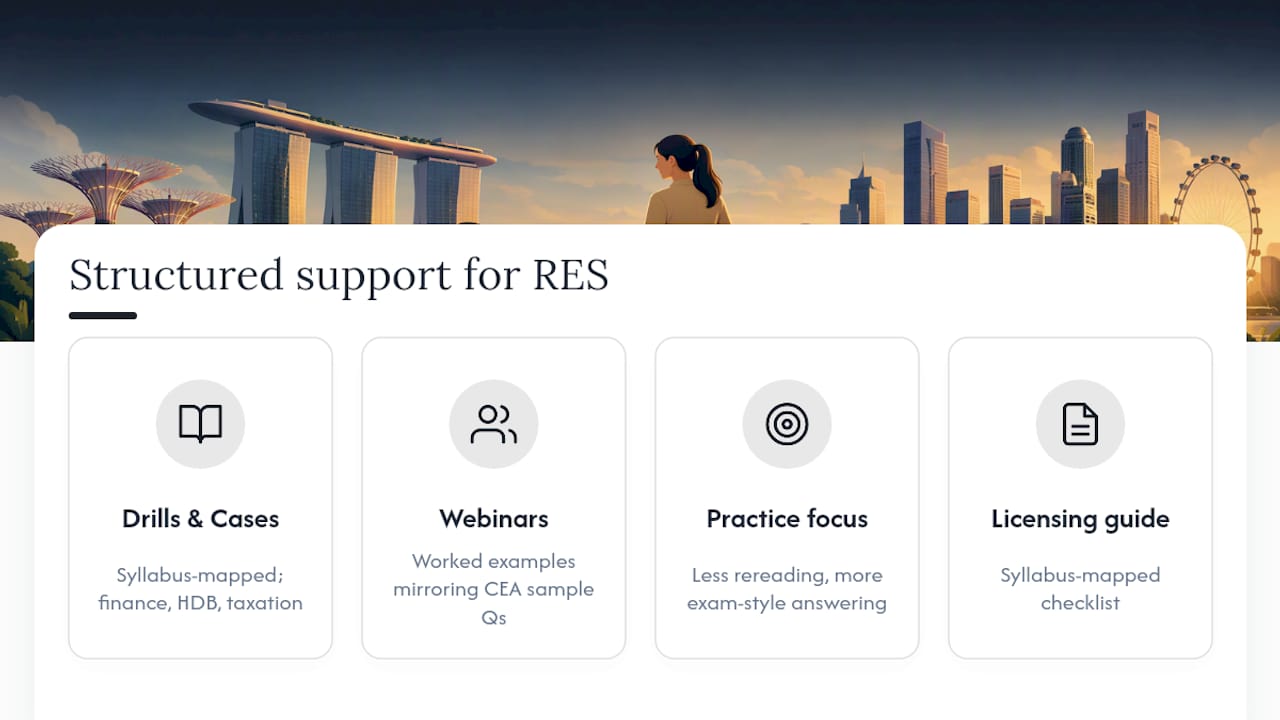
Passing the RES exam consistently comes down to output-focused practice, not just reading time. An effective approach to new-agent preparation leans on syllabus-mapped drills and mock case studies built around the exact high-difficulty topics covered above: property finance, HDB rules, and taxation.
Webinar-based training sessions walk through worked examples the way CEA’s own sample questions are structured, tagged by cognitive level rather than treated as generic revision notes. The goal is simple: fewer hours spent re-reading, more hours spent answering questions the way the real exam asks them. A detailed licensing guide mapped to the syllabus rounds out the practical side of preparation for candidates who want a checklist to follow.
A Straight Answer on What Actually Separates Passers From Failers
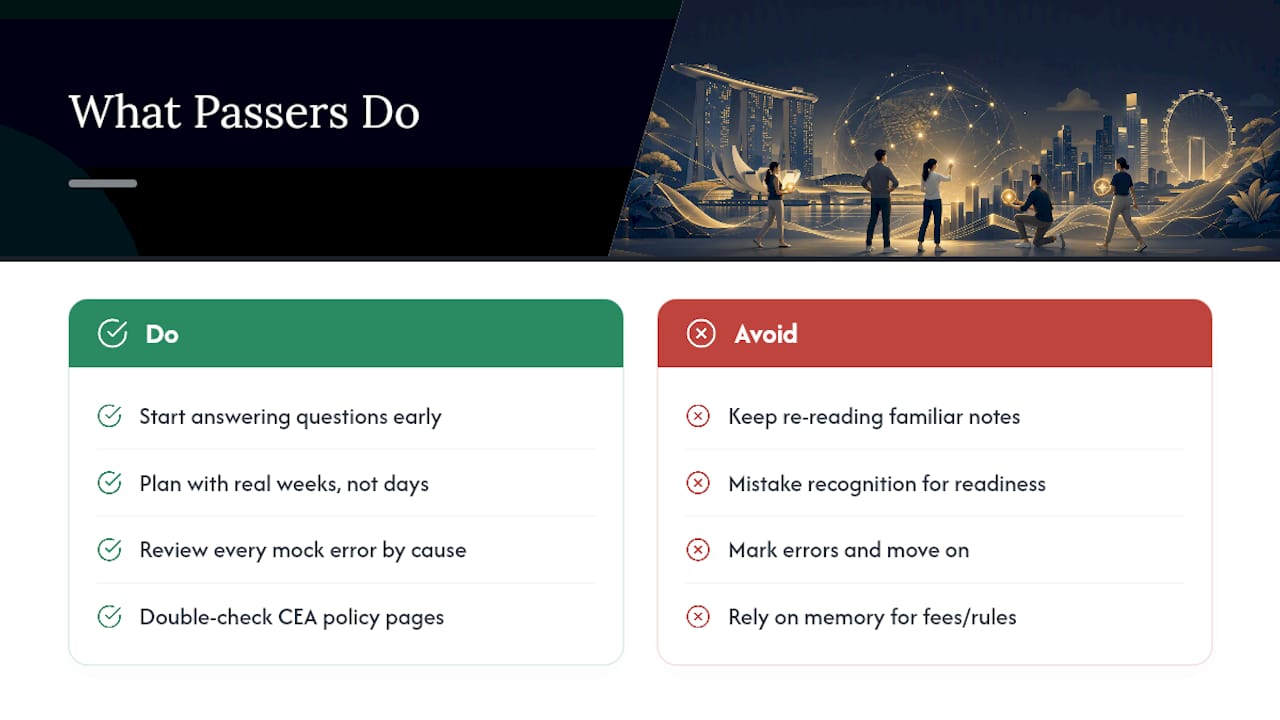
Candidates who pass tend to share one habit: they stop reading notes early and start answering questions instead. The ones who struggle usually keep re-reading material that already feels familiar, mistaking recognition for readiness.
Give yourself real weeks, not days, and review every mock exam error by cause rather than just marking it wrong and moving on. Always double-check policy details like fees and attendance rules directly on CEA’s official pages, since these do shift over time.
— Donny
Get Structured Support for Your RES Exam Prep
A structured support program can provide a faster path than studying alone from scattered PDFs and secondhand notes. Instead of piecing together practice material from forums and outdated guides, comprehensive RES prep pairs ongoing mentorship, syllabus-mapped training, and a career pathway that starts the moment you pass.

If you’re a new entrant still working through course registration, start with RES Course Registration and Career Opportunities with ERA, which walks you through onboarding alongside the exam prep itself. Already licensed and looking to sharpen your edge or switch teams? The #Toolkit Training resources are built for exactly that. Team leaders shaping others’ growth should look at the PG Success Road Map. And if live, remote practice fits your schedule better than solo study, the Digital Training Via Zoom Webinar sessions run drills that mirror the case-study format directly. Pick the page that matches where you are today and take the next step now.
Where to Verify the Details Yourself
Skip third-party claims about the RES exam and go straight to CEA’s own materials whenever you need to confirm a rule. The official exam preparation page covers format, fees, and eligibility. The sample questions PDF and the syllabus PDF show exactly how questions are weighted and worded. These calibrate difficulty better than any secondhand summary, including this one.
Sources
FAQ
How difficult is the RES exam compared to other Singapore licensing exams?
The RES exam is widely considered one of the tougher professional licensing tests in Singapore because it combines legal knowledge, calculation-heavy application, and time-pressured case studies in a single sitting. It is manageable with structured, output-focused preparation rather than passive reading.
What is the passing rate for the RES exam?
CEA does not publish an official sitting-by-sitting pass rate, so treat any specific percentage you see elsewhere with caution. A detailed breakdown of what’s actually known about pass rates explains how to interpret the available data responsibly.
What happens after passing the RES exam?
Once you pass both papers, you become eligible to register with a licensed real estate agency and begin the CEA registration process to practice as a salesperson. The CEA registration process covers the exact steps and documentation required.
What is the most difficult subject on the RES exam?
Property finance, taxation, and HDB eligibility rules tend to cause the most errors because they involve calculation and multiple buyer permutations rather than simple recall. Case-study sections in Paper 2 test these topics hardest since they combine several rules into one scenario.
Do I need to pass both papers at the same time?
No. CEA allows a full sitting for both papers together or a modular sitting to attempt one paper at a time, which suits candidates spreading out their preparation. Each option carries a different fee, currently S$512.30 for full sitting and S$283.40 for modular, inclusive of GST.
Recommended
Comments