
How Long Does New Agent Ramp Time Really Take?


The median rep reaches quota in 11.4 weeks across sales and support teams, but property agents in a commission-driven, relationship-heavy business usually take several months before their pipeline looks dependable. The single biggest lever for cutting that timeline is deliberate, scored practice, specifically simulated role-play paired with real feedback, not another slide deck. Teams running three or more AI-assisted practice calls a week hit quota up to 42% faster than teams that skip structured rehearsal.
This article covers what you need to build your own plan:
Realistic ramp benchmarks and what changes them
The KPIs that actually define “ramped” for a property agent
A week-by-week 90-day playbook
The tools and dashboards that turn practice into measurable progress
The mistakes that quietly stretch a three-month ramp into a year
Key Takeaways
New agent ramp time shortens most reliably when frequent, scored practice and weekly KPI reviews replace one-time orientation and guesswork.
Point | Details |
Expect 3 to 6 months | Full ramp for property agents typically runs longer than the 11.4-week cross-industry median due to transaction complexity. |
Measure trends, not moments | Track lead-to-appointment rate, time to first unassisted listing, and pipeline growth weekly, not as a one-time checklist. |
Practice frequency drives speed | Three or more scored simulations weekly can cut ramp time roughly in half compared to sporadic practice. |
Extend onboarding past orientation | Schedule check-ins through month six, since SHRM guidance links longer integration to better retention. |
Use connected measurement tools | Myeracareer’s Agent Performance Dashboard links activity, coaching, and KPI trends into one feedback loop for new agents. |
Table of Contents
What Is a Realistic Ramp Time for a New Agent?
Cross-industry data puts median ramp at 11.4 weeks, roughly two and a half months, for reps to reach consistent quota performance. Real estate sales layers on more variables: licensing paperwork, market familiarity, and the slower natural cycle of a property transaction compared to a single sales call. That pushes the realistic window for a newly licensed agent to three to six months before pipeline activity looks steady rather than lucky.
Quick benchmark: Median ramp across sales teams sits at 11.4 weeks, but teams practicing three or more scored simulations weekly reach quota up to 42% faster than teams that don’t.
What stretches or compresses that window? Role complexity matters. An agent working HDB resale listings faces a shorter learning curve than one handling en-bloc negotiations or landed property. Practice frequency matters more. Coaching quality matters most of all, since a sharp weekly review catches bad habits before they calcify.
SHRM’s onboarding guidance recommends treating integration as an extended process, with formal check-ins at one month and again between three and six months. It notes that full onboarding often runs for an extended period when the goal is retention rather than just competence. That’s a longer horizon than most new agents expect, and it’s worth planning for rather than being surprised by.
How Do You Know When an Agent Is Actually Ramped?
Ramp isn’t a certificate you earn at the end of a course. Call Centre Helper defines ramp-up as the gap between an agent’s start date and the date they hit consistent proficiency on defined metrics, and the operative word is “consistent.” One good week doesn’t count. You’re looking for a trend line, not a finish line.
For a property agent, six KPIs give you that trend line:
Lead-to-appointment rate. What share of inbound or assigned leads convert to a scheduled viewing or consultation.
Time to first unassisted listing. How many days pass before the agent signs a listing agreement without a mentor co-signing the pitch.
Appointment-to-offer conversion. How often a viewing or consultation moves a deal forward.
Pipeline growth rate. Whether the number of active, qualified prospects is climbing week over week, not just churning.
Activity volume. Calls, viewings, and follow-ups logged against a weekly target.
Client feedback quality. Direct signals, referrals, or repeat inquiries, not just transaction counts.
Set a threshold for each, not a pass/fail cutoff but a band you’d expect a ramped agent to hold for three consecutive weeks. That’s what separates a lucky month from real competence.
Pro Tip: Track these numbers weekly from day one, even before you have enough data to see a trend. The habit of measurement matters more in week two than the numbers themselves.
Cadence matters as much as the metrics. Log daily activity, review it with a mentor weekly, and check the KPI trend monthly against the thresholds you set.
The 90-Day Ramp Playbook for New Agents
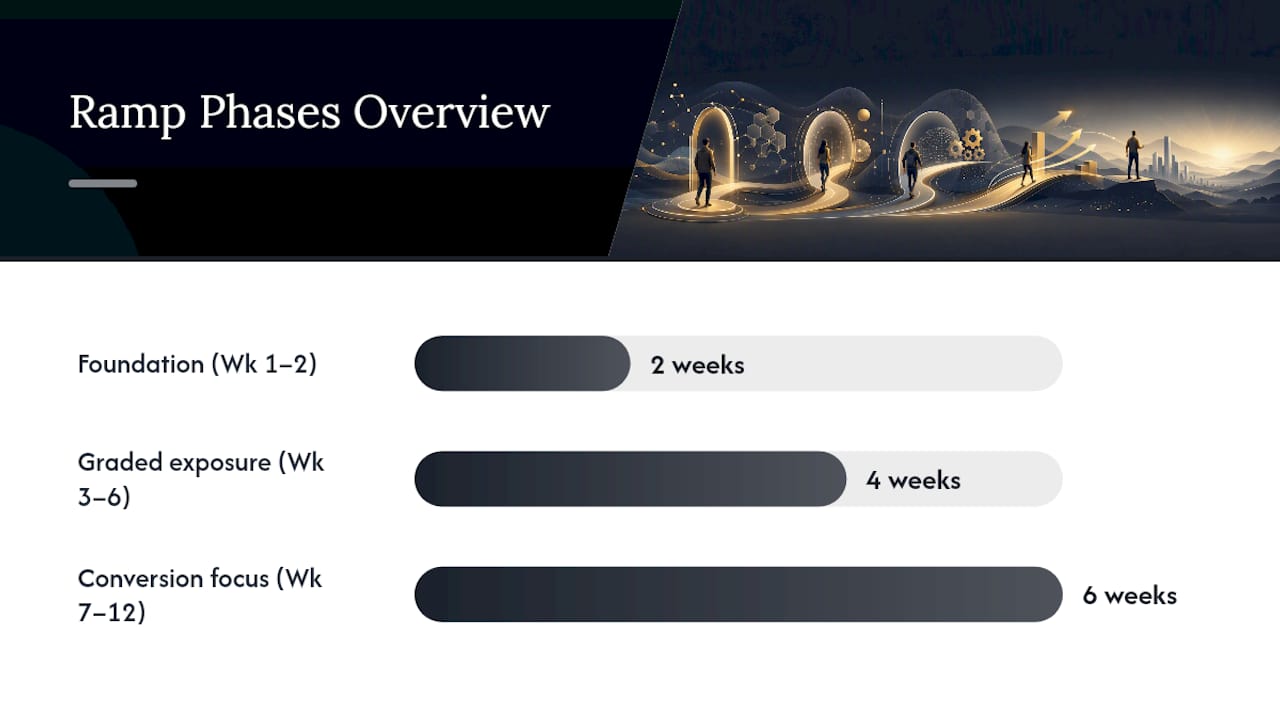
A structured 90 days beats an open-ended “figure it out” onboarding every time. Here’s how to break it down.
Weeks 1 to 2: Foundation
Complete orientation and CRM setup, including importing any existing contacts.
Shadow two to three experienced agents through full client interactions, from first call to closing walkthrough.
Run short, scored role-play sessions daily, five to ten minutes each, covering basic objection handling and listing pitches.
Begin low-stakes outreach to warm leads under supervision.
Weeks 3 to 6: Graded exposure
Shift role-play toward harder scenarios: price objections, competing agent situations, difficult negotiations.
Take on your first independent appointments with a mentor reviewing outcomes afterward, not sitting in.
Get daily micro-coaching, five minutes on one specific behavior, rather than a single long weekly session.
Practice at least three scored simulations per week. Call Flow’s analysis found agents hitting that frequency cut time-to-full-ramp roughly in half, from six weeks down to three, compared to agents practicing sporadically.
Weeks 7 to 12: Conversion focus
Prioritize listing appointments and showings over administrative tasks.
Clean up pipeline hygiene weekly: dead leads out, stalled deals flagged, next actions assigned.
Run a formal KPI review every week against the thresholds you set in month one.
Begin transitioning off intensive coaching into the steady-state routine you’ll use for the rest of your career.
The through-line across all three phases is repetition with feedback. An agent who does ten real client calls with no review learns less than one who does five calls followed by five scored rehearsals of the parts that went wrong.
Which Tools Actually Track Ramp Progress?
Good tools don’t replace coaching, they make coaching sharper by showing exactly where an agent is stuck. A workable stack has four pieces: a CRM for pipeline visibility, call recording with quality scoring, a simulation or AI role-play tool for rehearsing hard conversations, and a dashboard that turns all of it into a trend you can act on.
The Agent Performance Dashboard is built for exactly this: it pulls activity and KPI data into one view so mentors can spot a slowing trend before it becomes a three-month slump.
Training, assistive tools, quality monitoring, and coaching work best as one connected system. Bought and run separately, they generate data nobody reconciles. Wired together, they form a feedback loop where a bad rehearsal call flags a coaching topic, and a coaching fix shows up in next week’s numbers.
To set this up without overengineering it:
Baseline your KPIs in week one, even with imperfect numbers.
Automate a weekly report so trend checks take minutes, not an afternoon.
Tag simulation scores to the specific KPI they’re meant to move, not just a general “practice” bucket.
Review dashboard trends with a mentor every week during the first 90 days.
Common Ramp Mistakes That Quietly Extend Onboarding
Most extended ramp times trace back to one of four repeated mistakes.
Ending onboarding at orientation. A one-week induction isn’t onboarding; it’s an introduction. Fix it by scheduling structured check-ins through month six, in line with SHRM’s guidance on extended integration.
Skipping rehearsal of hard scenarios. Agents who face their first tough negotiation live, with a real client, tend to freeze or fumble it. Front-load escalations and negotiation edge cases into simulated practice so the first time isn’t the real time.
Measuring only averages. A team average can look healthy while one or two agents quietly stall. Track variance across your cohort, not just the mean, so slow starters get coaching before month four.
Running a disconnected tech stack. A CRM that doesn’t talk to your coaching notes or simulation scores makes it hard to see cause and effect.
Pro Tip: If your ramp feels stuck, check variance before you check the average. One struggling agent buried in a healthy team average is invisible until someone looks for it.
Training That Matches How New Agents Actually Learn
Not every new agent absorbs a script the same way, and treating training as one-size-fits-all is a common reason ramp drags. Some agents learn fastest by watching, others by doing, and a rigid curriculum built around lectures and manuals underserves both.
Effective programs mix formats deliberately. Shadowing covers observational learners. Scored role-play, ideally short and frequent rather than long and occasional, covers agents who need repetition to build muscle memory. Written scripts and CRM playbooks serve agents who process information best on the page. Interactive, simulation-based training has been shown to compress training timelines that used to run several weeks into a matter of days when it replaces passive lecture formats.
The other variable is pace. A rigid 90-day curriculum applied identically to every hire ignores that some agents need more reps at the objection-handling stage while others are ready to move to live appointments faster. Build checkpoints, not fixed dates, so an agent’s own KPI trend decides when they graduate to the next phase rather than the calendar.
Peer training deserves more credit than it usually gets. Pairing a new agent with someone six months ahead of them, rather than only a senior mentor, often surfaces the exact confusion points a newcomer has, because the peer solved the same problem recently and remembers how.

What Does Ramping Up Actually Cost in Time and Money?
Plan on ramp requiring real, protected hours, not leftover time between appointments. A realistic weekly commitment during the first 90 days runs eight to twelve hours dedicated to structured practice, shadowing, and coaching reviews, on top of live client work. Compress that number and ramp stretches; new agents who treat training as optional when a lead comes in tend to be the ones still struggling at month six.
The time cost falls on three parties: the new agent, who needs to show up for scored practice even when it feels slower than just calling leads directly; the mentor or team lead, whose weekly review time is the highest-leverage hour in the whole plan; and the agency, which needs to provide the tools and structure rather than leaving onboarding to informal osmosis.
Financially, the investment is mostly time and infrastructure rather than large upfront cash outlay for most agents, since CRM access, training materials, and mentorship are typically part of what a brokerage provides. The real cost of skipping this investment shows up later: a slower ramp means fewer transactions in the first year, which affects both income and confidence. Agencies that treat the first 90 days as a real cost center, staffing mentors and building structured programs, consistently see faster time to productivity than agencies that hand a new agent a desk and a lead list.
How Do You Stay Motivated During a Slow Ramp?
Ramp is uneven, and the emotional low points usually hit around week four to six, right when the initial orientation excitement fades and real client rejection starts landing. Knowing that dip is normal, not a sign something’s wrong, helps agents push through it rather than second-guessing the career choice.
Structured support matters here as much as skill training. Weekly check-ins with a mentor should include a genuine question about how the agent is feeling about the pace, not just a KPI readout. Small, visible wins, a first unassisted appointment, a positive client callback, deserve real recognition, because early wins are what convert uncertainty into momentum.
Isolation is the quiet ramp-killer. Agents who ramp fastest tend to have a peer group going through the same stretch at the same time, someone to compare notes with who isn’t a supervisor. If your brokerage doesn’t build that in formally, find it informally: a group chat with your cohort, a standing coffee with another new agent, anything that normalizes the hard weeks.
Progress that’s visible on a dashboard also does real motivational work. Watching a lead-to-appointment rate climb from 8% to 15% over a month is concrete proof that the effort is working, even when the commission checks haven’t caught up yet.
What I’ve Learned Watching New Agents Ramp
The agents who ramp fastest aren’t the most naturally talented, they’re the ones who treat practice like a job requirement instead of an inconvenience. One agent I watched go through a structured 90-day plan cut what would normally be a five or six-month stretch to closer to ten weeks, mostly by refusing to skip scored role-play sessions even during weeks when live leads felt more urgent.
The data backs that instinct: daily practice and weekly KPI checks produce faster results than talent or motivation alone. Building the measurement habit early, before you feel like you need it, is what separates agents who ramp on schedule from agents who are still finding their footing at month eight.
How MyERA Career Helps You Ramp Faster
Myeracareer built its new-agent program around the exact gap most brokerages leave open: structured mentorship paired with real measurement, not a manual and a desk. New agents get guidance through the RES exam and CEA licensing requirements, a personalized mentorship track, and access to the Agent Performance Dashboard so your KPI trend is visible from week one instead of guessed at in month four.

If you’re newly licensed and want your first 90 days to look like the playbook above rather than a scramble, visit the New Agents program to see how the mentorship structure and dashboard tools work together. Booking a baseline conversation now means your ramp clock starts with a plan already in place, not three weeks in once you realize you need one.
Frequently Asked Questions
How long does it take for a new real estate agent to become productive? Most newly licensed agents reach consistent productivity in three to six months, though the pace depends heavily on practice frequency and coaching quality rather than time alone.
What’s a good KPI to track during ramp-up? Lead-to-appointment conversion rate is one of the clearest early signals, since it reflects both prospecting effort and pitch quality before a single deal closes.
Does onboarding really need to last a year? Full onboarding activity often extends up to 12 months when the goal is long-term retention, according to SHRM, even though core proficiency usually arrives well before that.
Can AI role-play actually shorten ramp time? Yes. Teams practicing three or more AI-assisted scored calls weekly have reached quota up to 42% faster than teams without structured rehearsal.
What’s the biggest mistake that extends ramp time? Treating orientation as the end of onboarding. Agents who get structured check-ins and coaching through month six consistently ramp faster than those left alone after week one.
Sources
Recommended
Comments