
Six Real Estate Negotiation Tactics with Scripts for Agents


The most effective negotiation posture in real estate combines a data-backed anchor, documented preparation, and a genuine willingness to use a property negotiation strategy for Sydney buyers that trades contract terms instead of just price. Four tactics do most of the work: a tight CMA before you open your mouth, precise anchoring with non-round numbers, tiered inspection demands, and knowing your BATNA well enough to walk away calmly. What follows are the scripts and sequences that make those tactics work in practice, for agents and buyers alike.
TL;DR:
Building a strong CMA with three to five comparable sales and proof of funds is crucial for credible negotiation tactics.
Anchoring with precise, non-round numbers backed by recent comps tends to reduce subsequent offer sizes.
Tiered inspection requests, focusing first on safety and structural issues, have led buyers to save an average of $14,000.
Using term trades like rent-back, credits, or warranties often closes deal gaps better than simply lowering the price.
Silence and tone control, along with understanding buyer and seller psychology, significantly improve negotiation outcomes.
Table of Contents
Six High-Impact Negotiation Strategies Real Estate Pros Rely On
Every deal has a handful of moments where leverage actually shifts. These six negotiation strategies for real estate transactions cover most of them, and the order below roughly matches when you’d deploy each one in a typical deal cycle.
Build a CMA and gather proof of funds first. A credible number backed by three to five comps carries more weight than confidence alone.
Anchor with precision, then use escalation clauses carefully. Round numbers read as guesses; specific ones read as analysis.
Tier your inspection requests. Lead with safety and structural items, not the chipped tile in the guest bath.
Trade terms before you trade price. A leaseback or credit often closes a gap that a lower number never would.
Read days on market and build a real BATNA. Time pressure cuts both ways, and it usually favors whoever has options.
Use silence and pick up the phone. Agent-to-agent rapport built over a call outperforms a chain of clipped texts.
How Do You Prepare a Negotiation With Data Instead of Guesswork?
Preparation is what separates a negotiator from someone who’s just hoping the other side blinks first. Before you draft an offer or a counter, you need a comparative market analysis tight enough to defend line by line, not a printout of everything within a mile radius.
A useful CMA sticks to three to five truly comparable sales, adjusted for condition, square footage, and location, so preparation grounded in comps and proof of funds is what turns an emotional back-and-forth into an analytical one. Pair that with hard paperwork: pre-approval letters, proof of funds, and, where repairs are on the table, real contractor estimates rather than round-number guesses.
Before any offer goes out, agents should nail down who actually holds decision-making power on the other side, whether it’s an owner, a listing agent with discretion, or an estate executor, and set a firm BATNA: at least one backup property or backup buyer lined up in case this deal stalls.
Three to five adjusted comps, no more
Pre-approval or proof of funds attached
Contractor estimates for any known repair issues
A named decision-maker and a real fallback option
Pro Tip: Tools like the resources in Best CMA Software for Real Estate Agents can help reduce CMA turnaround time, which matters when a hot listing gives you hours, not days, to respond.
When Should You Set the Anchor vs Let the Seller Go First?
Set the anchor when you have strong comps and the listing is priced loosely; invite the other side to name a number first when pricing is ambiguous or you’re missing recent sales data. A credible anchor is built from your CMA plus honest condition adjustments, not from splitting the difference between asking price and what you’d love to pay.
Precise increments do real work here. A counter of $412,500 instead of $410,000 signals you’ve actually calculated something, and anchoring backed by data tends to shrink counteroffers compared with round-number offers that read as arbitrary.
Escalation clauses deserve caution. They can win a multiple-offer situation, but a poorly written one exposes your ceiling to a listing agent who’s paying attention.
Anchor first when your comps are recent and tight
Use non-round increments like $3,500 or $7,250, never flat thousands
Require written verification of a competing offer before an escalation triggers
Add appraisal-gap protection so escalation clauses don’t leave buyers overexposed if the appraisal comes in low
What’s the Right Way to Use Inspection Findings as Leverage?
Inspection reports work best when you sort every finding into three tiers instead of dumping a twelve-page list on the seller: safety and structural issues first, high-cost mechanical or roofing items second, cosmetic flaws last. Lead with the roof and foundation, and you keep credibility; lead with a scuffed baseboard, and you lose it.
Attach real contractor estimates to the top two tiers, itemized by line, and decide upfront whether you’re asking for a price reduction, a credit at closing, or the seller completing the repair. Credits tend to move faster because they don’t require the seller to manage contractors before closing.
Buyers who negotiate on inspection findings save an average of roughly $14,000 through inspection-based renegotiation in practitioner case studies, a figure large enough that skipping this step on a flawed property leaves real money on the table.
Tier one: foundation, roof, electrical, structural safety
Tier two: HVAC, water heater, major appliances
Tier three: paint, minor cosmetic wear, concede these for goodwill
Match the ask to the tier: reduction or repair for tier one, credit for tier two
What Terms Can You Trade Besides Price?
Sellers who won’t move on price will often move on everything around it. A rent-back arrangement that lets the seller stay for two or three extra weeks, a closing cost credit, included appliances, or a home warranty can all bridge a valuation gap without either side touching the headline number.
The trick is packaging: present these as solving a specific problem for the other party rather than as a discount in disguise. A seller worried about finding temporary housing values a 30-day leaseback far more than a buyer might expect. Notice periods and possession timing matter here too, and agents unfamiliar with how rental transition timing works sometimes miss an easy concession that costs the buyer nothing.
Seller rent-back for 2 to 4 weeks post-closing
Closing cost credits in place of a price cut
Included appliances or furnishings
A home warranty, often under $700, that removes a sticking point entirely
Trading terms instead of price closes more stalled deals than another round of number-chasing ever does.
How Does Silence and Tone Actually Win Concessions?
Calibrated silence is one of the most underused negotiation techniques for agents, and it costs nothing to deploy.
State your offer or counter clearly, then stop talking. Don’t fill the pause with justification.
Let a five to ten second silence sit after a number is on the table. Silence after an offer frequently prompts the other party to concede or reveal information they hadn’t planned to share.
Ask open questions that surface motivation: “What’s driving your timeline on this move?” works better than “Are you flexible on price?”
Move complex or emotionally loaded points to a phone call or an in-person meeting. Reserve text and email for confirming details already agreed.
Mirror the counterparty’s pace. A methodical listing agent responds better to a measured tone than a rushed one.
Pro Tip: Practicing these lines out loud matters more than reading them. The modular prospecting scripts built for cold calls translate directly to negotiation calls, since both rely on comfortable pauses.
How Do Days on Market and BATNA Change Your Leverage?
Days on market is one of the clearest signals in the entire transaction. Seller flexibility tends to increase after 30 to 45 days on market, especially if there’s already been one price cut, and a buyer who spots that pattern can push harder on price while a buyer facing a five-day-old listing should focus on terms instead.
Uncovering timing pressure without sounding adversarial usually means asking practical questions: where are they moving, do they have a closing date already lined up elsewhere. The answers tell you how much urgency you’re actually working with.
Track DOM and any price history before writing an offer
Line up a genuine backup property or backup buyer, since optionality is what actually protects a buyer from overbidding emotionally
Signal a walk-away calmly: “This works well for us at $X, but we understand if that doesn’t fit” leaves the door open without sounding like a bluff
Worked Scenarios and Scripts You Can Use Today
Two scenarios show how these negotiation tactics for real estate combine in practice.
The stuck-on-price deal: A seller won’t move below asking, but the buyer’s CMA supports $18,000 less. Instead of pushing price further, the agent offers full asking price with a 21-day seller rent-back and a $5,000 credit toward closing costs. The seller accepts because the rent-back solves their housing gap.
The multiple-offer situation: Six offers land on one listing. The winning buyer skips an escalation clause entirely, submits a clean offer $4,750 over the next-highest comp-supported number, waives a minor contingency, and includes a personal note. The seller picks certainty over the highest number on paper.
Short scripts worth memorizing: “Based on the three closed comps within half a mile, we’re comfortable at $X.” “We’d like 24 hours to review the inspection before we respond.” “What matters most to you in this sale, the number or the timeline?” Agents can rehearse these using the objection-handling scripts and one-week practice plan built for exactly this kind of drilling.
How Do You Manage Emotion and Psychology at the Table?
Real estate negotiation is never purely financial. Buyers get attached to a kitchen they’ve already mentally decorated; sellers get defensive when a childhood home gets picked apart in an inspection report. The agents who close the most deals aren’t the ones with the sharpest spreadsheets, they’re the ones who read the room before they read the numbers.
Watch for anchoring bias in your own client first. A buyer who fell in love with a listing on day one will often overvalue it relative to the comps, and your job is to bring them back to the data gently, not to lecture them out of their enthusiasm. On the other side, sellers frequently confuse sentimental value with market value, and a direct challenge to that (“this house isn’t worth what you paid in 2021”) tends to backfire.
Loss aversion is the psychological lever worth understanding best. People feel a potential loss roughly twice as sharply as an equivalent gain, which is why framing a concession as “keeping the deal together” lands better than framing it as “losing $10,000.” Frame requests around what both sides keep, not just what one side gives up.
Reading tone on a call matters more than most agents credit. A pause that’s a little too long, a voice that tightens on a specific number, these are real signals, and they’re part of why phone and in-person negotiation outperforms text-based back-and-forth when something substantive is on the line.
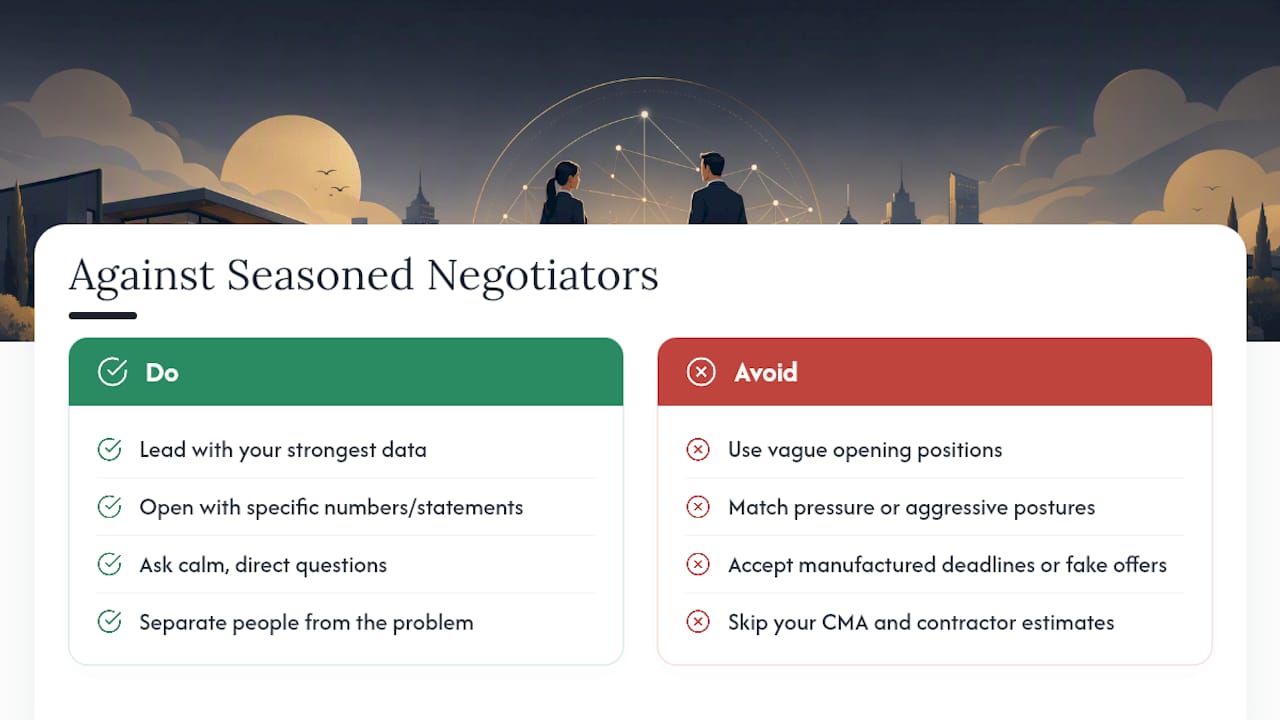
What Works Against a Tough or Seasoned Negotiator?
Experienced listing agents and investor buyers negotiate differently than a first-time seller, and treating them the same way is a common mistake. They know the standard scripts, they’ve heard the standard objections, and they’re rarely rattled by a firm number.
Against a seasoned opponent, lead with your strongest data first rather than saving it for a counter. Vague opening positions invite them to test you, and testing wastes time both sides could spend closing. Specificity signals you’ve done real homework, and that alone changes how a sharp negotiator treats your next move.
Difficult counterparts often use pressure tactics: manufactured deadlines, claims of other offers that may or may not exist, or a flat refusal to explain their reasoning. The right response is rarely to match the aggression. Ask a direct, calm question instead: “Can you help me understand what’s driving that number?” It forces them to either justify their position or drop the posture.
Some agents on the other side negotiate collaboratively even when representing a tough client, and it’s worth distinguishing the person from the position. Frameworks from Harvard’s Negotiation Project consistently point to separating the people from the problem, useful advice when a listing agent’s combative tone doesn’t actually match the flexibility their seller privately has.
Above all, never let a tough counterpart rush you into skipping your own preparation. The CMA and the contractor estimates matter more, not less, when the person across the table is experienced enough to exploit a soft spot.
How Do Contingencies and Contract Clauses Factor Into Negotiation?
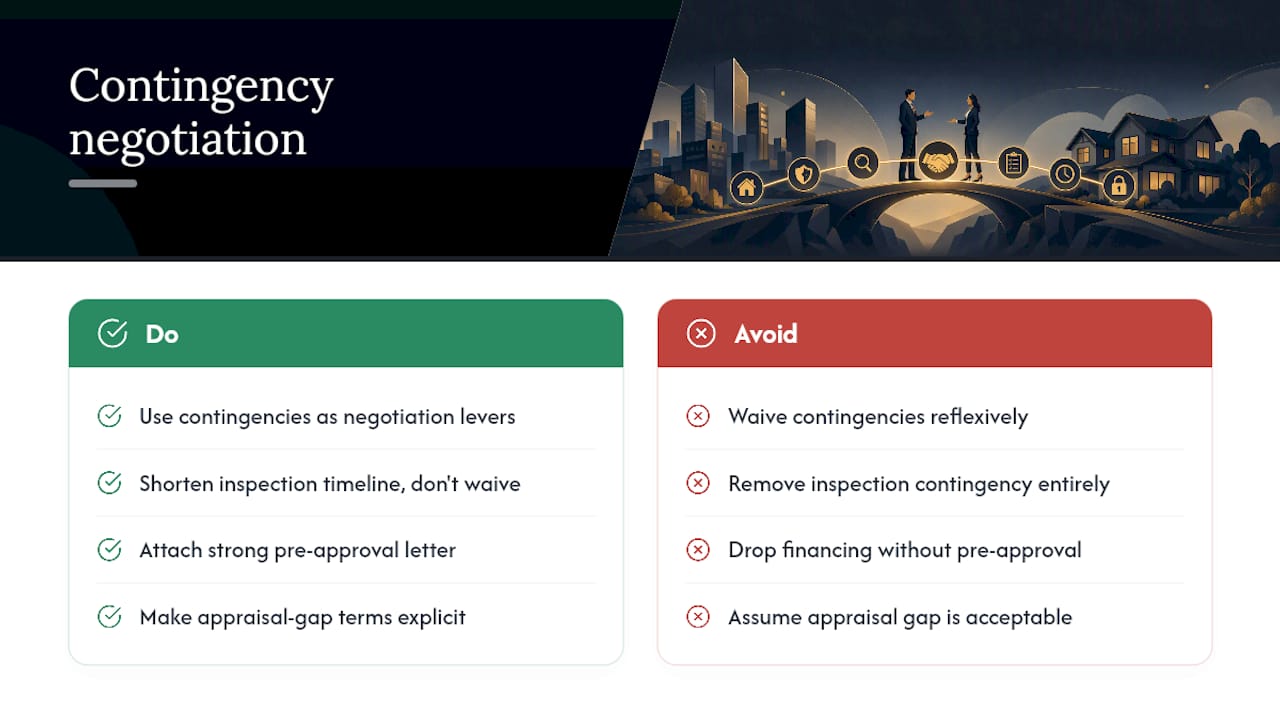
Contingencies are negotiation levers, not just legal boilerplate, and agents who treat them as fixed boilerplate miss real opportunities to shape a deal. Inspection, financing, and appraisal contingencies each carry their own leverage, and waiving one strategically is different from waiving it because a client feels pressured.
An inspection contingency gives you the tiered renegotiation power covered earlier; shortening its timeline (five days instead of ten) can make an offer more competitive without giving it up entirely. A financing contingency matters most in a market where sellers worry about deals falling through late, so a strong pre-approval letter attached upfront often does more work than removing the contingency outright.
Appraisal contingencies deserve particular care alongside escalation clauses. Waiving the appraisal contingency to win a bidding war means the buyer covers any gap between the appraised value and the purchase price in cash, a real financial exposure that needs to be explicit and agreed to, not assumed.
Possession and closing date clauses are softer contract terms that frequently get overlooked as negotiation tools. A flexible closing date costs a buyer nothing financially but can be worth more to a seller than a few thousand dollars in price, particularly when tied to their own move.
The general rule: never negotiate away a contingency to win a deal faster if the underlying risk it protects against, financing falling through, a bad inspection surprise, an appraisal gap, still exists. Trade contingencies deliberately, with your client fully aware of what they’re giving up, not as a reflexive way to look more competitive.
How Should Agents Practice and Track These Skills?
Negotiation improves with repetition, not theory. Role-play a full offer-to-close cycle weekly, tracking close rate, average dollar savings per deal, and days from offer to accepted terms. Those three numbers tell you more about your progress than any script alone.
Donny has spent years inside recruitment and training for real estate teams, watching new agents confuse aggression with leverage and seasoned agents win quietly through preparation instead. The internal training paths available include structured mentorship for agents working toward RES exam readiness, built around that same practice-and-measure approach.
— Donny
Sources
If you’re building these skills toward a full-time career, Myeracareer’s new agent onboarding program folds negotiation training directly into RES exam preparation and early mentorship, while agents already licensed and looking for a stronger team structure can explore opportunities for experienced agents and team leaders built around the same coaching model.
Recommended
Comments