
Delegation Matrices and Meeting Rhythms for Real Estate Leaders


A real-estate leadership framework is a capability-first system that ties decision rights, team rhythms, and KPIs directly to deal and asset outcomes. It names the specific behaviors a leader must show, maps them to a stage in that leader’s career, and sets a cadence of meetings and scorecards that turn those behaviors into repeatable results. Done right, it produces faster decisions, cleaner delegation, and a team that scales without the leader burning out.
TL;DR:
Networking capability and risk management are the most critical domains for deal flow and deal survival, according to research on real estate leadership.
Effective leaders translate core domains into observable behaviors, such as setting quarterly priorities, flagging risks early, and coaching under pressure.
Leaders at different stages need tailored development: early-stage focus on fundamentals, emerging leaders on judgment calls, and strategic leaders on portfolio oversight.
Building a delegation matrix with clear decision thresholds and establishing disciplined cadences improves decision-making and prevents bottlenecks.
Technology dashboards should blend leading and lagging indicators, but leaders must treat data as a starting point and prioritize relationship and team health.
Table of Contents
What Are the Core Domains of a Real Estate Leadership Model?
Six domains show up consistently in research on effective housing and property leadership: strategic management, industry expertise, networking capability, risk management, emotional intelligence, and leadership ethics. A six-component study of real estate executives found networking capability and risk management carried the most weight for operational success, ahead of the other four.
That ranking makes sense once you consider how real estate actually moves. Deals close in bursts, not on a steady schedule, so a leader’s network determines deal flow while risk judgment determines which deals survive due diligence.
Strategic management — setting direction on inventory mix, geography, and growth pace
Industry expertise — reading market cycles, financing conditions, and regulatory shifts
Networking capability — building the referral and investor relationships that generate deal flow
Risk management — pricing exposure correctly before capital or reputation is committed
Emotional intelligence — managing agents and clients through high-stakes, emotional transactions
Leadership ethics — protecting trust across investors, agents, and buyers
Rick Tollakson’s “Eight to Great” model adds a seventh consideration worth folding in: aligning business goals with community impact and a solution-focused culture so the vision survives past any single deal cycle.
How Do You Measure Leadership Capabilities in Practice?
Domains only matter once they translate into behaviors you can observe in a weekly meeting or a closed deal file. Here’s a working set of capability statements, each paired with what “good” looks like on the ground:
Sets quarterly priorities — publishes a written portfolio or team plan before the quarter starts.
Reads market signals early — adjusts pricing or listing strategy within two weeks of a rate or inventory shift.
Builds referral pipelines — tracks a personal network map and logs new introductions monthly.
Flags risk before commitment — requires a written risk note on any deal above a set exposure threshold.
Coaches under pressure — debriefs a lost deal with the agent within 48 hours, not weeks later.
Delegates with clarity — hands off decisions with a defined dollar or scope limit, not vague trust.
Runs disciplined meetings — every weekly sync ends with owners and dates, not just discussion.
Holds ethical lines — discloses conflicts of interest before, not after, a transaction closes.
Reads a scorecard fluently — can explain a variance in NOI or conversion rate without pulling a report.
Develops successors — names and actively mentors at least one emerging leader.
Evidence of proficiency shows up in specific outputs: a written risk memo, a completed 360 review, or a scorecard variance explained in under two minutes. Harvard Business Review’s leadership style assessment offers one structured way to convert a leader’s natural style into a targeted development plan rather than generic coaching.
Which Development Path Fits Each Career Stage?
A framework that treats a two-year agent and a fifteen-year team leader the same way wastes both their time. Development should sequence by stage, with each stage building the muscle the next one requires.
Early-stage leaders (first 1 to 3 years leading others) need to master fundamentals before anything else:
Running a clean, on-time team meeting every week
Learning to read a basic P&L or commission report
Practicing delegation on low-stakes tasks first
Building one or two dependable referral relationships
Emerging leaders (managing a growing team or a small portfolio) shift toward judgment calls:
Owning pricing and negotiation strategy on mid-size deals
Sitting in on investor or vendor conversations as an observer, then a co-lead
Running a formal risk review before any deal above a set threshold
Mentoring one early-stage agent directly
Strategic leaders (portfolio or brokerage-level responsibility) operate one level removed from daily transactions:
Setting the delegation matrix other leaders operate inside
Representing the business in investor or lender relationships
Building succession plans, not just filling open roles
Reviewing portfolio-level KPIs quarterly rather than deal-by-deal
Sequencing matters more than speed here. A leader who skips the fundamentals stage and jumps straight to investor exposure tends to make confident decisions on incomplete information, which is exactly the failure mode risk management is supposed to catch. MyEraCareer’s career progression roadmap lays out this staging in more detail for agents mapping their own trajectory.
Building the Playbook: Delegation, Cadence, and KPIs
Generic leadership advice tends to ignore what makes real estate different: cash flow arrives in bursts, deal cycles run long, and every decision eventually touches an investor or a client’s largest financial commitment. A workable playbook has to be built around that reality, not around a textbook org chart.
Start with a delegation matrix that separates two decision types. Asset-level decisions, things like pricing a single listing or approving a marketing spend under a set dollar threshold, belong to the agent or team lead closest to that deal. Portfolio-level decisions, such as entering a new market segment or restructuring commission splits, stay with the strategic leader. Writing this split down, with dollar thresholds attached, is what stops a leader from becoming the bottleneck every decision routes through.
Cadence comes next:
Weekly team sprints reviewing active deals and blockers
Monthly asset-level reviews checking performance against target
Quarterly portfolio reviews tied to strategic goals
Track a mix of lagging and leading indicators: NOI, conversion rate from lead to close, and activity metrics like calls or showings logged. MyEraCareer’s one-hour team meeting agenda gives a ready structure for the weekly sprint, and the agent scorecard metrics guide offers weighting examples for the monthly review.
Pro Tip: Build an exception protocol before you need one. Define in advance which deal problems get escalated automatically versus handled at the agent level. Without that line drawn ahead of time, every leader defaults to reviewing everything, which is how over-centralization creeps in.
How Should Technology and Data Shape Leadership Decisions?
Dashboards have replaced gut instinct as the primary tool serious leaders used to spot problems early. A leader watching conversion rates, days on market, and lead response times in one place catches a slowdown weeks before it shows up in closed revenue.
The mistake most teams make is tracking financial results only. NOI and closed commission tell you what already happened. Leading indicators, call volume, showing requests, follow-up speed, tell you what’s about to happen. A framework that blends both gives a leader room to correct course instead of just explaining a bad quarter after the fact. MyEraCareer’s agent performance dashboard approach pairs these two indicator types so a leader can scan both at a glance rather than pulling separate reports.
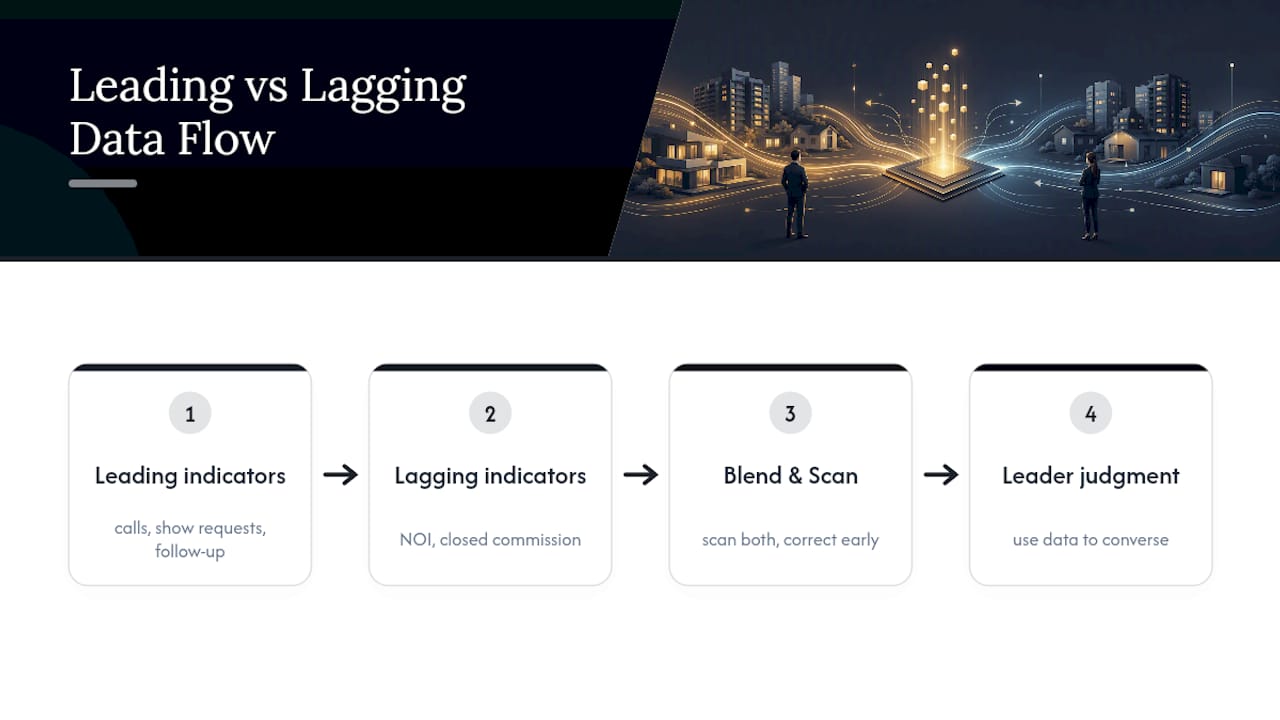
Technology also changes who does what. Automated lead routing and CRM scoring take over first-pass qualification, which frees a team leader’s time for the judgment calls a system can’t make, negotiation strategy, risk review, coaching a struggling agent. That shift only pays off if the leader actually reallocates the freed time toward those higher-value activities instead of absorbing more transactional work.
One caution worth stating plainly: dashboards report what’s measured, not what matters. A leader who optimizes purely for the numbers on a screen can miss client relationship quality or team morale, neither of which shows up cleanly in a spreadsheet. The strongest leaders treat data as a starting point for a conversation, not a replacement for one.
Leading Change When Market Conditions Shift Fast
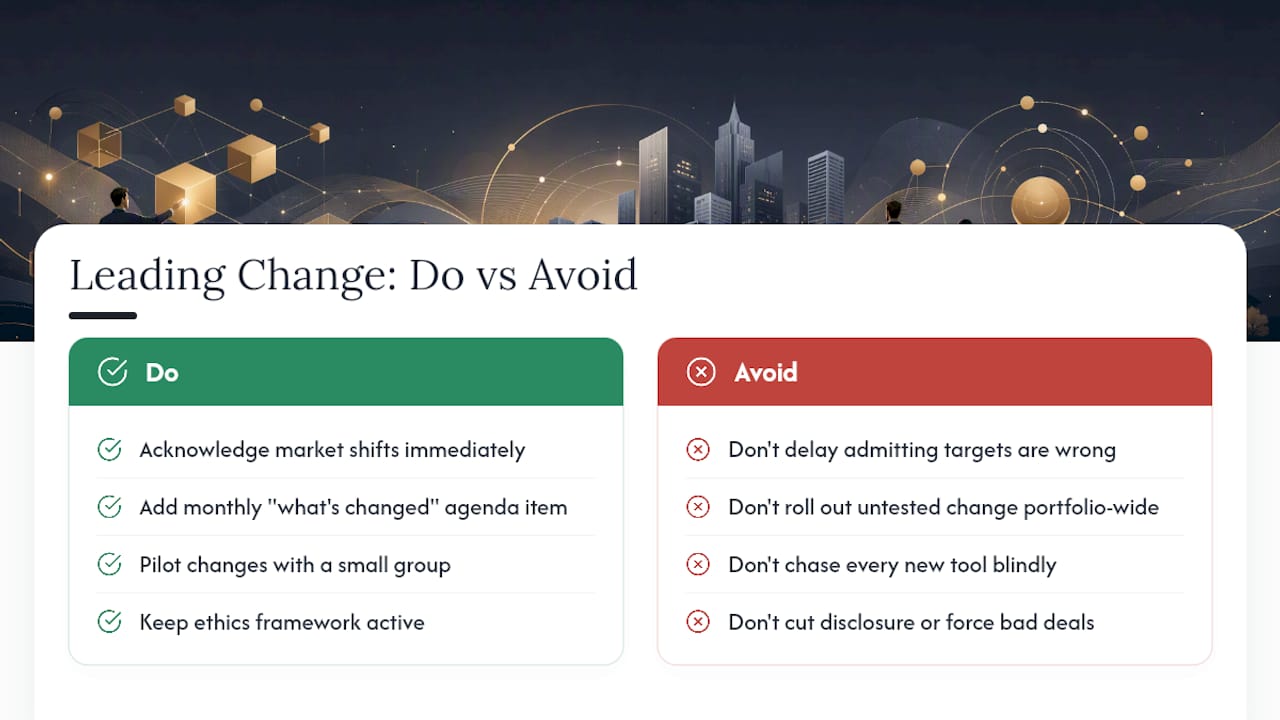
Real estate leadership gets tested hardest during a market shift, when the playbook that worked for the last two years stops working and nobody has agreed on the new one yet. A framework earns its value here or nowhere.
Change management in this industry has a specific failure pattern: leaders wait too long to acknowledge the shift because acknowledging it means admitting the old targets are wrong. By the time the team hears about it officially, agents have already noticed on their own, and trust in leadership takes the hit. The fix is structural, not motivational: build a standing item into the monthly portfolio review specifically for “what’s changed in the market,” so shifts get discussed before they become a crisis.
Innovation leadership in real estate looks less like chasing every new tool and more like disciplined piloting. A leader who tests one new process, a new lead-scoring method, a revised commission structure, with a small group before rolling it out portfolio-wide avoids the common trap of forcing untested change on an entire team at once. That explorer mindset, paired with disciplined execution once a pilot proves out, is what separates leaders who adapt well from those who either freeze or chase every trend.
The ethical dimension matters here too. During a downturn, the pressure to cut corners on disclosure or push a deal that shouldn’t close rises sharply. A framework’s leadership ethics domain is not decorative; it’s the thing that holds when incentives point the wrong direction.
What I’ve Learned Rolling Out These Frameworks
Recruitment and leadership development aren’t separate problems. Every leader I’ve watched succeed built their team by hiring for coachability and role potential first, technical skill second. Skills get taught. A resistance to feedback rarely does.
The most common rollout failure isn’t lack of effort, it’s unclear decision rights. A leader announces “the team will now delegate more” without ever writing down what counts as an asset-level call versus a portfolio-level one. Within a month, everyone defaults back to asking permission for everything, and the framework quietly dies. The fix takes an afternoon: write the dollar thresholds down, put them somewhere everyone can see, and stop relitigating them in every meeting.
Set realistic expectations on timeline. A new cadence of weekly sprints and monthly reviews takes about a full quarter to feel normal rather than forced. Leaders who expect instant traction abandon the structure right before it would have paid off. Give it ninety days before judging whether it’s working, and track the leading indicators, not just closed deals, during that window.
— Donny
How MyEraCareer Turns This Framework Into a Program
This program offers an integrated approach to leadership development tailored to real estate career stages and decision rhythms. Each service maps to a different point in the framework above.

New agents preparing for licensing start with RES course registration, which also opens the door to career opportunities with ERA once licensed.
Experienced agents ready to scale their production use the #Toolkit training to build the systems this article covers, from scorecards to pipeline tracking.
Team leaders managing a portfolio or a growing roster can work through the PG Success Road Map, built for exactly the delegation and cadence challenges outlined above.
Anyone wanting a faster way to build a specific skill can join digital training via Zoom webinar for focused, live upskilling without committing to a full program.
If you’re weighing whether your current agency actually supports this kind of structured growth, it’s worth comparing notes on what to look for in a supportive agency before deciding where to build your career next. Start with the RES course registration page to see which path fits where you are right now.
Sources
FAQ
What Are Examples of Leadership Frameworks Used in Real Estate?
Common examples include capability-based models built around strategic management, networking, and risk management, along with vision-driven models like Rick Tollakson’s “Eight to Great” framework, which ties business goals to community impact. MyEraCareer’s PG Success Road Map applies a similar capability-and-cadence structure specifically for team leaders.
What Are the 7 C’s of Leadership?
Definitions of the “7 C’s” vary by source and aren’t standardized in real estate leadership research specifically. Rather than relying on a single acronym, a more reliable approach for property leaders is the six-component model of strategic management, industry expertise, networking, risk management, emotional intelligence, and ethics, validated in real estate leadership research.
What Are the 5 P’s of Leadership?
Like the 7 C’s, the “5 P’s” framework isn’t a fixed standard within real estate leadership literature, and definitions differ across sources. Real estate leaders get more practical mileage from the domain-based approach covered in this article: strategy, industry depth, networking, risk management, and execution rhythm.
What Is the Leadership Framework Used in Property Management?
A property management leadership framework combines the same core capabilities, risk management, industry expertise, networking, with operational rhythms suited to ongoing asset performance rather than one-off deals. That means more emphasis on recurring KPIs like NOI and occupancy, tracked through regular scorecard reviews rather than deal-by-deal assessment.
How Do I Start Applying a Leadership Framework as a New Team Leader?
Begin with the delegation matrix: write down which decisions your agents can make independently and which require your review, with dollar thresholds attached. Pair that with a weekly meeting cadence, MyEraCareer’s one-hour team meeting agenda is a ready template, and give the new rhythm a full quarter before judging results.
Recommended
Comments