
Commission Split Models: What Agents Need to Know


For most agents, a capped or graduated split delivers the better long-term balance of support and earnings compared to a static low split that never improves with production. The 2026 US national average total commission sits around 5.46%, and agent-side splits typically run anywhere from 50/50 for new agents up to 100% commission models for high-volume producers who pay flat fees instead. Myeracareer’s own placement data backs this pattern across the agents it trains and mentors.
Two scenarios decide which model actually fits you:
New or part-time agent: prioritize a traditional or graduated split with strong training and lead support over a bare high percentage with no backup.
Consistent high producer: push toward a capped split or 100%-plus-fee model, since your production volume covers the fixed costs and the upside compounds fast.
Key Takeaways
Choosing among commission split models comes down to matching your production level and cash runway to a structure whose fixed costs you can comfortably outpace.
Point | Details |
Match model to production | New agents benefit from fixed or graduated splits with strong support; high producers benefit from capped or flat-fee models. |
Run the exact formula | Multiply sale price by total commission rate, side split, and agent-broker split before comparing any offer. |
Watch hidden fees | Transaction fees, franchise royalties, and technology charges can erode an attractive headline split. |
Get cap and reset terms in writing | Confirm what counts toward your cap and what happens to deals that straddle the reset date. |
Support changes the math | Myeracareer’s onboarding, coaching, and performance dashboard tools help agents reach cap-worthy production faster. |
Table of Contents
Commission Split Models: The Core Formula Agents Need
A commission split model is simply the agreed method for dividing the commission a brokerage earns on a sale between the brokerage and the agent who closed it. The math behind every split, no matter how the marketing brochure dresses it up, comes down to one formula: sale price × total commission rate × your side’s share × your agent-broker split percentage.
Three terms matter here. Total commission is the full percentage the seller agrees to pay, historically clustered in the 5% to 6% range. The side split divides that total between the listing brokerage and the buyer’s brokerage, a structure that has come under new scrutiny since the August 2024 NAR settlement changed how buyer-agent compensation gets negotiated and documented. The agent-broker split is what your brokerage then pays you out of its side.
Here’s an example math on a $500,000 home with a typical total commission rate, evenly split between listing and buyer sides, and an agent split that varies by experience:
Total commission is calculated by applying the total percentage to the sale price
The commission is then split between buyer and listing sides
The agent receives a portion of their brokerage’s share depending on their agreed split percentage
Pro Tip: Run this same formula against every offer you get from a brokerage. If a recruiter can’t walk you through each variable in under two minutes, that’s a sign their comp plan is more marketing than substance.
Comparing the Common Commission Split Models
Brokerages generally offer some version of four structures: fixed percentage, tiered or graduated, capped, and flat-fee or 100% plans. Team splits layer on top of any of these. Roughly 42% of agents work under a traditional fixed split, while about 19% work under a tiered arrangement, so the fixed model remains the default most new agents will encounter first.
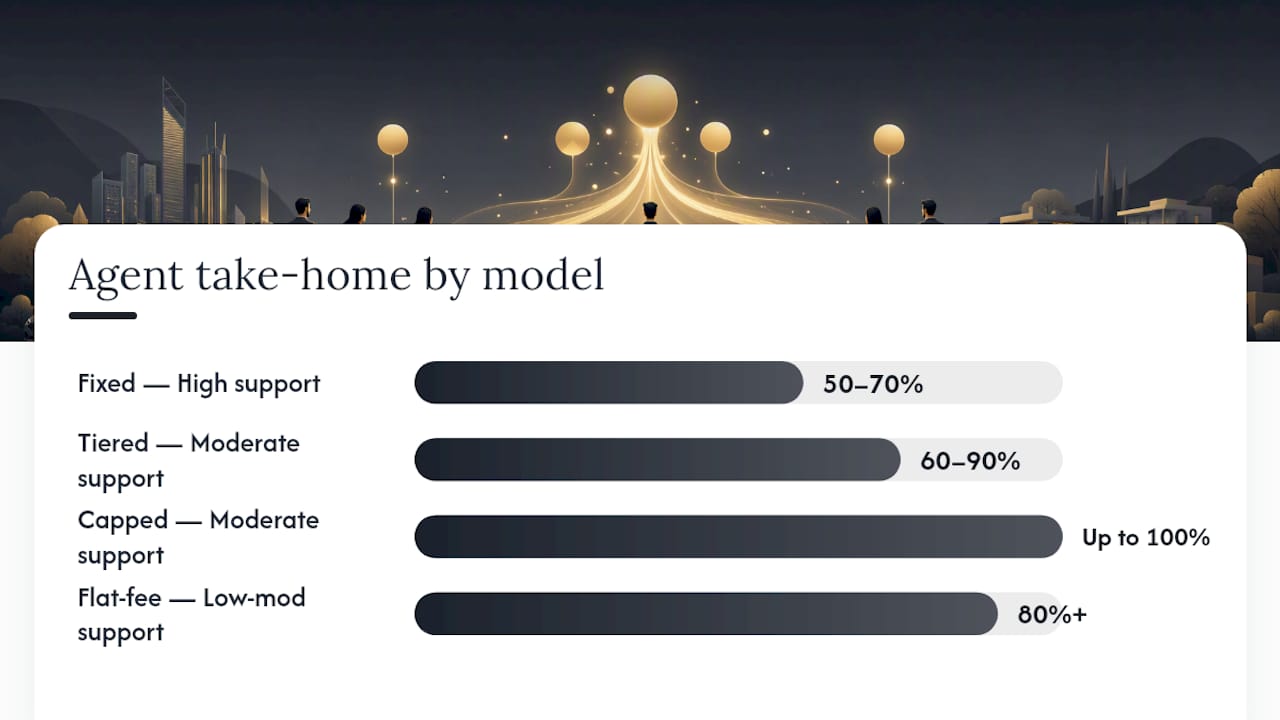
Fixed percentage splits lock in one ratio (50/50, 60/40, 70/30) for every closing regardless of volume. They suit brand-new agents who need predictable brokerage support and don’t yet have the production to justify a higher-risk plan.
Tiered or graduated splits start conservative and climb as you close more deals within a commission year, often stepping from 50/50 up toward 80/20 or 90/10 as thresholds are hit. Mid-level agents producing consistently but not yet at cap-worthy volume benefit most, since the model rewards momentum without requiring a big fee commitment upfront.
Capped splits work like a tiered model with a ceiling: you pay your brokerage a percentage until you hit a preset annual cap, commonly around $18,000, after which you keep 100% of every commission for the rest of that cap year, minus transaction fees.
Flat-fee and 100% commission models charge a monthly or per-transaction fee instead of a percentage cut, often layered with franchise royalties in branded systems. Agent-side splits here can run 80 to 90% or higher, but the fixed costs only pay off once your volume clears a real break-even point.
Team splits add another division: the brokerage takes its cut first, then the team leader takes a share before the individual agent gets paid. Per-deal take-home usually drops, but access to shared leads and training can accelerate a newer agent’s ramp.
Model | Best for | Agent take-home | Broker support included | Predictability vs. upside | Fees | Cap/reset rules | Complexity |
Fixed split | New agents | 50-70% | High (leads, training, admin) | Predictable, low upside | Usually none upfront | No | Low |
Tiered/graduated | Mid-level producers | 60-90% (climbs) | Moderate to high | Balanced | Sometimes transaction fees | Often, annual reset | Moderate |
Capped | Consistent high producers | Up to 100% post-cap | Moderate | High upside once capped | Transaction fees post-cap | Yes, annual reset | Moderate |
Flat-fee/100% | Top producers, established agents | 80% or higher | Low to moderate (self-directed) | High upside, higher fixed risk | Monthly/per-transaction, franchise royalties | Rarely | Higher |
Team split | New agents wanting mentorship, or team leads | 30-60% per deal | Very high (shared leads, coaching) | Lower per-deal, higher volume potential | Team overhead | Varies by team | Higher |
Note that hidden costs such as franchise royalties, per-transaction fees, technology, and desk fees may reduce the effective earnings from the headline split.
What Your Take-Home Looks Like Under Each Model
To illustrate, a home sale at $600,000 with a typical total commission rate and an even side split can be analyzed under different commission models for net agent payout comparisons.
Three takeaways jump out:
The 80/20 post-cap scenario and the flat-fee model land within a few hundred dollars of each other. Once you’re capped out or paying a flat monthly rate, the math converges. The deciding factor becomes how much support you still want from your brokerage.
The team split produces the lowest net on this single deal, but that comparison only tells half the story. Team structures typically feed more transactions per year through shared leads, so annual income can still outpace a solo agent on a better per-deal split closing fewer deals.
Fixed 60/40 leaves real money on the table for a producer who could qualify for a cap. If you’re closing enough volume to hit $18,000 in company dollar contribution partway through the year, staying on a flat 60/40 all twelve months is a costly default.
Fees, Payout Timing, and How Caps Reset
Commission rarely arrives in one clean, round number. Brokerages typically deduct several types of fees before you see your check:
Desk fees, a monthly charge for office space and admin support, often $0 to $500 depending on the brokerage.
Transaction fees, a flat charge per closing (commonly $200 to $500) that applies regardless of your split percentage.
Franchise royalties, a percentage cut that branded franchise offices pass up to the parent company.
Technology and compliance fees, covering CRM access, e-signature platforms, and regulatory paperwork.
Payout timing typically follows the closing date, but disbursement can lag a few business days while the brokerage processes escrow paperwork and confirms the transaction fee deduction. Some brokerages apply holdbacks on new agents until a track record is established, which is worth asking about before you sign.
Cap and reset mechanics matter as much as the cap number itself. A commission year that resets on your anniversary date behaves differently than one that resets on the calendar year, especially if you close a big deal right before the reset and lose the benefit of your near-cap status.
How to Choose and Negotiate Your Split
Your production level should drive this decision more than brand loyalty or office culture alone. Ask yourself how much cash runway you have, whether you need lead flow to survive your first year, and how much fixed-fee risk you can absorb if a slow month hits.
Before signing anything, run through this negotiation checklist:
Confirm the exact cap amount and what counts toward it (gross commission, company dollar, or net).
Ask what transaction fees apply after you hit the cap, since “100%” rarely means zero deductions.
Get the reset date in writing, and ask what happens to pending deals that straddle the reset.
If you’re joining a team, clarify how team splits are counted separately from your individual cap.
Request the method for verifying your earned split each closing, not just a verbal promise.
Ask how buyer-agent compensation is documented and negotiated under current buyer-agreement requirements, since this affects your side of the split directly.
Watch for red flags: opaque fee schedules that change without notice, verbal-only promises about lead volume or training, vague cap language that never specifies what counts toward the threshold, and any requirement to funnel referrals to an in-house vendor without disclosure.
Common Mistakes That Cost Agents Money
The most expensive mistake agents make is treating the split conversation as a one-time decision instead of a written contract term. Verbal promises about “we’ll work something out” evaporate the moment a dispute arises.
Three practices protect your earnings long-term:
Put team split rules in your independent contractor agreement, not just in a team handbook that can change without your signature.
Track every commission remittance against your own worked math, so a miscalculated fee doesn’t slide by unnoticed.
Verify your broker’s accounting at each closing, especially around cap-reset dates when errors are most common.
Since the 2024 settlement reshaped buyer-agent compensation and MLS advertising practices, agents should confirm buyer agreements are signed and compensation terms documented before showing property, not after an offer is accepted.
Calculators and Tools That Simplify the Math
A basic spreadsheet with columns for sale price, total commission rate, side split, agent-broker split, fees, and net payout will reproduce every example in this guide. For agents who want dedicated software, look for tools that offer:
Split modeling across multiple commission structures
Fee line items for transaction, franchise, and technology charges
Cap tracking with automatic reset alerts
Team allocation reporting
Export functions for tax preparation
An agent performance dashboard that tracks progress toward your cap in real time removes the guesswork of manual tracking, and pairing that with a commission calculator lets you sanity-check every closing statement against your own numbers before you sign off.
How Brokerage Support Changes the Break-Even Math
A lower split isn’t automatically a worse deal. If a brokerage supplies consistent lead flow, structured training, and hands-on coaching, a 60/40 split with real support can outperform an 85/15 split where you’re generating every lead yourself.

Myeracareer’s own data on agent income expectations shows that formal onboarding, recurring digital coaching, and a working performance dashboard shorten the time it takes a new agent to reach cap-worthy production. That shifts the entire break-even calculation in the agent’s favor.
Before accepting any recruitment offer, request these commitments in writing:
Specific lead guarantees or lead-source access, not vague promises
A defined training cadence (weekly, monthly) with named topics or coaches
Access to a performance dashboard or equivalent tracking tool
A clear break-even production target tied to your specific split model
What Experienced Agents and Team Leaders Actually Prioritize
Seasoned agents rarely chase the highest headline percentage. What they weigh instead is predictability of costs against real upside, and how much administrative overhead a plan adds to their week. A team leader I’d trust knows that a capped split with clean, disclosed fees beats a flashy 90/10 offer buried in undisclosed charges. The move to a flat-fee or 100% model usually makes sense only once your production consistently clears the fixed costs by a comfortable margin, not the first month you brush against your cap.
Ready to Build Your Earnings Around a Better Split?
Choosing the right commission structure matters less than choosing the right brokerage behind it. Myeracareer’s recruitment and training programs are built to shorten your path to a cap-worthy split, whether you’re studying for the RES exam or already licensed and evaluating a switch.

New and experienced agents get structured onboarding, recurring digital coaching, and access to the Sales+ app and performance dashboard, tools designed to help you track exactly where you stand against your cap and your production goals. If you’re new to the industry, start with the new agent program to see how training and lead support change your break-even math from day one. Experienced agents weighing a move should look at what a switch to a new team actually offers in caps, fees, and support before renewing on autopilot.
Frequently Asked Questions
What is the most common commission split model for new agents? A fixed percentage split, typically 50/50 to 60/40, is the most common starting point since it pairs predictable costs with brokerage-provided training and lead support.
How do tiered commission split models work? Your split percentage climbs as your gross commission for the year increases, often moving from an entry-level ratio up toward 80/20 or 90/10 once you cross production thresholds.
It depends on your volume. Flat-fee models only outperform a percentage split once your production clears the fixed monthly and per-transaction costs by a meaningful margin.
How does a commission cap affect my taxes? Caps don’t change your tax obligations directly, but the higher net income you keep after hitting a cap increases your quarterly estimated tax payments, so plan cash flow accordingly.
Do team splits count separately from my personal cap? This varies by brokerage. Always confirm in writing whether team-generated commission counts toward your individual cap or is tracked under a separate team threshold.
Sources
Recommended
Comments