
Singapore Agents: Beat Sept 30 With Career With ERA's ACEAS Playbook


Yes, you can switch agencies in Singapore, and the process runs through the Council for Estate Agencies’ own system, not a resignation letter to your old boss. You initiate the request yourself in ACEAS, your current estate agency acknowledges it, and CEA typically clears a complete application in a few weeks. Time it against the September 30 renewal cutoff, or your new registration may not kick in until January 1.
TL;DR:
Agents should start their switching process in ACEAS by mid-September to ensure approval before the September 30 renewal deadline.
Complete documentation, including proof of income, CPD records, and proper agency confirmation, is crucial for avoiding delays.
Incomplete paperwork or verification gaps can add weeks to processing time and push the effective start date into the next registration year.
CEA processes switches in two to three weeks when all documents are in order, but delays often occur if applications are incomplete or unverified.
Active listings generally stay with the original agency unless explicitly transferred, so agents must clarify transaction status before switching.
Table of Contents
How Do You Change Property Agency in Singapore Through ACEAS?
Switching estate agencies in Singapore is a digital workflow, not a paper trail. CEA built ACEAS specifically so the salesperson controls the transfer, rather than leaving it to whichever agency wants to claim you next. That design choice matters: CEA has said it deliberately keeps the initiation step with the RES to stop an agency from moving a salesperson without consent.
Here’s the sequence, start to finish:
Log in to ACEAS with Singpass and open the Switching module under RES Management.
Submit your switching request, naming the receiving estate agency you’re joining.
Your current EA acknowledges the request, or lets it route automatically if no action is taken within the system’s set window.
The receiving EA verifies your application, checking your standing details and confirming they’re taking you on.
CEA reviews and approves the submission, updating the public register once it clears.
Both EAs get notified the moment CEA approves the switch, and your registration status updates accordingly.
You stay registered with your current EA until the switch is fully approved, or until December 31, whichever comes first. Check progress any time under RES Management > Switching in ACEAS. If your window has stretched past three weeks with no movement, that’s usually a sign paperwork somewhere is incomplete, not that anything is wrong with your license.
One detail agents miss: the receiving EA’s verification step isn’t a rubber stamp. They’re confirming your CPD standing and fit and proper evidence, the same documentation CEA checks for good standing. If that evidence is thin, your receiving agency may hold the application before it ever reaches CEA, which adds delay that has nothing to do with CEA’s own processing time.
When Should You Time Your Switch Around Renewal?
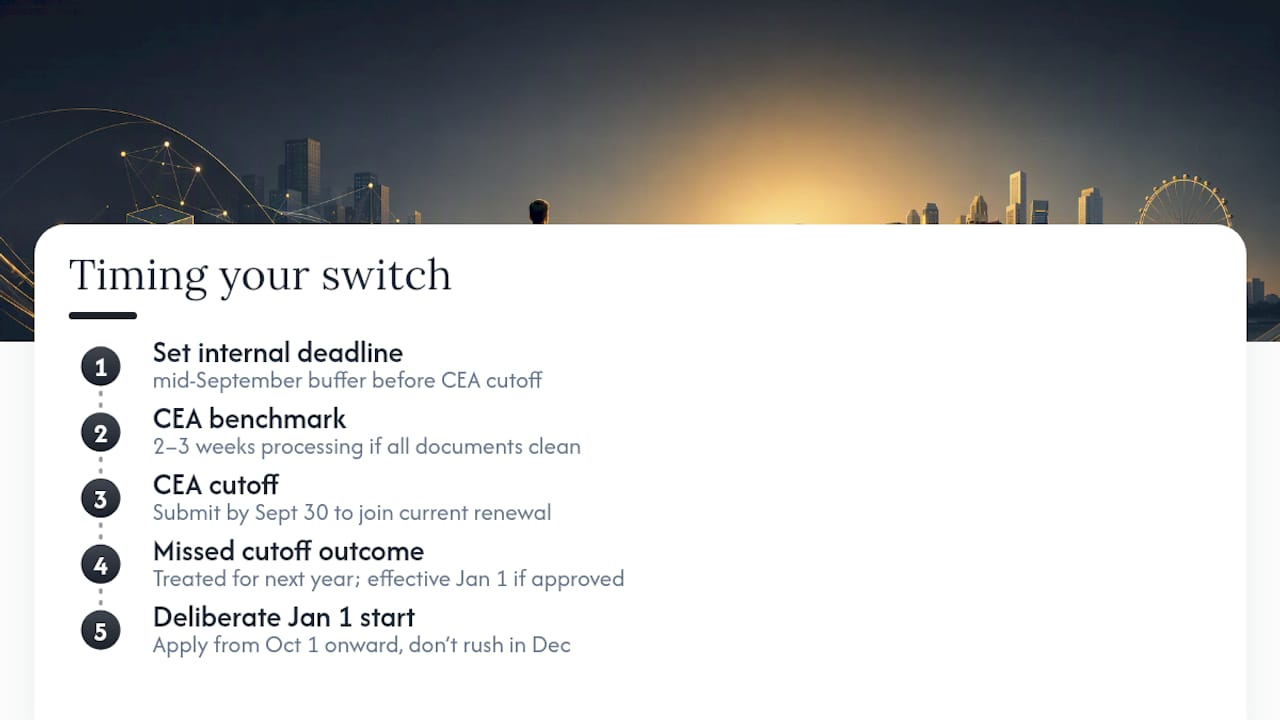
CEA’s benchmark for a complete switching application is about two to three weeks. That number assumes everything arrives clean the first time. Missing documents, an unverified income statement, or a CPD shortfall will push that timeline out, sometimes by weeks, because the application sits in a queue waiting on you or your current EA to respond to a query.
The date that actually changes your outcome is September 30. If your switching application reaches CEA by that date, you take part in the current year’s renewal exercise under your new agency. Miss it, and CEA may treat your application as intended for the following registration year, with the new registration effective January 1 if approved before year end.
Here’s the trap: agents who wait until late November or December to start their switch often assume there’s still time before the calendar year closes. There usually isn’t. A two to three week estimate leaves almost no room for error once you’re inside that window, and any document gap can push your effective date into the new year even if that wasn’t your plan.
Pro Tip: Build your own internal deadline of mid-September, not September 30. That gives you a buffer if the receiving EA needs a few extra days to verify your file before it reaches CEA.
If you’re planning a January 1 start deliberately, apply from October 1 onward rather than rushing something through in December. A clear read on renewal timing removes most of the guesswork agents run into every fourth quarter.
What Documents Do You Need Before You Start?
Receiving agencies and CEA both expect a specific paper trail before they’ll move your file forward. Gathering these ahead of time is the single biggest lever you have for avoiding a stalled application.
NRIC, front and back, in a clear scan.
A recent, professional corporate photo matching current CEA formatting standards.
Proof of the last 12 months’ income, when the receiving EA or CEA requests it for verification.
Your current company’s business card or letterhead, confirming your existing EA affiliation.
CPD completion records current through your last cycle.
Fit and proper evidence supporting your ACEAS submission.
Fees are the part agents get wrong most often. A switching application may or may not carry a registration fee, depending on whether your registration period is changing as part of the move. A same-year transfer typically doesn’t trigger a fresh fee the way a transfer into the following registration year can.
Before you file anything, check whether you’re carrying a bond, a notice period, or any outstanding commitment tied to your current agency agreement. Switching is not the same event as cancelling your registration, and the two get confused constantly. Know which one applies to your situation before you touch ACEAS.
What Should You Expect When Onboarding at a New Agency?
The first few weeks after a switch approves set the tone for the next few years of your career, and yet most agents spend more time negotiating commission splits than asking what training actually looks like. That’s backwards. Commission structures are usually comparable across the major agencies. Onboarding quality is not.
A solid onboarding package typically includes an associate agreement, help with your IPA paperwork, a structured orientation, and a mentorship pairing with someone senior who’s actually available, not just listed on an org chart. Programs built around structured coaching, such as #Toolkit training or scheduled digital webinars, tend to separate agencies that invest in agents from ones that just process headcount.
Ask these questions in your first meeting with a prospective agency:
What does the training calendar look like for my first 90 days?
How often will I actually meet with my assigned mentor, and is that cadence in writing?
What sales tools, CRM access, or lead systems come with the desk?
What marketing or lead-generation support is included, versus what I’m expected to fund myself?
Pro Tip: Get written confirmation of who handles your existing listings and pending transfers during the switch window. A verbal assurance from a team lead means nothing once you’re three weeks into a new registration and a client calls the old office.
What Are the Common Mistakes That Delay a Switch?
The costliest mistake is straightforward: canceling your RES registration when you actually meant to switch. Cancellation is built for agents leaving the industry entirely. Doing it by mistake forces a full re-registration later, not a quick fix.
Never cancel your registration if your intent is to move to a new EA. File a switching request instead.
Read your current agency agreement closely for undisclosed obligations, especially around commission splits on deals still in progress.
If your ACEAS status stalls past the usual two to three weeks, document every communication with both EAs before escalating to the receiving agency or CEA directly.
Get written confirmation on how client files and active listings transfer before you formally resign, not after.
Do KEO Changes Affect Your Switching Process?
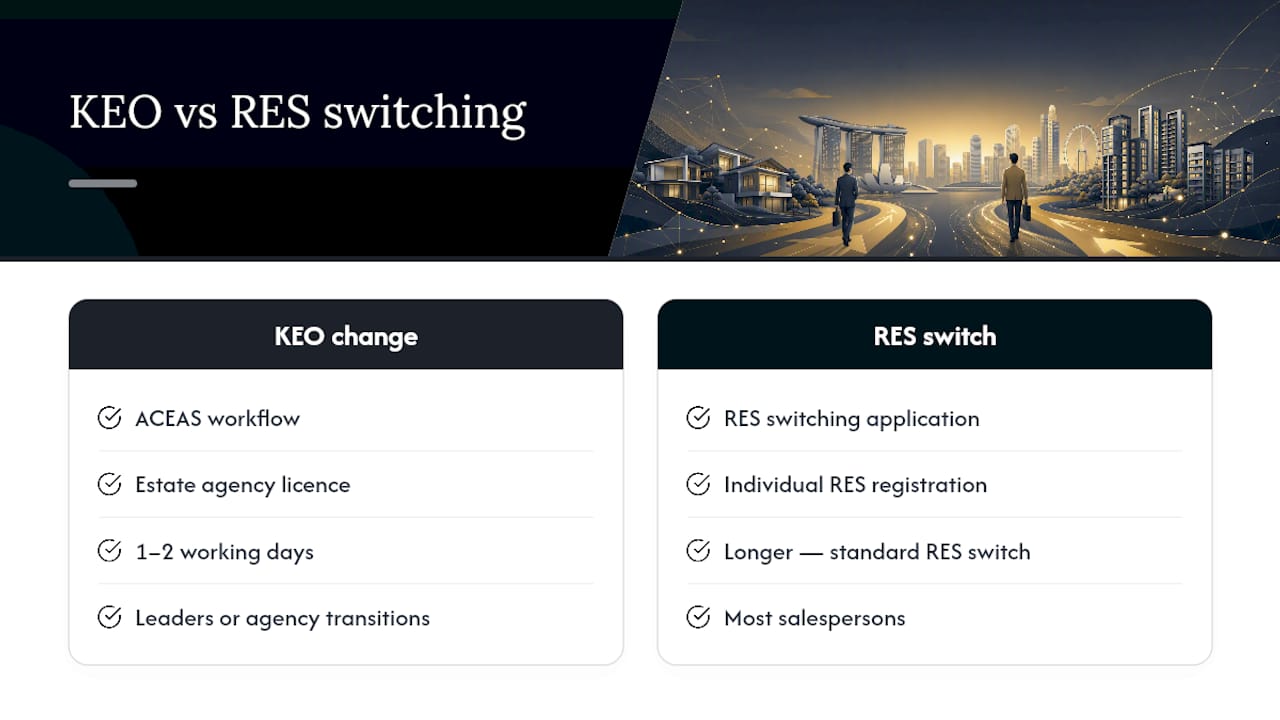
Most salespersons switching between agencies never touch KEO matters at all, since Key Executive Officer changes belong to the estate agency’s licensing structure, not the individual RES’s registration. But if you’re moving into a leadership role, or the receiving agency’s business structure is itself in transition, it’s worth understanding how the two processes interact.
KEO additions or removals run through a separate ACEAS workflow tied to the estate agency’s license, not your personal RES switching application. These KEO actions typically process in one to two working days, far faster than a standard RES switch, because they’re changing an executive record rather than transferring an individual’s registration and history.
If you’re being recruited into a team leader or branch management position where you’d also serve as a KEO, that appointment needs to clear on the agency’s licensing side independently of your own switching approval. The two timelines don’t have to align, but agencies sometimes bundle the conversations, which can create confusion about which approval is actually holding up your start date. Ask directly whether your onboarding depends on a KEO change or purely on your RES switch. If a recruiter can’t answer that clearly, treat it as a sign to ask more questions before committing.
Why Do Agents Actually Switch Agencies in Singapore?
Commission splits get all the attention in agency comparisons, and they matter, but they’re rarely the real reason experienced agents move. The agents who switch and thrive usually cite something structural: a mentor who’s actually reachable, a training calendar that goes beyond a single orientation day, or tech tools that replace spreadsheets and manual tracking.
Some agents switch because their current agency has no real leadership track, and they want a clearer path toward team leadership. Others move because their current brand’s referral pipeline has gone quiet, and a bigger network means more inbound leads without paying for every one out of pocket. A smaller group switches for something simpler: they want an agency whose values and culture actually match how they want to build a career, not just close transactions.
Whatever the specific motivation, the pattern holds across most successful switches: agents who articulate exactly what they want before they start interviewing with new agencies end up negotiating better onboarding terms than agents who switch reactively, out of frustration with their current setup. Frustration is a valid trigger. It’s a poor negotiating position.
How Does Switching Affect Your Current Listings and Clients?
Your listings don’t automatically move with you, and your clients don’t automatically know you’ve changed agencies unless someone tells them. This is the part of switching that catches agents off guard, usually because they assumed the transition would be as clean as the ACEAS process itself.
Active exclusive listings are typically tied to the estate agency, not just to you personally, under the agency agreement signed with the seller. That means a listing you brought in may stay with your former agency unless the client agrees to transfer it, or unless your agreement specifies otherwise. Read the fine print before you assume a deal in progress travels with you.
Get written, dated confirmation from both your old and new agency on exactly who manages any pending transaction and how commission splits on that deal will work. Verbal handshakes evaporate fast once two different offices have competing claims on the same closing. Clients, for their part, generally don’t care which agency badge you wear. They care whether you’re still their point of contact. A short, professional notice explaining the move, sent before the switch completes rather than after, tends to preserve far more of the relationship than agents expect.
What Career With ERA Sees in Practice
Some agencies work through switching applications with agents regularly enough to know where things typically go sideways: incomplete CPD records, agents who cancel registration by mistake instead of switching, and listings left in limbo because nobody wrote anything down before resignation. ERA’s own onboarding approach for experienced agents follows a stepwise path, starting with an initial discussion, moving through IPA assistance, and closing with CEA confirmation once the transfer clears.
The agents who land well after a switch are usually the ones who ask sharp questions before signing anything, not after. Mentorship pairing that actually happens on a schedule beats a vague promise of “support” every time. That’s the difference between an agency that recruits headcount and one that builds careers.
— Donny
Switch With Support: RES Registration and Real Onboarding
Some agencies offer an alternative to switching agencies without a structured onboarding path or an actual training calendar behind the offer. Where a lot of agency transfers in Singapore amount to a new business card and a commission sheet, Career With ERA pairs the ACEAS process with RES course registration, #Toolkit training, and a mentorship structure built to support agents through their first months and beyond.

If you’re preparing your RES exam or already licensed and weighing a move, the first step is a straightforward conversation about where you are and what support your transfer actually needs, including help with your IPA paperwork during the switch window. Agents building toward team leadership can also look at the PG Success Road Map for a structured path forward. Start that conversation on the new agents page and find out what onboarding actually looks like before you commit your ACEAS application anywhere.
Where to Verify These Rules Directly
CEA: switching estate agent, renewal of registration, practice guidelines
Career With ERA: experienced agents onboarding
Sources
FAQ
Can You Switch Property Agencies in Singapore?
Yes. You initiate the request yourself in ACEAS, your current agency acknowledges it, and the receiving agency verifies it before CEA approves the switch.
How Long Does an Agency Switch Take to Process?
CEA typically processes a complete switching application in about two to three weeks. Incomplete documentation or unresolved CPD gaps will extend that timeline well beyond the standard estimate.
What Happens if I Miss the September 30 Deadline?
If your application reaches CEA after September 30, it may be treated as intended for the following year, with your new registration effective January 1 once approved. Applying by mid-September gives you a buffer against processing delays.
Should I Cancel My Registration Before Switching?
No. Cancellation is for agents leaving the industry entirely, and doing it by mistake forces a full re-registration later. Switching keeps your registration continuous through the transfer.
Does Career With ERA Help With the Switching Process?
Career With ERA supports experienced agents through IPA assistance and onboarding steps alongside the ACEAS switching workflow, including mentorship pairing and training calendars. Pricing and program details are typically available directly through the agency’s site rather than listed publicly.
Recommended
Comments