
What the CEA Ethics Guidelines Require of Every Agent

Updated: Sep 24

The CEA Code of Ethics and Professional Client Care (CEPCC) is binding subsidiary legislation prescribed under the Estate Agents (Estate Agency Work) Regulations 2010, and it binds every licensed estate agent and registered salesperson in Singapore. It is not a voluntary charter or a set of best-practice suggestions you can skim once during onboarding and forget. Breach it, and the Council for Estate Agencies can issue financial penalties, demerit points, or suspend or revoke your licence or registration outright.
Here is what to check today, before you read another word of legal background:
Honesty and integrity in every client interaction, including how you frame a listing’s condition or a competing offer.
Conflict of interest disclosures made in writing, not verbally, whenever you represent both sides or have a personal stake in a transaction.
Client confidentiality, especially around financial position and motivation to sell or buy.
Compliance with current CEA practice circulars, which change more often than most agents realize.
Accurate, properly consented advertising, with the required licence and registration numbers displayed.
Three bodies anchor this entire framework: the Council for Estate Agencies (CEA), the Estate Agents Act 2010, and the Attorney-General’s Chambers, which publishes the actual statutory text on Singapore Statutes Online. Myeracareer built its onboarding curriculum around exactly this framework, because agents who understand the CEPCC from day one make fewer costly mistakes later. Your first move: pull up your last five advertising templates and your prescribed estate agency agreement, and check whether they match the current wording CEA has published. If you cannot remember the last time you checked, that is your answer.
Key Takeaways
The CEPCC is enforceable subsidiary legislation that requires honesty, conflict disclosure, confidentiality, and adherence to current CEA practice guidelines from every licensed agent and RES.
Point | Details |
Legal status is binding | The CEPCC sits under the Estate Agents (Estate Agency Work) Regulations 2010, not voluntary guidance. |
Core duties demand documentation | Honesty, conflict disclosure, and confidentiality all require written proof, not verbal assurances. |
KEOs carry supervisory exposure | Individual agent misconduct can trigger scrutiny of the entire agency’s compliance systems. |
Guidance updates continuously | CEA issues new practice circulars regularly, including recent attention to AI-edited listing images. |
Structured onboarding builds habits early | Myeracareer folds CEPCC compliance into new-agent training and ongoing mentorship rather than treating it as a one-time briefing. |
Table of Contents
Where Does the CEA Ethics Guidelines Framework Come From?
The CEPCC is not a stand-alone document CEA invented for optics. It sits inside the Estate Agents (Estate Agency Work) Regulations 2010, which itself is subsidiary legislation made under the Estate Agents Act 2010. That layered structure matters: it means the Code carries the same enforceability as a regulation, not the weight of a suggestion.
A few pages are worth bookmarking rather than searching for each time:
Singapore Statutes Online for the full statutory text of the Regulations, including every schedule.
CEA’s Regulatory Matters hub, which explains the enforcement pathway in plain language.
One distinction trips up even experienced agents. Most CEPCC provisions describe conduct standards, judged against a reasonable-agent benchmark. But handling client transaction money yourself is a different category entirely. That is a criminal offence under Regulation 7 of the Estate Agency Work Regulations, separate from and more severe than an ordinary Code breach. An ethics violation gets you a disciplinary hearing. Touching client funds gets you a police report.
Who Does the Code Apply to and When Does It Attach?
Every licensed estate agent and every registered salesperson carrying out estate agency work falls under the CEPCC. There is no carve-out for part-timers, agents new to the industry, or those working under a team leader rather than running their own book. If you are performing estate agency work as defined under the Act, the Code follows you into every conversation, every listing, and every signature.
Key Executive Officers carry a heavier version of this obligation. A KEO is not just another licensed agent; CEA treats the KEO as the person accountable for the agency’s overall compliance posture, which means the Code applies to KEOs both personally and as a supervisory function over everyone under their roof.
In practice, the Code attaches at these specific moments:
The instant you draft or approve a property advertisement, whether on a portal, social media, or a printed flyer.
Every negotiation exchange with a buyer, seller, landlord, or tenant, including WhatsApp messages.
The moment you ask a client to sign an option, a Sale and Purchase form, or a prescribed estate agency agreement.
Any co-broking arrangement where you are relying on another agent’s representations to your own client.
That last one catches people off guard. Co-broking does not dilute your personal obligation to verify facts before you pass them along. If your co-broking partner misrepresents a unit’s condition and you repeat that claim to your client without checking, you carry your own share of the exposure.
What Do the Core CEPCC Duties Actually Look Like Day to Day?
CEA groups its expectations into a handful of duties, but the real skill is translating each one into a specific action you take before you hit send or sign a form.
Honesty, fidelity, and integrity. This means you disclose material facts about a property even when disclosure works against your commission. If a unit has a history of water seepage or a disputed boundary, you say so before the client makes an offer, not after they ask a pointed question.
Competence and diligence. You are expected to know the transaction type you are handling. Compliant behavior looks like verifying a title search before marketing a property; noncompliant behavior looks like relying on a client’s verbal assurance that “everything is fine” with the title.
Avoiding and declaring conflicts of interest. If you or a family member has a financial interest in a property you are marketing, or you are representing both the buyer and seller in the same deal, that goes in writing, signed by the affected party, before the transaction proceeds. A verbal heads-up in the lift lobby does not count as disclosure.
Protecting client confidentiality. A seller’s rock-bottom acceptable price, or a buyer’s maximum budget, stays between you and that client unless they authorize you to share it. Leaking that information to speed up a deal is a shortcut that regularly ends in a complaint.
Accurate representations and ethical advertising. Every advertisement needs your name, licence number, and registration number displayed as required, and every listing needs written owner consent before it goes live, not a text message you interpreted as approval.
The granular “how” for advertising, including exact formatting for mandatory identifiers, lives in CEA’s practice guidelines, specifically PG 02-11 on Ethical Advertising. Read the guideline itself rather than relying on what a colleague told you it says.
Pro Tip: Keep a dated folder of every advertisement you publish alongside the written consent that authorized it. When a dispute surfaces six months later, the agent who can produce a signed consent form in thirty seconds looks credible. The one who cannot looks like they cut a corner, even if they did not.
What Do KEOs Owe Their Agency and CEA?
A KEO’s job under the CEPCC is not limited to holding the licence that lets the agency operate. CEA expects active supervision, and when a registered salesperson under a KEO’s watch breaches the Code, the agency itself can face scrutiny for whether its systems were adequate to prevent it.
That exposure is why treating supervision as paperwork rather than practice is a mistake. CEA’s licensing guidance makes clear that KEOs must maintain the structures that keep an entire agency conversant with the Act, the Regulations, and every practice circular CEA issues.
A working KEO checklist looks like this:
Written internal policies covering advertising approval, conflict disclosure, and confidentiality, distributed to every RES on onboarding.
A documented onboarding process that walks new agents through the CEPCC before they list their first property.
Record-keeping systems that store consent forms, prescribed agreements, and advertisement copies for the required retention period.
An incident escalation path so a minor complaint gets addressed before it becomes a Disciplinary Committee referral.
Remedial training triggered automatically after any near-miss or client complaint, not just after a formal breach finding.
If CEA ever asks why an incident happened, the strongest answer a KEO can give is a paper trail: dated policy documents, training attendance logs, and a record of corrective action taken the moment a red flag appeared. “We told them verbally” is not a defense that holds up in a disciplinary review.
What Happens When an Agent Breaches the Code?
Most breaches CEA sees are not exotic. They cluster around a handful of repeat offenses: misleading advertising copy, undisclosed conflicts of interest, withholding a material fact about a property, and sloppy handling of signed documents that later go missing or get altered.
The disciplinary pathway follows a predictable arc. A complaint is lodged, usually by a client or a competing agent. CEA reviews the complaint and gathers evidence. If the case has merit, it goes before a Disciplinary Committee, which can impose a range of outcomes depending on severity and whether the agent has prior demerit points.
Sanction Type | Typical Trigger | Severity Level |
Financial penalty | Advertising without required consent or identifiers | Low to moderate |
Demerit points | Repeated minor breaches, incomplete disclosures | Moderate |
Licence or registration suspension | Serious conflict of interest, confidentiality breach | High |
Licence or registration revocation | Repeated serious misconduct, dishonesty findings | Severe |
Criminal referral | Handling client transaction money (Regulation 7) | Severe, distinct from Code breach |
That last row deserves its own emphasis. Handling client money is not judged on the same scale as an advertising slip-up. It is a criminal offence, investigated separately from a standard CEPCC complaint, and it carries consequences beyond your licence.
How Does CEA Keep the Rules Current?
CEA does not treat the CEPCC as fixed text. It issues Practice Guidelines and Practice Circulars, consolidated in the Professional Service Manual, to address issues the Code’s original language did not anticipate. If you last reviewed CEA’s guidance a year ago, you are almost certainly missing something that now applies to your listings.
Recent examples worth tracking include ethical advertising standards under PG 02-11, guidance on marketing foreign properties, and due diligence obligations that intersect with the Women’s Charter when a transaction involves matrimonial property. Parliament has also recorded active discussion on updating the Code to require disclosure when listing photos or videos have been AI-edited, which signals CEA is actively closing gaps as technology changes how properties get marketed.
A simple monitoring routine prevents surprises:
Bookmark the CEA Practice Guidelines and Circulars page and check it monthly, not annually.
Assign one person in your agency, often the KEO or a designated compliance lead, to own this monitoring task.
Circulate a short internal summary whenever a new circular affects advertising, disclosure, or documentation practices.
Because CEA tends to issue targeted circulars around emerging issues, waiting for a colleague to mention a change is a weak strategy. By the time word travels informally, you may already have published a noncompliant listing.
How Do You Report a Suspected Breach?
If you witness or suspect a breach, whether by a colleague or another agency, the reporting process is more accessible than most agents assume.
File the complaint through CEA’s official channels, referencing the specific transaction and the RES or EA involved.
Include supporting details: dates, property address, and a plain description of what happened.
If you are the KEO of an agency where the incident occurred, suspend the individual’s access to sensitive systems and client files immediately while the matter is reviewed internally.
Preserve every relevant record rather than allowing files to be edited or deleted.
CEA investigators typically request communications logs, advertisement copies, signed consent forms, and full transaction records once a complaint moves past initial screening. Build your evidence file around exactly these categories:
Email and messaging threads relevant to the transaction.
Copies of every advertisement published, with dates.
Signed consent forms and prescribed agreements.
Internal notes documenting any escalation or corrective steps already taken.
Investigations move at CEA’s pace, not yours, and cases that require referral to a Disciplinary Committee take longer than a straightforward administrative review. Confidentiality is maintained throughout, which protects both the complainant and the agent under review until findings are made.
What Should Your Compliance Checklist Cover?
A checklist only works if it maps to how your agency actually operates, not a generic list copied from a compliance seminar. Build yours across these five domains.
Documentation and prescribed agreements. Confirm you are using the current version of every prescribed estate agency agreement, not a template someone saved three years ago.
Advertising and marketing templates. Version-control every ad template, and require sign-off before publication, not after a client complains.
Conflict declaration processes. Have a standard written form ready so agents are not improvising disclosure language under time pressure.
Confidentiality and record retention. Store signed documents securely, and know your retention obligations rather than guessing.
CPD and training logs. Track completed hours and topics, since CEA’s CPD requirements tie directly back to the competence duty under the CEPCC.
Document Type | Minimum Retention | Recommended Owner |
Prescribed estate agency agreements | Duration of transaction plus statutory period | KEO or compliance lead |
Advertisement copies and consents | Duration of listing plus statutory period | Individual agent, reviewed by KEO |
Client communications | Duration of transaction plus statutory period | Individual agent |
CPD training records | Ongoing, per licensing cycle | Agency admin or KEO |
New agents building these habits from scratch benefit from starting with structured onboarding resources rather than assembling a system piecemeal after their first close call.
Pro Tip: Run a fifteen-minute monthly quick-audit: pull five recent advertisements at random and check each against your current consent records. Catching a gap in month one costs you nothing. Catching the same gap after a client complaint costs you a disciplinary hearing.
Why Verbal Consent and Loose Templates Keep Causing Trouble
The gap between agents who stay clean and agents who end up in front of a Disciplinary Committee usually has nothing to do with intent. Almost nobody sets out to breach the Code. The pattern I keep seeing is agents who treat the CEPCC as background noise until a client complaint forces them to reread it, by which point the damage is already done.
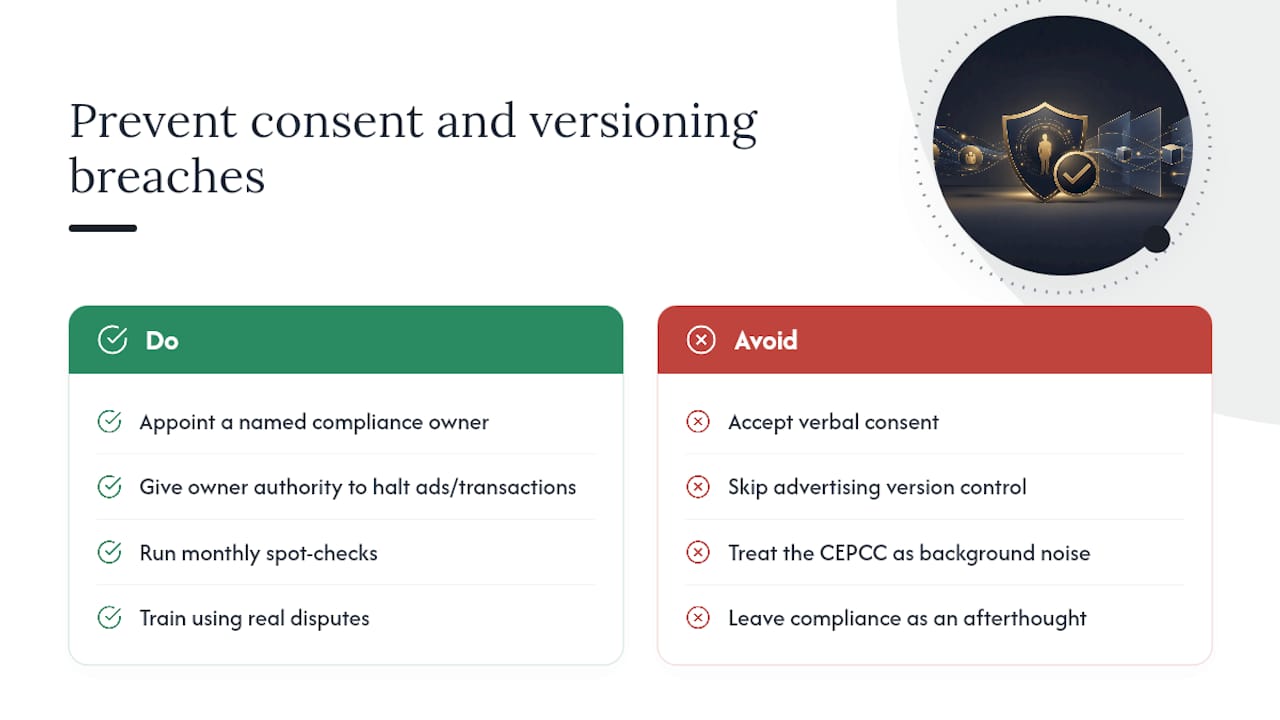
The single most common failure point is verbal consent. An agent gets a nod from a homeowner over a phone call, publishes the listing, and assumes that conversation counts as authorization. It does not, and when CEA or a disciplinary panel asks for the written record, there is nothing to produce. The second most common failure is advertising version control, or the lack of it. Agents update a listing’s price or description without keeping the old version, then cannot demonstrate what was actually published when a dispute arises months later.
What separates agencies that stay out of trouble is not more rules. It is one person owning compliance as an actual job function rather than a shared afterthought, monthly spot-checks that catch small gaps before they compound, and training sessions built around real disputes rather than abstract summaries of the Code’s clauses. Agents remember the story of a colleague who lost a listing over a missing consent form far more vividly than they remember a slide that says “obtain written consent.”
If you take one thing from this and apply it this week, make it this: appoint a compliance owner by name, even if your agency is small, and give that person explicit authority to hold up an advertisement or a transaction until the paperwork is right.
How Myeracareer Helps You Build Compliance Into Daily Practice
Reading the CEPCC is one thing. Building it into how your team actually works every day is a different challenge, and it is where most agencies quietly fall short. Myeracareer’s real advantage here is structural: compliance training is not a separate module bolted onto recruitment, it is woven into onboarding, ongoing mentorship, and the Sales+ app agents use for daily transaction tracking, so the habits form from day one instead of getting patched in after a complaint.

New agents preparing for the RES exam and their first year of practice get onboarding support that walks through CEPCC obligations alongside licensing steps, not as a separate legal briefing nobody revisits. Experienced agents and team leaders looking to tighten supervision, documentation, and CPD tracking across a team have a dedicated path through Myeracareer’s experienced team leader programs, which pair leadership frameworks with the practical record-keeping systems KEOs need to demonstrate reasonable supervision. If your agency also handles overseas listings, partners like ULI & LISA offer useful perspective on the extra due diligence foreign property marketing demands.
If you are weighing a move into real estate or a switch to a team with stronger compliance systems already in place, start by reviewing Myeracareer’s new agent program and booking a conversation about what onboarding and ongoing support actually looks like.
Where to Go for Authoritative Guidance
Treat these as your primary references, not secondhand summaries from a forum or a training slide deck someone forwarded you years ago.
CEA Practice Guidelines and Circulars: the operational detail behind broad Code principles, including advertising and foreign property marketing rules.
CEA Estate Agent Licensing Matters: licensing procedures, KEO obligations, and renewal or cancellation processes.
This article provides general information on regulatory obligations and does not substitute for professional legal advice. Confirm current requirements directly with CEA or a qualified legal advisor before making agency-wide policy decisions.
This article is general information, not a substitute for advice from a qualified lawyer. Consult a qualified legal professional about your own circumstances before acting on anything here.
Sources
Codes of conduct | Council for Estate Agencies
Estate Agents (Estate Agency Work) Regulations 2010 - Singapore Statutes Online
Practice guidelines and circulars | Council for Estate Agencies
Estate agent licensing matters | Council for Estate Agencies
Written answer by Ministry of National Development on updating Code of Ethics and Professional Client Care for property agents to declare property listings with AI-edited images and videos
Regulatory matters - Singapore | Council for Estate Agencies
Recommended
Comments