
How to Become a Property Agent in Singapore (2026)


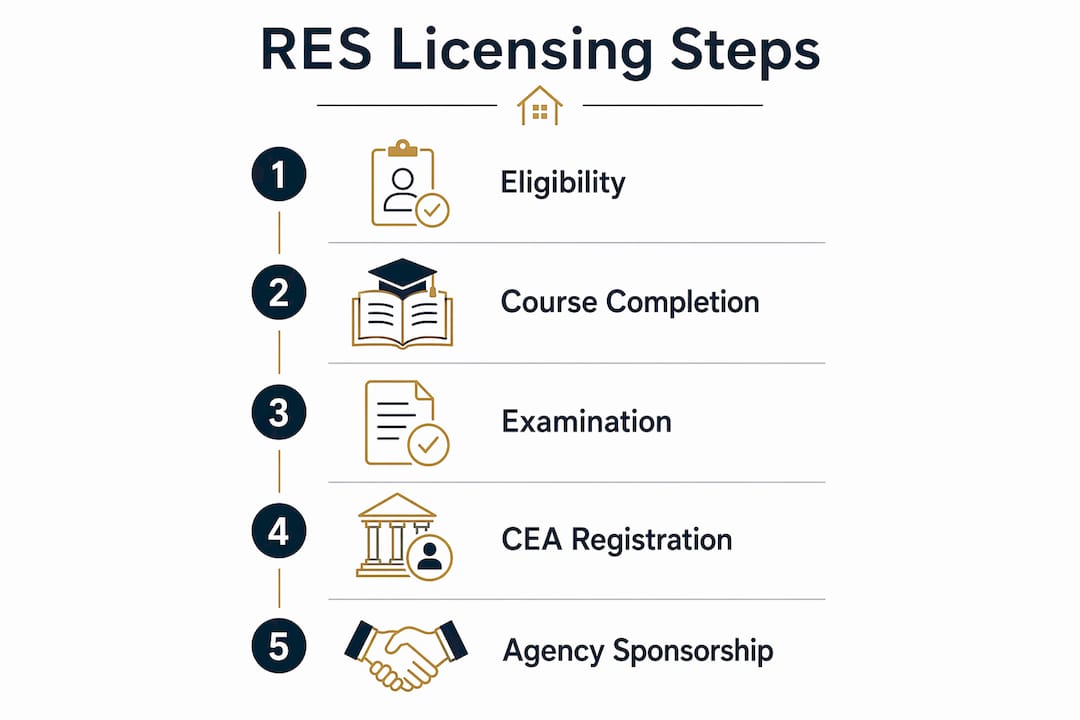
Becoming a licensed property agent in Singapore follows a clear, regulated pathway set by the Council for Estate Agencies (CEA). Here is the official sequence, step by step:
Meet the minimum age, residency, education, and fit & proper criteria under the Estate Agents Act.
Complete the mandatory Real Estate Salesperson (RES) course with a CEA-approved training provider, attending at least 75% of sessions.
Register and pass both papers of the RES examination within two years of course completion.
Secure sponsorship from a licensed estate agency before submitting your registration application to CEA.
Receive CEA approval and begin practicing as a registered real estate salesperson (RES).
Each stage has specific requirements, fees, and timelines. The sections below walk through every one of them in detail, including how to choose the right agency once you are licensed.
Table of Contents
Who can become a property agent in Singapore?
The CEA sets firm eligibility criteria that every applicant must satisfy before enrolling in the RES course or sitting for the examination. These are not flexible guidelines; failing any one of them disqualifies you from registration regardless of how well you perform on the exam.
Age and residency:
You must be at least 21 years old.
You must be a Singapore Citizen or Permanent Resident with proof of long-term residence.
Educational qualifications:
A minimum of four GCE O-Level passes, which may be combined from up to two examination sittings, or an equivalent qualification recognized by CEA.
Alternatively, you may qualify by attaining Level 5 and above in all five components of the Workplace Literacy and Numeracy (WPLN) assessment developed by the British Council in collaboration with SkillsFuture Singapore: Reading, Listening, Speaking, Writing, and Numeracy.
Fit & proper criteria:
No criminal offenses involving dishonesty, fraud, or moral turpitude.
No status as an undischarged bankrupt.
No current license with another estate agency or moneylender license.
Full compliance with the Estate Agents Act and CEA’s regulatory framework.
Applications are reviewed against all of these conditions simultaneously. CEA may reject an application due to undischarged bankruptcy or a fraud-related criminal record even when all other criteria are met. If you have any concern about your background, it is worth clarifying your position with CEA before investing time and money in the course.
Pro Tip: Check your credit and criminal record status before enrolling in any RES course. Discovering a disqualifying issue after completing training costs you both time and course fees.
Professional Indemnity Insurance is also required as part of the registration process, and your sponsoring agency will typically guide you through obtaining the appropriate coverage.
What does a registered real estate salesperson actually do?
The CEA’s regulatory framework is explicit: protecting clients’ interests is the foundational duty of every registered salesperson, not an optional professional courtesy. Understanding these obligations before you enter the industry shapes how you build your practice from day one.
Client protection: Act in the best interests of your client throughout every property transaction, including full disclosure of material facts.
Ethical conduct: Adhere to CEA’s Code of Ethics and Professional Client Care, which governs how you communicate, negotiate, and close transactions.
Transparent dealings: Maintain honest, accurate representations of properties and avoid any conduct that could mislead buyers, sellers, landlords, or tenants.
Continuing professional development (CPD): Complete the required CPD hours each year to keep your registration active and your knowledge current with regulatory changes.
Role boundaries: Operate only within the scope of your registration and under the supervision of your sponsoring licensed estate agency.
Integrity within the industry: Avoid conflicts of interest, dual representation without proper disclosure, and any arrangement that could compromise your professional independence.
These responsibilities are not theoretical. CEA actively investigates complaints and has the authority to suspend or revoke registrations. Agents who treat compliance as a formality rather than a professional standard tend to find their careers cut short.
Which RES course providers should you consider?
The RES course is the gateway to the examination, and you must complete it through a CEA-approved course provider (ACP). The course mandates a minimum 75% attendance and covers real estate fundamentals, Singapore property laws, agency practice, and relevant government policies. Upon completion, the ACP issues a Certificate of RES Course Completion, which is required to register for the examination.

Course fees vary, and eligible candidates can offset costs through SkillsFuture credits or the UTAP (Union Training Assistance Programme) subsidy available to NTUC union members.
Approved Course Provider | Notes |
Bench Mark Realpro Pte Ltd | Established provider with structured classroom delivery |
Hastor Property Services Pte Ltd | Offers flexible scheduling options |
Institute of Estate Agents | Industry-affiliated provider with strong professional network |
Life Mastery Academy Pte Ltd | Known for motivational and practical training approach |
Ngee Ann Polytechnic | Polytechnic-backed provider; diploma holders may qualify for partial exemptions |
Pioneer Training & Consultancy Pte Ltd | Focused on exam preparation and regulatory content |
Real Centre Network Pte Ltd | Active industry presence with experienced instructors |
Realty International Associates Pte Ltd | Provides both course and post-course career guidance |
Holders of certain recognized qualifications, such as a Bachelor of Business Administration (Real Estate) from NUS or a Diploma in Real Estate Business from Ngee Ann Polytechnic, may be partially or fully exempted from the RES course and examination. NUS BBA (Real Estate) graduates, for example, are exempted from Paper 1 but must complete the partial RES course for Paper 2 and sit that paper. All other recognized qualification holders must still pass both papers unless their specific qualification is listed under CEA’s exemption table.
Pro Tip: Use your SkillsFuture credits to reduce out-of-pocket course costs. Most ACPs accept SkillsFuture funding directly, and NTUC members can stack UTAP on top for additional savings.
Choosing a provider is not purely about price. Consider the provider’s pass rate, the quality of their study materials, and whether their schedule fits your current commitments, especially if you are planning to complete the course while still employed.
How does the RES examination and CEA registration work?
Passing the RES exam is a two-paper process administered three times a year by NTUC LearningHub. You must pass both papers within two years of receiving your Certificate of RES Course Completion. Missing that window means restarting the course.
Exam registration process:
Indicate your interest via GovEntry, authenticating with your Singpass. Only one submission per NRIC/FIN is accepted per examination session.
Shortlisted candidates receive notification to proceed with official registration and payment through NTUC LearningHub.
Seats are limited, so early interest indication is critical. Do not wait until the deadline.
Exam fees and retake fees apply; check the current schedule and fee structure on the CEA and NTUC LearningHub websites, as these are updated periodically.
Post-examination registration with CEA:
Once you pass both papers, you must find a licensed estate agency willing to sponsor your registration before you can submit an application to CEA.
Your sponsoring agency submits the registration application on your behalf through CEA’s ACEAS portal.
Agency administrative fees apply, in addition to registration fees payable to CEA and the cost of Professional Indemnity Insurance.
CEA reviews the application and, upon approval, issues your registration as a real estate salesperson.
You cannot practice, solicit clients, or represent yourself as a property agent at any point before CEA approval is granted. The registration is tied to your sponsoring agency; if you leave that agency, your registration must be transferred to a new one before you can resume practice.
How do you build a strong career after getting licensed?
Passing the exam and securing your CEA registration is the starting line, not the finish. The agents who build sustainable, high-earning careers in Singapore real estate consistently credit one factor above all others: the quality of mentorship and support they received in their first 12 to 24 months.
Choosing the right agency and team leader is a decision that shapes your trajectory more than almost anything else in those early years. Agencies differ significantly in the training infrastructure, technology access, and leadership culture they provide. Some offer structured onboarding with dedicated mentors; others hand you a desk and a phone and expect you to figure it out. The difference in outcomes between those two environments is substantial.
Look specifically for agencies that provide access to AI-powered sales tools and performance tracking, since coaching paired with technology measurably accelerates the process of building a client base. Understanding the Singapore luxury condo segment and other specialized property categories also gives new agents a sharper edge when positioning themselves with clients.
Pro Tip: Before signing with any agency, ask specifically about their new-agent training program, their mentorship structure, and what technology tools they provide. A vague answer to any of those questions tells you something important.
Common challenges for new agents include building initial client trust, managing irregular income during the ramp-up period, and navigating the administrative demands of CEA compliance alongside active prospecting. Agents who join teams with clear performance frameworks and regular coaching sessions tend to move through that ramp-up phase faster and with less attrition.
Ethics and conduct adherence do not end at licensing. CEA’s ongoing requirements mean that professional standards, CPD completion, and ethical practice are permanent features of your career, not a phase you graduate from.
Is there a practical experience or internship requirement before full licensing?
Singapore’s RES pathway does not include a formal internship or supervised work experience period as a standalone prerequisite before licensing, which distinguishes it from frameworks in some other jurisdictions. The structured learning happens through the RES course itself, and the examination validates that knowledge before registration is granted.
That said, the requirement to be sponsored by a licensed estate agency before CEA will process your registration functions as a practical form of supervised entry into the profession. You cannot practice independently; you must operate under the umbrella of an established agency from your very first transaction. This structure means your early deals are conducted within a regulated environment where your agency carries professional and legal accountability alongside you.
Some agencies formalize this further by pairing new registrants with senior agents for a defined period, treating it as a structured mentorship rather than a loose arrangement. If hands-on guidance during your first transactions matters to you, this is worth asking about explicitly when evaluating agencies. The career support structure at ERA, for example, is built around exactly this kind of structured early-career development.
Myeracareer: where your property agent career gains real momentum
Clearing the RES exam and securing CEA registration puts you in the industry. What happens next depends almost entirely on where you land.

Myeracareer, the career platform for ERA Real Estate, is built specifically for agents at this crossroads. For those preparing for the RES exam, the platform offers structured guidance on exam preparation and onboarding requirements. For newly registered agents, it provides access to ERA’s Sales+ app, an AI-powered sales tool designed to support prospecting and client management from day one, alongside digital coaching, performance tracking, and personalized leadership frameworks. These are not generic resources; they are built around the realities of the Singapore property market and the specific challenges new agents face in their first year.
ERA’s team leaders bring structured mentorship that goes beyond compliance, focusing on capital growth strategy, portfolio thinking, and the kind of long-term client relationships that generate referral income. If you are ready to move from licensed to productive, explore new agent opportunities at Myeracareer and connect with a team that treats your career as a long-term investment.
Key Takeaways
Becoming a licensed property agent in Singapore requires meeting CEA’s eligibility criteria, completing the RES course with a minimum 75% attendance, passing both exam papers within two years, and securing agency sponsorship before registration is approved.
Point | Details |
Eligibility is non-negotiable | You must be 21+, a Singapore Citizen or PR, hold four GCE O-Level passes or WPLN Level 5, and meet fit & proper standards. |
RES course attendance matters | A minimum 75% attendance is required; course fees vary, with SkillsFuture and UTAP subsidies available. |
Exam window is two years | Both RES papers must be passed within two years of course completion; seats are limited, so early GovEntry registration is critical. |
Agency sponsorship is mandatory | CEA will not process your registration without a sponsoring licensed estate agency; administrative fees typically range from S$300 to S$500. |
Myeracareer accelerates the start | ERA’s platform offers AI-powered tools, structured mentorship, and performance tracking designed for new agents entering the Singapore market. |
Recommended
Comments