
AI Listing Descriptions for Singapore Agents: Fast, Accurate Copy


AI listing descriptions work best as a drafting accelerator, not a publishing shortcut. The right move is to feed a photo-aware or MLS-trained generator your verified property facts, let it produce a structured first draft, then perform a focused fact-and-compliance pass before any copy goes live on PropertyGuru, 99.co, or your agency’s portal. That sequence, done consistently, cuts drafting time while keeping you on the right side of CEA advertising standards.
Quick tool picks by priority:
Speed with structure: ChatGPT (GPT-4o) or Google Gemini, using a templated prompt you control
Photo-aware output: AgentQuill Pro, which analyzes up to 10 listing photos to surface visual specifics without inventing them
Compliance-conscious drafting: Anthropic Claude, which tends toward measured, factual language with fewer embellishments
Video hook integration: Dunphy, which is built around converting listing copy into short-form video scripts
Immediate action steps:
Complete your property intake checklist before opening any AI tool (see Section 4)
Paste verified facts only, never assumptions, into your prompt
Run the pre-publish checklist on every draft before it goes live
Pro Tip: Never paste a raw AI draft directly into a portal. Treat every AI output as a proposed first edit, not finished copy.
Key Takeaways
AI listing descriptions are most effective when agents supply verified facts, use a structured prompt, and run a compliance pass before publishing — the tool handles drafting speed, the agent handles accuracy.
Point | Details |
Use AI as a drafting accelerator | Feed verified intake facts into a structured prompt; never publish a raw AI draft without a fact and compliance check. |
Keep copy to 150–250 words | Portal previews truncate early, so place the single strongest verifiable fact in the first sentence. |
Apply the five-part structure | Headline → opening hook → impact-ranked features → neighbourhood line → low-pressure CTA improves conversion and portal preview performance. |
Screen every draft for compliance | Remove demographic language, unverifiable superlatives, and any AI-generated fact not present in your intake checklist before publishing. |
Myeracareer supports AI adoption | ERA’s Sales+ app, training modules, and CEA-aligned compliance checklists give agents a structured framework for producing accurate listing copy at scale. |
Table of Contents
Which AI listing-description tools should Singapore agents actually use?
How do AI listing-description generators actually work, and where do they fail?
What does a reliable AI listing workflow look like, step by step?
How do you keep AI listing copy compliant with Singapore advertising standards?
Three before-and-after Singapore rewrites: HDB, condo, and landed
Which AI listing-description tools should Singapore agents actually use?
The market has two broad categories: generalist large language models (LLMs) you prompt yourself, and purpose-built real estate generators with structured templates. Both have a place in a Singapore agent’s workflow, but they serve different moments.
Tool profiles
ListingAI positions itself as a professional-grade hub that centralizes multiple AI models alongside listing-adjacent features such as virtual staging and CMA templates. It is best suited to agents who want one dashboard rather than switching between tools. Output quality depends heavily on the facts you supply; the platform does not independently verify property data.
Easy-peasy.ai is a general-purpose AI writing platform with real estate templates among its library. User reviews on Trustpilot and G2 are a useful signal about ease-of-use and billing transparency, though review samples skew toward early adopters, so treat them as one data point alongside your own trial.
ChatGPT (GPT-4o) and Google Gemini are generalist LLMs with no real estate training by default. Their strength is output control: you can specify tone, length, Singapore English conventions, and structure in the prompt itself. They require more prompt discipline than purpose-built tools but offer the most flexibility for localisation.
Anthropic Claude produces measured, factual prose and is less prone to superlative inflation than some competing models. It does not have a built-in real estate template library, so you supply the structure through your prompt. For compliance-sensitive copy, that restraint is an asset.
Dunphy (via the Typito blog ecosystem) is oriented toward agents who publish listing content across video channels. It recommends writing the video hook first and using those two sentences as the MLS opening line, which creates natural cross-channel consistency.
AgentQuill returns three MLS description variations plus social captions in roughly 30 seconds and offers a photo-aware Pro plan that extracts visible details from up to 10 listing photos to produce more specific copy without fabricating features.
Side-by-side comparison
Dimension | Generalist LLMs (ChatGPT, Gemini, Claude) | Purpose-built generators (ListingAI, AgentQuill, Easy-peasy.ai) | Video-first tools (Dunphy) |
Best for | Output control, localisation, custom tone | Speed, templates, bulk generation | Cross-channel copy (MLS + video) |
Output control | High — prompt-driven | Medium — template-constrained | Low — format is fixed |
Templates / prompt support | None built-in; you supply | Built-in real estate templates | Listing-to-video templates |
Compliance / hallucination mitigation | Manual pass required | Manual pass required; some built-in Fair Housing defaults | Manual pass required |
Pricing shape | Subscription or pay-per-token | Subscription or per-listing credits | Subscription |
Privacy / data handling | Varies by plan; check enterprise data terms | Varies; ask vendor about data residency | Check Typito/Dunphy data policy |
Integration options | API available; no native MLS/CRM | Some CSV import; limited CRM export | Video platform integrations |
Practical notes by use case:
Solo agents drafting 5–10 listings per month: a templated ChatGPT or Claude prompt costs nothing beyond the subscription and gives full control
Teams generating 20+ listings monthly: AgentQuill’s bulk output and photo analysis reduce per-listing time materially
Agents active on Instagram Reels or TikTok: Dunphy’s video-hook-first structure aligns listing copy with short-form video from the start
How do AI listing-description generators actually work, and where do they fail?
Every AI listing tool, whether a generalist LLM or a purpose-built generator, operates on the same basic mechanic: it takes your text inputs (and, in photo-aware tools, your images), runs them through a language model trained on large text corpora, and produces a structured draft. Understanding where that process breaks down is what separates agents who use AI well from those who publish errors.
The generation flow
Your inputs (property facts, photos, tone instructions) → Model processing (pattern-matching against training data) → Raw draft output → Your human edit (fact check, compliance pass, localisation) → Published listing
The model has no access to the Singapore Land Authority database, the Urban Redevelopment Authority’s approved use records, or the actual strata title. It generates plausible-sounding copy based on patterns, not verified data.
Common failure modes
Hallucinations. A model may invent a nearby MRT station, a school name, or a lease remaining figure if those facts are not in your prompt. This is the highest-risk failure for Singapore listings, where proximity to specific schools and MRT lines carries significant buyer weight.
Over-generalized praise. Phrases like “stunning views,” “impeccable finishes,” and “rare opportunity” appear in AI output because they appear frequently in training data. They add no verifiable value and weaken credibility.
Localisation failures. Generalist models default to US or UK real estate conventions: square footage instead of square metres, “HOA fees” instead of maintenance fees, “realtor” instead of “property agent.” Singapore English conventions and HDB-specific terminology require explicit prompt instructions.
Fair Housing-style pitfalls. Even without a formal Fair Housing Act in Singapore, the CEA’s advertising guidelines require that descriptions focus on the property, not on the type of buyer. A model may generate phrases that imply demographic preferences if not constrained.
Pro Tip: After every AI draft, run a three-point check: (1) Is every named fact in the output present in my intake notes? (2) Does any phrase describe a person rather than a property? (3) Are all units in square metres and all distances in minutes or kilometres?
What does a reliable AI listing workflow look like, step by step?
A structured workflow with organized property inputs and controlled prompts consistently produces better AI outputs than ad-hoc prompting. The system below is designed to be repeatable across every listing type.
Step 1: Complete the property intake checklist
Before opening any AI tool, capture these fields in writing:
Property type (HDB flat, condo unit, landed)
Block/street address and postal code
Floor level and total floors in block
Floor area in square metres (strata and/or built-up)
Number of bedrooms and bathrooms
Tenure (99-year leasehold, freehold, 999-year)
Remaining lease (for HDB and leasehold properties)
Facing direction and notable views
Key fittings and inclusions (air-con units, built-in wardrobe, kitchen appliances)
Nearest MRT station and walking time (verified, not estimated)
Nearest primary school (verified name, not assumed)
Asking price and price per square metre
Unique selling point in one sentence (your positioning angle)
Step 2: Write your prompt using a verified template
Paste this structure into ChatGPT, Claude, or your chosen tool, filling in the bracketed fields from your intake checklist:
“Write a Singapore property listing description for a [property type] at [address]. Floor area: [X] sqm. [Bedrooms] bedrooms, [bathrooms] bathrooms. [Tenure and remaining lease]. Facing [direction]. Key features: [list from intake]. Nearest MRT: [station name], [X]-minute walk. Asking price: S$[X]. Tone: professional, factual, warm. Length: 150–250 words. Use Singapore English (square metres, not square feet; property agent, not realtor). Do not invent any facts not listed above. Structure: headline → opening hook → three ranked features → neighbourhood line → low-pressure CTA.”
Step 3: Apply the five-part structure
High-performing listing descriptions follow a five-part structure: headline → opening hook → impact-ranked feature stack → neighbourhood line → low-pressure CTA. Front-load the single strongest verifiable fact.
Headline templates:
HDB: “Spacious [X]-Room HDB at [Estate] | [X] sqm | [X] min to [MRT]”
Condo: “[Development Name] | [Bedrooms] BR | [Facing] | S$[Price psm] psm”
Landed: “[Property Type] at [Street] | [X] sqm Land | [Tenure]”
Opening hook templates:
HDB: “One of the larger [X]-room units in [estate], this [X] sqm flat on the [X]th floor offers [view/feature] and is a [X]-minute walk to [MRT].”
Condo: “Priced at S$[X] psm, this [facing]-facing unit at [development] sits on the [X]th floor with [specific view or feature].”
Landed: “A [X] sqm freehold [property type] on [street], with [specific feature], offered at S$[X].”
Step 4: Run the pre-publish checklist (60–90 seconds)
[ ] Every named fact in the copy appears in the intake checklist
[ ] MRT station name and walking time are verified (not AI-generated)
[ ] School name is correct and currently operational
[ ] Floor area unit is square metres throughout
[ ] No phrases describe buyer demographics or lifestyle preferences
[ ] Word count is within 150–250 words
[ ] Headline fits portal preview (under 80 characters)
[ ] Price per square metre is calculated correctly
How do you keep AI listing copy compliant with Singapore advertising standards?
Singapore agents operate under CEA’s advertising guidelines, which require that listing copy describes the property accurately and avoids statements that could mislead buyers or imply preferential targeting. AI tools do not know these rules unless you build them into your prompt.
Factual items to verify before publishing:
Remaining HDB lease (check HDB’s official records, not the AI’s estimate)
School names and their current operational status (MOE school finder)
MRT station names and distances (Google Maps walking time, not driving)
Strata area versus built-up area (state which figure you are quoting)
Maintenance fees and sinking fund contributions (from management corporation records)
Renovation inclusions (confirm with seller in writing before listing)
Approved use and zoning (URA’s property enquiry service for commercial or mixed-use)
Phrases to avoid and safer rewrites:
Risky phrase | Why it’s risky | Safer rewrite |
“Perfect for young families” | Implies demographic targeting | “Within 1 km of [School Name] Primary School” |
“Quiet, exclusive enclave” | Can imply demographic exclusivity | “Low-traffic residential street, [X] units in development” |
“Stunning panoramic views” | Unverifiable superlative | “Unobstructed [facing] view from the [X]th floor” |
“Rare gem” | Meaningless filler | “One of [X] units with this floor plan in the development” |
“Ideal for investors” | Implies financial advice | “Current rental yield in the area: [X]% (based on URA data)” |
HDB-specific risk callout: For HDB listings, never state or imply the remaining lease without citing the exact figure from HDB’s records. Buyers of older HDB flats are acutely sensitive to lease decay, and an AI-generated estimate that understates the remaining lease is a material misrepresentation.
Pro Tip: Create a “source facts” note inside every listing file: one paragraph listing where each key fact came from (HDB portal, URA, Google Maps, seller’s invoice). If a complaint arises, that documentation is your audit trail.
Agent-facing prompt libraries often advertise MLS-compliant defaults and Fair Housing language checks as core features, but a manual compliance pass remains necessary regardless of what the tool promises. Built-in filters catch obvious violations; they do not catch locally specific errors like an incorrect school name or a misquoted lease figure.
How do you choose the right AI tool for your agency?
The decision is not primarily about which tool produces the best sample output. It is about which tool fits your workflow, protects your data, and scales with your team without creating new compliance risks.
Buying checklist:
Data residency: Where are your prompts and property data stored? For Singapore agents, confirm the vendor’s servers are not storing client data in jurisdictions with weaker privacy protections.
Edit controls: Can you lock certain fields (price, address, tenure) so the model cannot alter them? Tools with editable output fields reduce the risk of publishing a hallucinated figure.
MLS/CRM integration: Does the tool export directly to PropertyGuru, 99.co, or your agency’s CRM? Manual copy-paste introduces transcription errors.
Photo analysis: Does the tool analyze your actual listing photos, or does it generate generic visual descriptions? Photo-aware tools reduce invented details.
Compliance features: Does the tool flag demographic language or unverifiable superlatives? Treat this as a safety net, not a substitute for your own pass.
Pricing model: Per-listing credits suit agents with variable volume; monthly subscriptions suit teams with consistent output. Calculate your break-even at your actual listing volume.
Vendor questions to ask in a demo:
Where is my data stored, and who can access it?
What happens to my prompts after the session ends?
Can I export outputs in bulk to a CSV or directly to a portal?
How does the tool handle a property fact I did not supply — does it leave a blank or generate a placeholder?
What is your process when a model update changes output behavior?
Red flags that should stop onboarding:
Vendor cannot answer the data residency question
Tool auto-fills missing facts without flagging them as assumptions
No edit history or version control on generated drafts
Pricing changes without notice (check user reviews on G2 and Trustpilot for billing complaints)
Decision flow by agency size:
Solo agent: A well-structured ChatGPT or Claude prompt costs less than any subscription and gives full control. Invest time in building your intake checklist and prompt template once; reuse them on every listing.
Small team (2–10 agents): A purpose-built tool with shared templates and bulk export saves coordination time. Prioritize CRM integration and shared prompt libraries.
Brokerage (10+ agents): Data residency, role-based access, and audit trails become non-negotiable. Evaluate enterprise plans and ask for a data processing agreement before signing.
Three before-and-after Singapore rewrites: HDB, condo, and landed
These rewrites apply the five-part structure and the compliance rules from the sections above. Each pair shows the raw AI output a tool might produce versus a human-edited, publish-ready version, with annotations explaining each change.
HDB: 4-room flat, Tampines
Before (raw AI output):“Beautiful 4-room HDB flat in the heart of Tampines! This stunning home features gorgeous interiors and is perfect for families. Close to schools and MRT. Don’t miss this rare opportunity!”
After (edited, publish-ready):"Spacious 4-Room HDB at Tampines | 93 sqm | 6 min to Tampines MRTOne of the larger 4-room units in the estate at 93 sqm, this high-floor flat faces north and is a 6-minute walk to Tampines MRT (EW2/DT32). Three bedrooms, two bathrooms, full-length kitchen with built-in cabinets. Within 1 km of Poi Ching School. Asking S$620,000 (S$6,667 psm). Viewing by appointment."
Edit annotations:
Removed “beautiful,” “stunning,” “rare opportunity” — unverifiable superlatives
Replaced “perfect for families” with a school proximity fact
Added verified MRT line codes and walking time
Added price per square metre for buyer comparison
Added floor area in square metres (not square feet)
“Spacious 4-Room HDB at Tampines — 93 sqm, north-facing, 6 minutes to Tampines MRT. One of the larger units in the estate, priced at S$6,667 psm.” (Video hook: use these two sentences as your Reel caption or TikTok opening line.)
Condo: 2-bedroom unit, Queenstown
Before (raw AI output):“Luxurious 2-bedroom condo in the prestigious Queenstown area. Enjoy breathtaking views and world-class amenities. Ideal for young professionals and investors. Priced to sell!”
After (edited, publish-ready):"[Development Name] | 2BR | South-Facing | S$2,150 psmPriced at S$2,150 psm, this south-facing 2-bedroom unit on the 18th floor at [Development Name] offers an unobstructed view of the Southern Ridges. 65 sqm strata area, two full bathrooms, split air-con throughout. A 4-minute walk to Queenstown MRT (EW19). Asking S$1.398M. Schedule a viewing today."
Edit annotations:
Removed “luxurious,” “prestigious,” “breathtaking,” “world-class” — all unverifiable
Removed “ideal for young professionals and investors” — demographic and financial-advice language
Added specific floor level, view description, and MRT line code
Stated strata area explicitly to avoid ambiguity
“[Development Name] on the 18th floor, south-facing, with an unobstructed view of the Southern Ridges. 65 sqm, 4 minutes to Queenstown MRT, asking S$1.398M.” (Video hook for Reels or short-form video.)
Landed: Semi-detached, Serangoon Gardens
Before (raw AI output):“Charming semi-detached house in the exclusive Serangoon Gardens enclave. Perfect for families who value privacy and prestige. Rare freehold opportunity in a sought-after neighborhood!”
After (edited, publish-ready):"Freehold Semi-D at Serangoon Gardens | 3,200 sqft Land | 4BRA 3,200 sqft (297 sqm) freehold semi-detached on a quiet street in Serangoon Gardens, with a 4-bedroom, 3-bathroom layout and a private car porch for two vehicles. Renovated kitchen and master bathroom in 2023. A 12-minute drive to Serangoon MRT (CC13/NE12) and within 1 km of Rosyth School. Asking S$4.5M. Serious enquiries welcome."
Edit annotations:
Removed “exclusive enclave” and “prestige” — demographic exclusivity language
Replaced “rare freehold opportunity” with the specific tenure and land area
Added renovation year as a verifiable fact
Added school proximity with verified school name
Retained land area in both sqft and sqm for buyer clarity
Dunphy’s approach of writing the video hook first and using it as the MLS opening line works particularly well for landed properties, where the visual story (land area, garden, car porch) translates directly into short-form video content.
How were these tools and evaluation points selected?
The shortlist and evaluation criteria in this guide were assembled by feeding identical property fact sets to each tool and assessing the outputs against four practical measures: hallucination rate (facts invented without a prompt input), localisation accuracy (Singapore English, square metres, correct MRT terminology), time-to-usable-draft (how many edits were needed before the output was publish-ready), and compliance exposure (demographic language, unverifiable superlatives, missing tenure disclosures).
Photo-aware claims were tested by uploading the same set of listing photos to tools that advertise that feature and checking whether the output referenced visible details (a specific tile pattern, a bay window, a built-in wardrobe) or defaulted to generic descriptions. Tools that generated visual details not present in the photos were flagged as higher hallucination risk.
The speed-versus-accuracy tradeoff matters in real-world agent workflows. A tool that produces a draft in 30 seconds but requires 15 minutes of fact-checking is slower in net terms than a tool that takes 2 minutes to prompt but delivers a near-publish-ready output. That net time calculation should drive your tool selection, not the headline generation speed.
Pro Tip: When trialing a new tool, run it on two similar listings you have already published. Compare the AI draft to your published version. The gap between them tells you exactly how much editing the tool requires and whether that effort is worth the subscription cost. A/B testing headline and hook variations on similar listings is also a reliable way to measure whether copy changes produce measurable lift in inquiry rates.
Why agents who stay in control of AI get better results
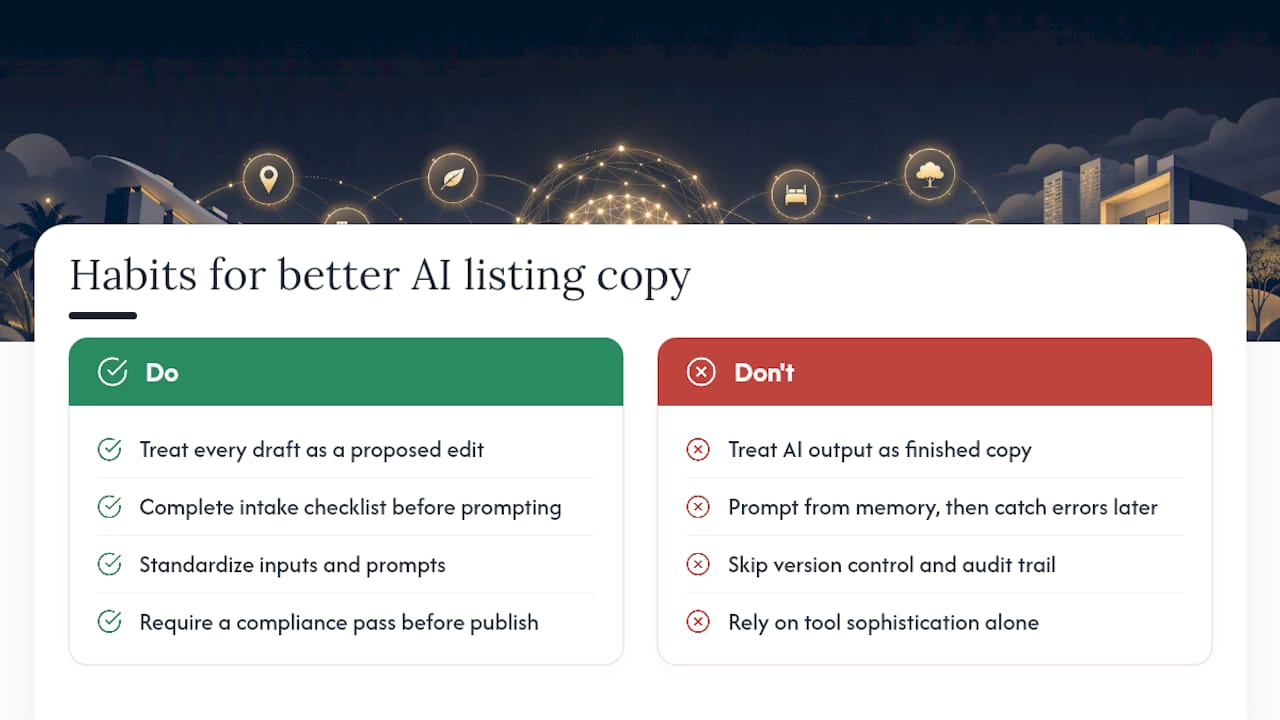
There is a temptation, especially when you are managing a large portfolio, to treat AI output as finished copy. The agents I have seen get the most value from these tools are the ones who treat every draft as a proposed edit, not a final product. That discipline is not about distrust of the technology; it is about understanding what the technology is actually doing.
AI models generate plausible language. They do not verify facts. The gap between “plausible” and “accurate” is exactly where listing errors live, and in Singapore’s market, where a buyer’s decision may hinge on a specific school’s proximity or a lease’s remaining years, a plausible-but-wrong figure is a material problem.
The practical habit changes that matter most are upstream, not downstream. Agents who build a rigorous intake checklist and fill it out completely before prompting any tool consistently produce better AI outputs than agents who prompt from memory and then try to catch errors in the draft. The model can only work with what you give it. Garbage in, polished-sounding garbage out.
Version control is the other habit most agents skip. Keep a dated copy of every intake checklist and every published draft in your listing file. If a buyer or regulator questions a fact in your listing, your documentation is your defense. AI tools do not keep your audit trail for you.
The agents who scale listing copy most effectively are not the ones using the most sophisticated tool. They are the ones who have standardized their inputs, built a repeatable prompt, and made the compliance pass a non-negotiable step in their workflow. That combination, not the tool itself, is what produces consistent, publish-ready copy at volume.
ERA’s AI training and workflow support for Singapore agents
Producing accurate, compliant listing copy at scale requires more than a good AI tool. It requires a structured workflow, local market knowledge, and a compliance framework built around Singapore’s CEA standards. That is where ERA’s agent development programs make a practical difference.

ERA agents have access to the Sales+ app, which integrates AI-powered sales tools with performance tracking and templated workflows, including listing intake forms and compliance checklists designed for Singapore’s property types. Training modules cover AI adoption for listing copy, portal optimization for PropertyGuru and 99.co, and CEA-aligned advertising standards, so you are not piecing together compliance knowledge from generic sources.
For experienced agents considering a move, ERA’s experienced agent pathway provides coaching, mentorship, and access to the Sales+ toolkit from day one. New agents can access structured onboarding through ERA’s new agent program, which includes guidance on the RES exam, CEA licensing requirements, and the listing workflows covered in this guide. Connect with ERA today to see how the Sales+ app and training programs fit your current listing volume.
Sources
These are the primary sources used to assemble this guide. Each link supports the specific claim noted.
Recommended
Comments